
That One Leaf Could Become a Whole New Plant
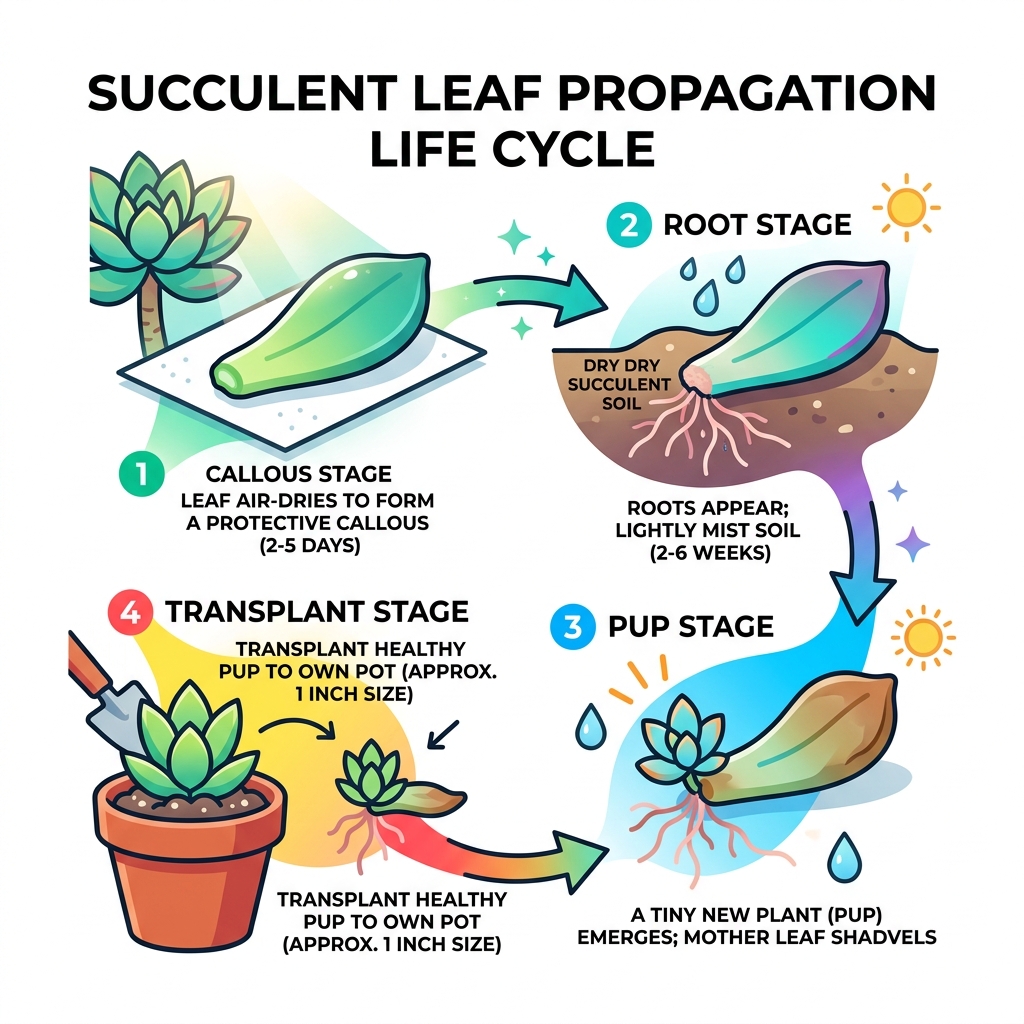
How to grow succulent from leaf is simpler than most people think. Here’s the quick version:
- Snap a healthy, plump leaf cleanly from the base of the stem
- Let it callous on a paper towel for 2-5 days
- Lay it on dry, well-draining succulent soil in bright indirect light
- Wait — roots and a tiny new plant (called a “pup”) appear in 2-6 weeks
- Mist lightly once roots show, and leave the mother leaf alone until it shrivels
- Transplant when the pup is about 1 inch across
You’ve probably knocked a leaf off a succulent and tossed it without thinking. That was a future plant in your hand.
Succulents have a biological trick called totipotent cells — tiny growth cells at the base of each leaf that can regenerate into an entirely new plant. No special tools. No green thumb required.
The catch? Not every method works equally well. Some leaves rot. Some grow roots but never produce a pup. And some succulent types won’t propagate from leaves at all.
This guide compares the best propagation methods so you know exactly what works — and what wastes your time.
Essential how to grow succulent from leaf terms:
Choosing the Right Varieties: How to Grow Succulent From Leaf Successfully
Before we start pulling leaves off every plant in the house, we need to know which ones are actually going to cooperate. Think of propagation as a “cloning glitch” in nature—but not every succulent species has it.

The best candidates for leaf propagation are those with thick, fleshy leaves. These leaves act like a “packed lunch” for the baby plant, providing all the water and nutrients it needs to survive before it has its own root system.
- Echeveria: These are the classic rosette-shaped succulents. They are the superstars of leaf propagation.
- Sedum (Stonecrop): Whether it’s the tiny leaves of a “Jelly Bean” plant or the larger leaves of “Autumn Joy,” Sedums root very quickly.
- Graptopetalum: These are incredibly hardy and often start growing pups before you even put them on soil.
- Pachyphytum: Known for their moon-stone-like, chubby leaves, these store immense amounts of energy for new growth.
If you are just starting out, we recommend beginning with a Jade plant (Crassula ovata) or a Sedum rubrotinctum. They are famously forgiving and have a high success rate.
Which Succulents Cannot Grow From a Single Leaf?
It can be heartbreaking to wait weeks for a leaf to grow, only to realize that specific species simply isn’t built for it. Some succulents lack the necessary regenerative cells in their leaves.
- Aeonium: These beautiful tree-like succulents usually require stem cuttings. A single leaf will almost always just shrivel up and die.
- Sempervivum (Hens and Chicks): These plants prefer to propagate via “offsets”—the little “chicks” that grow around the mother plant. While they look like Echeverias, leaf propagation rarely works for them.
- Haworthia and Aloe: These species generally need to be grown from offsets or seeds. Their leaves don’t have the right type of meristematic tissue at the base to spark new life.
If you’re working with these types, you’ll want to look into how-to-ensure-your-succulent-leaves-actually-root using stem or offset methods instead.
Step-by-Step Guide to Leaf Propagation
The most critical moment in the entire process happens in the first three seconds: the “harvest.” If you damage the base of the leaf, it won’t matter how much light or water you give it; it simply won’t grow.
The “Clean Snap” Technique
To successfully how to grow succulent from leaf, you need to ensure the meristematic tissue (the growth cells) stays on the leaf and doesn’t stay on the stem.
- Select a healthy leaf: Look for plump, firm leaves at the bottom of the plant. Avoid yellow, mushy, or shriveled leaves.
- The Wiggle: Grip the leaf firmly but gently between your thumb and forefinger.
- The Twist: Gently wiggle the leaf back and forth. You want a “clean snap.”
- Check the Base: Look at the end of the leaf. It should be a perfect U-shape or crescent. If the leaf is torn or a piece of it is still attached to the stem, it likely won’t propagate.
For more detailed imagery on this technique, check out our easy-guide-to-propagate-succulents-from-leaves.
The Callousing Phase and Soil Setup
Once you have your leaves, your instinct might be to stick them straight into wet soil. Don’t do it! This is the number one mistake beginners make. Because the leaf has an “open wound” where it was attached to the stem, it will soak up too much water and rot instantly.
The Callous (2–5 Days) Place your leaves on a dry paper towel in a spot with bright, indirect light. Over the next few days, the end of the leaf will “scab over.” This is called callousing. It creates a protective barrier that prevents fungus and rot from entering the leaf.
The Ideal Soil Setup While your leaves are callousing, prepare their new home. You don’t need deep pots yet. A shallow tray or even a metal baking tin works perfectly.
- The Mix: Use a well-draining cactus or succulent mix.
- The Pro-Tip: Mix in 50% perlite or coarse sand to ensure maximum drainage.
- The Placement: Lay the calloused leaves flat on top of the soil. Do not bury the ends! In nature, leaves fall and land on top of the ground; we want to mimic that.
Watering and Patience: How to Grow Succulent From Leaf Roots
Now comes the hardest part: waiting. For the first few weeks, you shouldn’t water at all. The leaf is currently using its own internal water stores to “search” for a new source. This “drought sensing” actually triggers the leaf to send out those tiny pink or white roots.
The Timeline
- Weeks 1-3: You might see nothing. This is normal.
- Weeks 4-6: Tiny pink hair-like roots will emerge. Shortly after, a microscopic “pup” (the new rosette) will appear at the base.
When to Start Watering Only start misting once you see roots. Use a spray bottle to lightly dampen the surface of the soil near the roots every 2–3 days, or whenever the soil feels bone dry. Avoid getting water on the mother leaf itself, as this can encourage rot.
For a deeper dive into the biology of this waiting game, read the-no-nonsense-succulent-leaf-propagation-guide.
Caring for Your New Pups and Transplanting
As the baby succulent (the pup) grows, it will continue to drain the mother leaf of its nutrients. You’ll notice the original leaf starting to shrivel, turn yellow, or look like a raisin. This is exactly what is supposed to happen!
The Independence Stage Do not pull the mother leaf off. Even if it looks ugly, it is still providing a “packed lunch” for the baby. Let it fall off naturally. Once it falls off, the pup is officially an independent plant.
When to Transplant
We generally recommend waiting until the pup is at least 1 inch in diameter or the mother leaf has completely withered away. At this stage, the roots should be at least an inch long and strong enough to anchor in a more permanent pot.
Long-term Care: How to Grow Succulent From Leaf into a Mature Plant
Once transplanted, your baby succulents need a slightly different care routine than the “neglect” we give mature plants.
- Light: They need bright, indirect light. Direct afternoon sun can “fry” a baby succulent in hours. A south-facing window with a sheer curtain is ideal.
- Temperature: Keep them in a warm environment, ideally between 65-75°F (18-24°C).
- Watering: Transition from misting to “bottom watering.” Place the pot in a tray of water and let the soil soak it up from the bottom. This encourages the roots to grow deep.
- Growth Rate: Be patient. It can take 9 to 12 months for a leaf-propagated succulent to reach a 4-inch diameter.
| Feature | Soil Propagation | Water Propagation |
|---|---|---|
| Success Rate | High (50-70%) | Moderate |
| Root Strength | Strong, “earth” roots | Fragile, “water” roots |
| Rot Risk | Low (if kept dry) | High |
| Visual Appeal | Natural | High (fun to watch) |
| Best For | Beginners | Impatient hobbyists |
If you’re worried about the transition to a pot, our guide on how-to-propagate-a-succulent-from-a-leaf-without-killing-it covers the transplanting phase in expert detail.
Troubleshooting Common Propagation Failures
Even the best “plant wizards” don’t have a 100% success rate. In fact, seeing 50% to 70% of your leaves thrive is considered a major victory. If your leaves aren’t making it, one of these three things is likely the culprit:
- Black and Mushy Leaves: This is rot. It happens if you didn’t let the leaf callous long enough or if the soil is too wet. If you see black spreading from the base, the leaf is toast—toss it before it infects others.
- The “Zombie” Leaf: Sometimes a leaf will grow massive, healthy roots but never produce a pup. Or, it grows a pup but no roots. This is often due to a lack of light. Try moving your tray to a brighter (but still indirect) location.
- Etiolation (Stretching): If your tiny pups are growing tall and skinny instead of tight rosettes, they are “searching” for light. They need more brightness!
- Shriveling without Roots: If the leaf dries up completely before roots appear, it likely wasn’t healthy enough to begin with, or the environment is too hot and dry.
To master the art of the “clean pull” and avoid these issues, see the-secret-to-growing-new-succulents-from-single-leaves.
Frequently Asked Questions about Succulent Propagation
Why are my succulent leaves turning black?
This is almost always due to overwatering or lack of callousing. If the “wound” of the leaf touches moisture before it has scabbed over, it will rot. Always wait 3-5 days before placing leaves on soil, and never water until you see roots.
Can I propagate succulents in the air without soil?
Yes! This is called “air propagation.” You can actually string leaves together like a garland or just leave them on a windowsill. They will eventually grow roots and pups using only the water stored in the leaf. However, they will eventually need soil to get the minerals required for long-term growth.
Should I use rooting hormone on my leaves?
For leaf propagation, it’s usually unnecessary. Succulent leaves are already packed with natural hormones. Rooting powder is much more effective for woody stem cuttings. If you do use it, only use a tiny dusting on the calloused end.
Conclusion
Learning how to grow succulent from leaf is one of the most rewarding experiences a gardener can have. There is something truly magical about watching a single, fallen leaf transform into a perfect, miniature version of its parent.
At FinanceBoostX, we believe that gardening shouldn’t be expensive. By mastering these simple steps—the clean snap, the callous, and the patient wait—you can turn a single $5 plant into an infinite garden for your home or to give as gifts to friends.
Ready to take your skills to the next level? Explore more of our expert Propagation Tips and start your own succulent nursery today!
