
Why Care Tips for Succulents Matter (Even for Busy People)
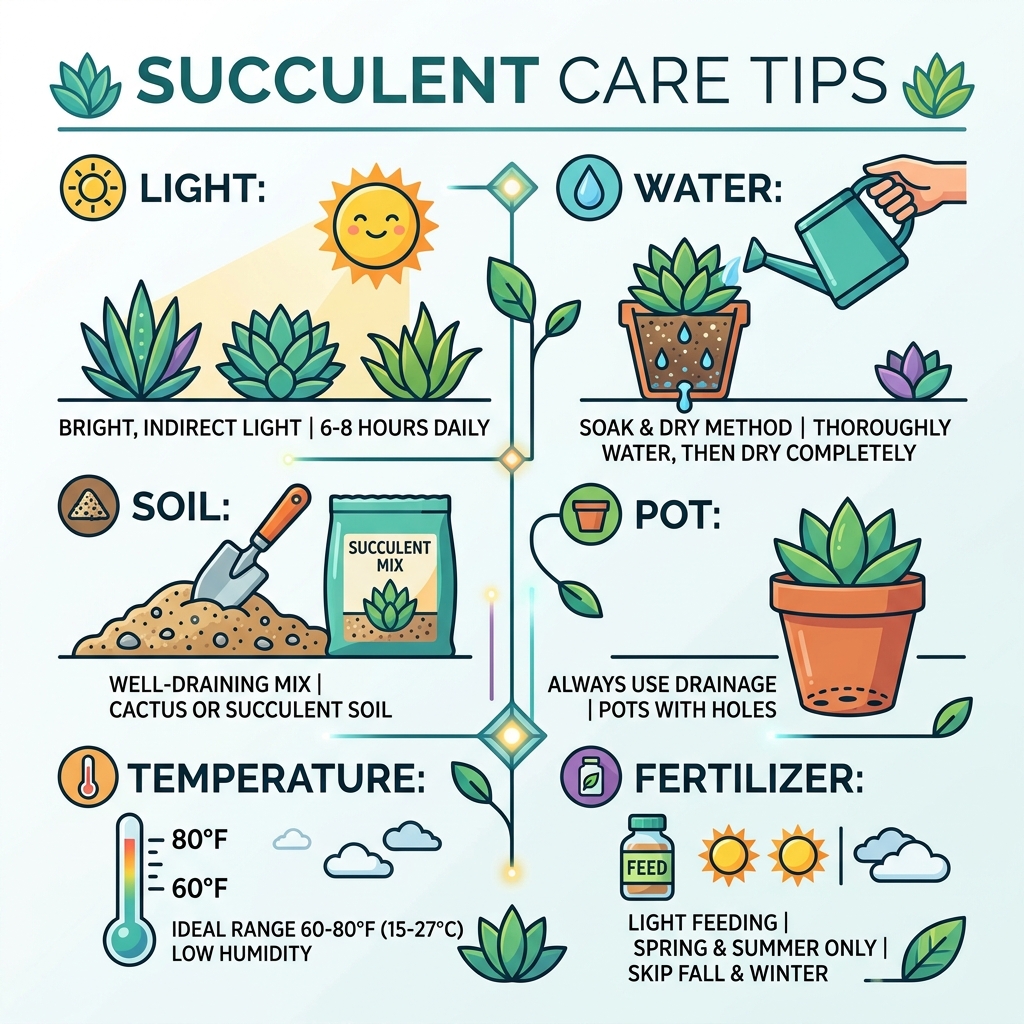
The best care tips for succulents come down to a few simple rules you can master quickly:
- Light: Give them 6-8 hours of bright, indirect light daily
- Water: Soak the soil thoroughly, then let it dry out completely before watering again
- Soil: Use a well-draining cactus or succulent mix
- Pot: Always use a container with drainage holes
- Temperature: Keep them in a 60-80°F (15-27°C) range with low humidity
- Fertilizer: Feed lightly in spring and summer only — skip it in fall and winter
Succulents are one of the most forgiving plants you can own. They store water in their thick, fleshy leaves, which means they actually prefer a little neglect over too much attention.
But here’s the thing — even easy plants have a few needs. And the most common reason succulents struggle (or die) isn’t drought. It’s overwatering.
Whether you’ve killed a succulent before or you’re just starting out, this guide walks you through everything you need to keep them healthy, compact, and looking great in your home.
Understanding Succulents: Why They Are Ideal for Beginners
If you have ever felt like you lacked a “green thumb,” succulents are here to change your mind. These plants are the ultimate survivors. With over 10,000 types of succulents spanning across 40 botanical families, they have evolved to thrive on every continent except Antarctica. From the high-altitude European Alps to the arid deserts of South Africa and Central America, succulents are masters of adaptation.
What makes a succulent a succulent? The name comes from the Latin word sucus, meaning “juice.” This refers to their incredible ability to store water in fleshy leaves, thick stems, or specialized roots. This biological “water tank” allows them to survive long periods of drought that would wither a typical houseplant. According to How to Care for Succulents Indoors, this drought tolerance is exactly why they are so appealing for indoor gardening.
For beginners, we recommend starting with “all-star” varieties that are particularly resilient:
- Aloe Vera: Famous for its soothing sap, it is nearly indestructible if given enough light.
- Jade Plant (Crassula ovata): A slow-growing beauty that can live for decades, often becoming a family heirloom.
- Zebra Plant (Haworthia fasciata): A compact plant with striking white stripes that handles lower light levels better than most of its cousins.
These plants don’t ask for much. They don’t need daily misting or a complex humidity schedule. In fact, they thrive in the dry air found in most modern homes, making them the perfect “set it and forget it” green companions.
Essential Care Tips for Succulents: Light and Environment
In the wild, most succulents spend their days basking in intense sun. When we bring them indoors, providing enough light becomes our biggest challenge. Most varieties need at least 6 to 8 hours of bright, indirect light daily to maintain their vibrant colors and compact shapes.
The best location in your home is usually a south-facing or west-facing window. These spots receive the most consistent sunlight throughout the day. However, be careful with “direct” summer sun through glass, as it can actually cause the leaves to sunburn—yes, plants can get sunburnt too! You might notice beige or brown scorched patches on the leaves if the light is too intense.
Temperature and airflow are also vital. Most succulents are happiest between 60°F and 80°F (15-27°C). While they enjoy warmth, they also appreciate a slight drop in temperature at night, which mimics their natural desert environment and can even trigger some species to flower. Unlike tropical plants, succulents prefer low humidity. Good air circulation is a secret weapon in your care tips for succulents arsenal; it helps the soil dry out faster and prevents the stagnant conditions that pests love. Check out our guide on indoor-succulent-success-the-role-of-light for more deep dives into positioning.
Indoor Care Tips for Succulents: Finding the Best Light
If your succulent starts to look like it’s trying to make a run for it—stretching out with wide gaps between the leaves—it’s telling you it’s hungry for light. This stretching is called etiolation. To prevent this, rotate your pots a quarter turn every week. Because plants grow toward their light source, rotating them ensures they grow straight and even rather than leaning lopsidedly toward the window.

For those living in basement apartments or north-facing homes, don’t despair. You can supplement natural light with full-spectrum LED grow lights. These are affordable and can be the difference between a struggling plant and a thriving one.
One of the coolest “pro” care tips for succulents involves “blushing.” When some succulents receive the perfect amount of bright light, they produce pigments (anthocyanins) that turn their leaves shades of red, pink, or purple. It’s the plant’s way of showing it’s perfectly happy!
Mastering the Soak and Dry Watering Method
If we could only give you one piece of advice, it would be this: stop watering your succulents on a calendar schedule. “Watering every Monday” is a recipe for root rot. Instead, we use the “soak and dry” method.
This technique involves pouring water onto the soil until it runs out of the drainage holes at the bottom. This ensures the entire root ball is saturated. Then—and this is the crucial part—you wait until the soil is bone-dry all the way to the bottom before watering again. You can test this by sticking a finger or a wooden skewer a few inches into the soil. If it comes out clean and dry, it’s time for a drink.
Why is this so important? Succulents are adapted to a cycle of “monsoon and drought.” They expect a heavy drenching followed by a long dry spell. If the soil stays damp for too long, the roots can’t breathe. They literally drown, turn mushy and black, and the plant dies from the bottom up. For a deeper look at this, read the-ultimate-guide-to-watering-succulents and our specific advice on avoiding-overwatering-succulent-care-guide.
Signs to watch for:
- Thirsty: Leaves look wrinkled, shriveled, or feel soft/flexible.
- Overwatered: Leaves look yellow, translucent, or feel “mushy.” They may fall off at the slightest touch.
It is much easier to save a thirsty succulent than an overwatered one. When in doubt, wait another three days.
Soil, Pots, and Repotting for Long-Term Health
The foundation of a healthy succulent is its “home”—the pot and the soil. Standard potting soil is designed to hold onto moisture, which is the opposite of what a succulent wants. You need a gritty, well-draining mix.
A great DIY recipe is mixing 50% regular potting soil with 50% “inorganic” material like perlite, pumice, or coarse sand (avoid fine play sand, which can clog the soil). This ensures that water moves through the pot quickly and air can reach the roots. We cannot overstate the-importance-of-well-draining-soil-in-watering-succulents for long-term survival.
When it comes to pots, drainage holes are non-negotiable for beginners. Terra-cotta is a fantastic choice because the clay is porous; it actually “breathes” and helps wick excess moisture away from the soil. According to How to Care for Succulents: 11 Pro-Approved Tips, using the right container is one of the most effective ways to prevent accidental overwatering.
When to repot: Most succulents enjoy being a bit “snug” in their pots, so you only need to repot every 2-3 years or when you see roots growing out of the drainage holes. When you do move up, choose a pot that is only 1-2 inches wider than the current root ball. A pot that is too large holds too much water, increasing the risk of rot.
Propagation and Seasonal Maintenance
One of the most rewarding parts of succulent ownership is propagation—making new plants for free! Many varieties can be grown from a single leaf or a “pup” (an offset).
To propagate from a leaf, gently twist it off the stem, making sure you get a “clean break.” Let the leaf sit in a dry, shaded spot for about three days until the end “callouses” over. Then, simply lay it on top of some succulent soil. Within a few weeks, you’ll see tiny pink roots and a miniature “baby” succulent forming at the base. It feels like magic every time!
Maintenance also involves keeping an eye out for “uninvited guests.” Mealybugs are the most common succulent pest—they look like tiny bits of white cotton hidden in the crevices of the leaves. If you see them, don’t panic. Simply dip a cotton swab in 70% rubbing alcohol and dab them away. Keeping your plants clean by wiping dust off the leaves with a damp cloth also helps them photosynthesize more efficiently. For more on humidity management, see lowering-humidity-for-healthier-indoor-succulents.
Seasonal Care Tips for Succulents: Spring vs. Winter
Your care tips for succulents should change with the seasons.
- Spring and Summer: This is the growing season. Your plants will be “hungrier” and “thirstier.” You can water more frequently (whenever the soil is dry) and apply a balanced fertilizer diluted to half-strength every 4-6 weeks.
- Fall and Winter: Many succulents enter a period of dormancy. Their growth slows down significantly. During this time, you should cut back watering to once a month and stop fertilizing entirely. They need this “rest” to stay healthy for the following year. For seasonal specifics, check how-often-should-you-water-your-succulents.
Frequently Asked Questions about Succulent Care
How do I fix a leggy succulent?
If your succulent has become tall and “stretched” due to low light, it won’t shrink back. However, you can “behead” it! Cut the top off (leaving an inch of stem), let it callous for a few days, and replant it in fresh soil. It will grow new roots and become a compact plant again. Meanwhile, the original stem left in the pot will often sprout several new “babies” along its length. Just make sure to move them to a brighter spot so they don’t stretch again!
Can succulents grow in pots without holes?
Technically, yes, but it is “Expert Level” gardening. Without a hole, there is nowhere for excess water to go. Even a layer of gravel at the bottom (the “drainage layer” myth) doesn’t help—it actually creates a “perched water table” that keeps the roots wetter for longer. If you must use a decorative pot without a hole, we recommend “double potting”: keep the plant in a plastic nursery liner with holes and place that inside the decorative pot. Learn more about the-role-of-drainage-in-succulent-watering.
Why are my succulent leaves falling off?
If the leaves are falling off from the bottom and they look dry or crispy, it’s likely just natural aging. The plant is shedding old leaves to focus energy on new growth. However, if healthy-looking or yellow/mushy leaves are falling off from all over the plant, this is a major red flag for overwatering and root rot. Stop watering immediately and check the roots.
Conclusion
Caring for succulents is a journey of patience and observation. These resilient little plants offer a unique way to bring nature into your home without the stress of high-maintenance gardening. By following these care tips for succulents, you aren’t just keeping a plant alive; you’re creating a little oasis of tranquility in your living space.
Remember the golden rule: when in doubt, don’t water! Treat them with a little “tough love,” give them plenty of light, and they will reward you with years of beauty and perhaps even some stunning desert blooms.
Ready to expand your collection or solve a specific plant problem? Explore more at our Succulent Care Hub for expert advice on every variety. Happy planting!
