
One Leaf Can Become a Whole New Plant — Here’s How
Replanting succulent leaves is one of the easiest ways to multiply your plant collection for free. Here’s the quick version:
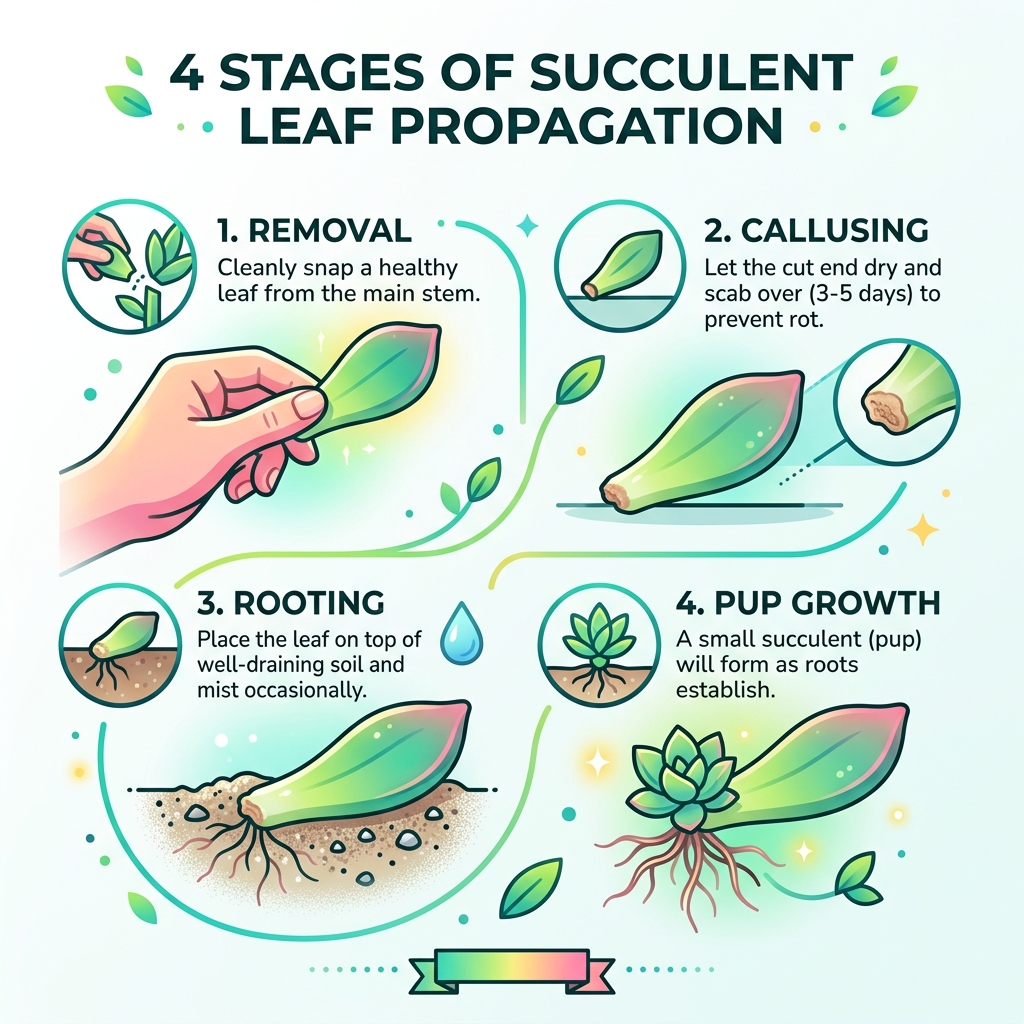
- Remove a healthy, plump leaf with a clean snap from the stem
- Dry the leaf for 3-5 days until the cut end scabs over
- Lay the calloused leaf on top of well-draining succulent soil
- Mist the soil lightly every few days — don’t water until roots appear
- Wait 4-6 weeks for tiny roots and a baby plant (called a pup) to form
- Transplant the pup into its own pot once the mother leaf shrivels away
You’ve probably knocked a leaf off a succulent by accident and tossed it without a second thought. Big mistake.
That single fallen leaf holds everything it needs to grow into a brand new plant. Succulents store water and nutrients inside their leaves — essentially a packed lunch for the baby plant waiting to emerge. It’s not magic. It’s biology.
The catch? Most people fail in the first two steps. Either the leaf tears and leaves behind a jagged base, or they water too early and end up with rot. Both are easy to avoid once you know what to look for.
The process takes patience — expect anywhere from a few weeks to several months before you have a pot-ready plant. But the cost is zero, and a single mother plant can give you dozens of new ones.
Selecting and Preparing Your Leaves for Success
The secret behind replanting succulent leaves lies in something called totipotent cells. These are “master cells” located at the base of the leaf that have the genetic blueprint to create an entirely new plant—roots, stem, and all. When we propagate, we are essentially performing a form of genetic cloning. It’s a sustainable way to grow your indoor jungle without spending a dime at the nursery.
However, success starts with the harvest. You can’t just rip a leaf off and expect it to grow. You need to ensure you capture the meristem tissue, which is the “growth engine” located exactly where the leaf meets the stem.
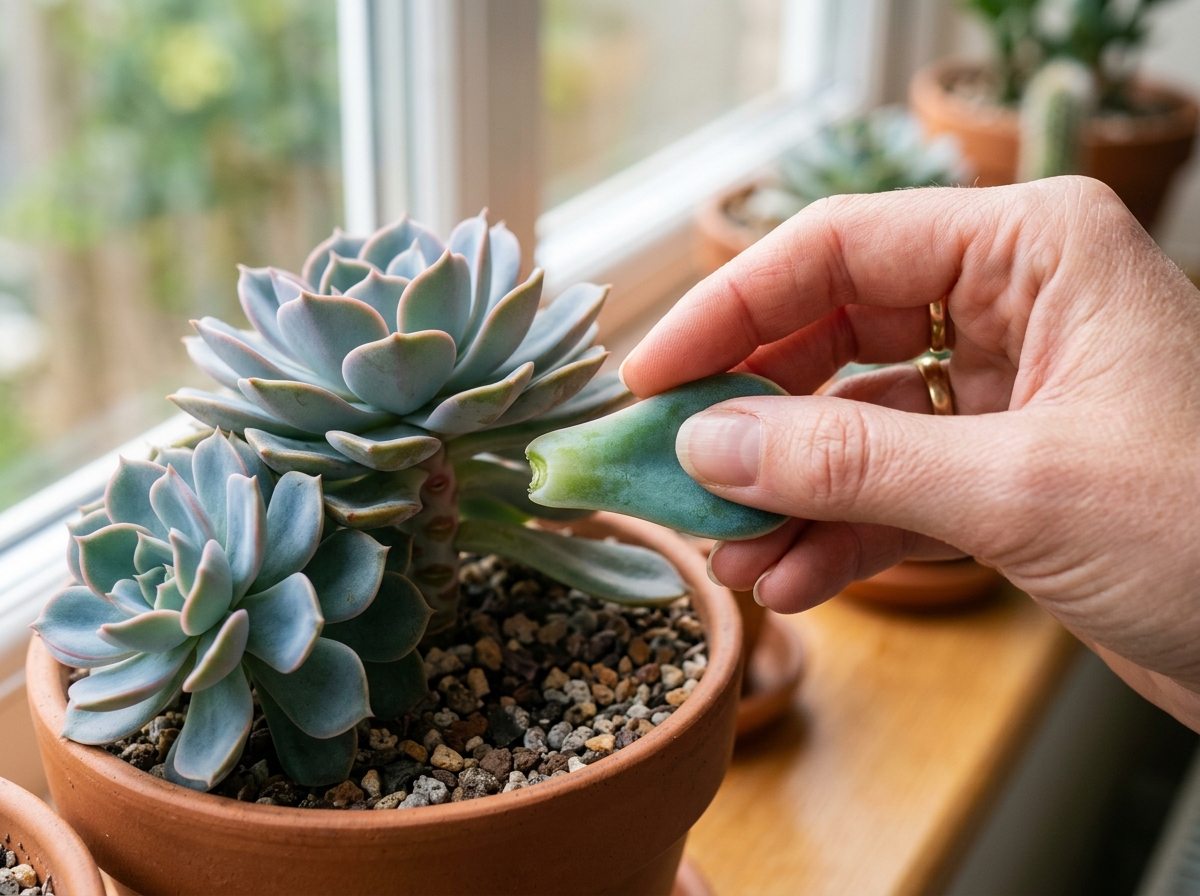
To get a perfect specimen, find a mature, plump leaf at the bottom of the plant. Grip it firmly but gently, and wiggle it back and forth until you hear a clean “snap.” If the leaf tears or leaves a chunk behind on the stem, it likely won’t grow because the meristem was left behind. Think of it like a puzzle piece; the end of the leaf should have a smooth, U-shaped or crescent-shaped curve.
For more detailed insights on the “why” behind this process, check out our Easy guide to propagate succulents from leaves or dive into our Mastering succulent propagation an in-depth guide.
Which Species are Best for Replanting Succulent Leaves?
Not all succulents are created equal when it comes to leaf propagation. Some varieties are “leaf-ready,” while others prefer to be grown from offsets (the “pups” that grow at the base of the mother plant).
Fleshy, bulbous leaves usually have the best success rates because they carry a larger “packed lunch” of water and nutrients to sustain the baby plant while it grows roots.
| Succulent Type | Propagation Method | Ease Level |
|---|---|---|
| Echeveria | Leaf or Offset | Very Easy |
| Sedum (Stonecrop) | Leaf or Stem Cutting | Very Easy |
| Graptopetalum | Leaf | Easy |
| Pachyphytum | Leaf | Easy |
| Aloe | Offsets Only | Hard from Leaf |
| Haworthia | Offsets Only | Hard from Leaf |
| Aeonium | Stem Cuttings Only | Impossible from Leaf |
If you are a beginner, we recommend starting with Echeveria or Sedum. These are the overachievers of the succulent world and will often start sprouting roots even if you just leave them on a countertop!
The Critical Callusing Phase
Once you have your perfect leaves, your first instinct might be to stick them straight into the dirt. Stop right there! If you put a fresh “wound” into moist soil, the leaf will drink up too much water too fast, turn into black mush, and rot. This is the #1 reason for propagation failure.
We need to let the leaves callus. This is simply the process of letting the wound air-dry until it forms a protective “scab.”
- Duration: 3 to 5 days (up to a week in humid climates).
- Conditions: Place them on a dry paper towel or an empty tray.
- Light: Keep them in a warm spot with bright, indirect light. Never put fresh leaves in direct, scorching sun, or they will shrivel up before they can heal.
Once the end feels dry and firm to the touch, you’ve successfully avoided the rot monster. You can learn more about this stage in our guide on How to propagate a succulent from a leaf without killing it.
The Step-by-Step Guide to Replanting Succulent Leaves
Now that your leaves are scabbed over and ready to work, it’s time to set up their “nursery.” You don’t need deep pots for this. In fact, succulents grow faster in shallow trays because their initial roots are quite fine and don’t like to sit in deep, soggy soil.
Use a fast-draining soil mix specifically designed for cacti and succulents. If you’re feeling DIY, you can mix standard potting soil with 50% pumice or perlite to ensure excellent drainage. For more on picking the right home for your babies, see Choosing the best container for succulent propagation and Mastering succulent propagation an in-depth guide.
Soil Placement and Initial Care
When replanting succulent leaves, the “planting” part is actually a bit of a misnomer. You aren’t burying them like a sunflower seed.
- Lay them flat: Simply lay the callused leaves on top of the soil.
- Surface contact: Ensure the callused tip is touching the soil surface, but don’t bury it. If you bury the leaf, you risk rot.
- The “Up” Side: New baby plants usually grow on the upward-curving side of the leaf. Keep the natural “up” side facing the ceiling.
- Environment: Aim for a temperature between 65-75°F (18-24°C). This is the “Goldilocks zone” for succulent growth.
For a deeper dive into these first steps, our Beginners guide propagating succulents is a great resource.
Watering Protocols for Replanting Succulent Leaves
Watering is where most people get nervous. Do you soak them? Do you mist them? Do you ignore them?
The rule of thumb is: No roots, no water. Until the leaf grows roots, it has no way to drink. Adding water to the soil before roots appear only increases the chance of fungal disease.
Once you see tiny pink or white hair-like roots emerging (usually after 2-3 weeks), you can start a light watering routine.
- Misting: Use a spray bottle to mist the soil surface every few days when it feels dry.
- Drought Sensing: Succulents are smart. They grow roots in response to sensing a lack of water. By keeping the soil mostly dry with just occasional misting, you encourage the roots to “reach” into the soil to find hydration.
- Avoid the Leaf: Try to mist the soil around the roots rather than soaking the mother leaf itself.
Check out our specific tips on How to propagate succulents from a single leaf for more watering wisdom.
Monitoring Growth and Troubleshooting Common Issues
Propagating is a lesson in patience. Most succulent leaves will root within two to three weeks, but it can take 4 to 6 weeks to see the actual “pup” (the miniature rosette).
As the pup grows, you will notice the mother leaf starting to shrivel, wrinkle, and turn yellow or brown. Don’t panic! This is supposed to happen. The mother leaf is sacrificing itself, pumping all its stored water and nutrients into the baby. It is the ultimate “packed lunch.” Do not pull the mother leaf off; let it dry up and fall off on its own naturally.
However, nature doesn’t always go according to plan. Statistics show that in a typical batch of cuttings, you might lose about 20-50% to various issues. It’s always best to propagate in batches to ensure you get at least a few winners!
For more troubleshooting, visit Mastering succulent propagation an in-depth guide.
Dealing with Rot and Etiolation
Two main villains can ruin your propagation party: Rot and Etiolation.
- Rot: If the leaf turns black, translucent, or mushy, it has rotted. This is caused by too much moisture or a poor callus. Remove these leaves immediately so they don’t spread fungus to the healthy ones.
- Etiolation (Stretching): If your tiny baby pups are growing tall, skinny, and pale instead of forming a tight rosette, they are “stretching” for light. This means they aren’t getting enough sun. Move them to a brighter spot, but avoid harsh, direct midday sun which can fry their delicate tissues.
We’ve compiled a list of The dos and donts of succulent propagation to help you navigate these hurdles.
Frequently Asked Questions about Succulent Propagation
Is rooting hormone necessary for leaf cuttings?
While not strictly necessary, rooting hormone can be a helpful “boost” for trickier varieties. Succulent leaves naturally contain auxins (growth hormones) that trigger rooting. However, dipping the callused end into a bit of rooting powder can speed up the process and lead to a higher success rate.
If you’re a hobbyist, you’ll likely do just fine without it. If you’re trying to start a “succulent farm” in your basement, it might be worth the investment. For more “pro” tips, see Up your gardening game propagating succulents.
Can I propagate a leaf that is broken or cut in half?
This is a common question! Generally, the answer is no. Because the meristematic tissue is located at the very base of the leaf (where it attached to the stem), a leaf cut in half lacks the “instructions” to grow a new plant.
However, there are rare exceptions. Some gardeners have reported success with halved leaves of Sansevieria (Snake Plants), but for your typical Echeveria or Jade, a clean pull is non-negotiable. If the leaf is damaged, it’s usually better to toss it and try again with a healthy one. Learn more in The dos and donts of succulent propagation.
When is the baby plant ready for its own pot?
The “graduation” ceremony happens when the mother leaf has completely shriveled into a dry, paper-like husk and falls off with a gentle touch.
At this point, the baby pup should be about 1 inch in diameter and have a strong set of its own roots. You can now move it into a small individual pot with standard succulent soil. Treat it like a mature plant, but be a bit more frequent with watering for the first few months as it establishes its root system in its new home.
For the final steps of the journey, read Maximize your garden how to propagate succulents.
Conclusion
At FinanceBoostX, we believe that gardening should be a therapeutic and rewarding experience, and there is nothing quite as satisfying as seeing a tiny life emerge from a single leaf you almost threw away. Replanting succulent leaves is a masterclass in patience and observation.
Whether you’re looking to create unique gifts for friends or simply want to fill every windowsill in your home with greenery, propagation is your ticket to an infinite plant collection.
Ready to level up? Explore our other resources like Grow more succulents propagation techniques or Master your garden with our professional propagation tips. Happy planting!
