
What Is Burro Tail Propagation (and Why It’s Easier Than You Think)
Burro tail propagation is the process of growing new Sedum morganianum plants from stem cuttings, individual leaves, or offsets. Here’s the quick version:
- Stem cuttings – Cut a stem at least 5cm long, let it callus for 1-5 days, then plant in well-draining soil
- Leaf propagation – Place whole, healthy leaves on moist succulent soil and wait 2-3 months for plantlets to form
- Water propagation – Submerge the bottom third of a stem in filtered water, change weekly until roots appear
- Offsets – Gently separate small pups from the base of the mother plant, callus, then pot up
Spring and early summer are the best times to propagate. Roots from stem cuttings typically form within 2 months.
Burro’s Tail (also called Donkey’s Tail or Sedum morganianum) is one of the most popular trailing succulents around. Its rope-like stems are packed with plump, blue-green leaves that cascade beautifully from hanging baskets — no fuss, no drama.
There’s one catch: those leaves are incredibly fragile. They drop at the slightest touch. But here’s the good news — that’s actually the plant’s own built-in propagation trick. Dropped leaves can root and grow into entirely new plants on their own.
That makes this one of the most forgiving plants to multiply, even if you’ve never propagated anything before.
Best Conditions for Burro Tail Propagation
Success with burro tail propagation starts with timing and environment. While these hardy succulents are survivors, they have a “sweet spot” where they grow much faster. We recommend starting your propagation projects during the spring or early summer. This is the plant’s active growth cycle, meaning it has the hormonal energy required to push out new roots and leaves quickly.
Temperature is another critical factor. The “Goldilocks” zone for rooting Burro’s Tail is around 75°F (24°C). If it’s too cold (below 50°F), the plant enters a semi-dormant state and may rot before it ever roots. Conversely, if it’s scorching hot, the delicate leaves might shrivel before they can establish themselves.
Light is the final piece of the puzzle. While mature Burro’s Tails love bright light, your “babies” (cuttings and leaves) need bright, indirect light. Direct afternoon sun can literally bake a leaf cutting in hours. A north or east-facing windowsill is usually perfect. For a deeper look at the science behind these environments, check out our mastering-succulent-propagation-an-in-depth-guide-2/ or dive into our beginners-guide-propagating-succulents-2/.
Step-by-Step Stem Cutting Method
If you want a full, lush plant as quickly as possible, stem cuttings are your best bet. While leaf propagation is “magical” to watch, it takes a long time. A stem cutting already has a head start with a developed vascular system and multiple leaves to store energy.
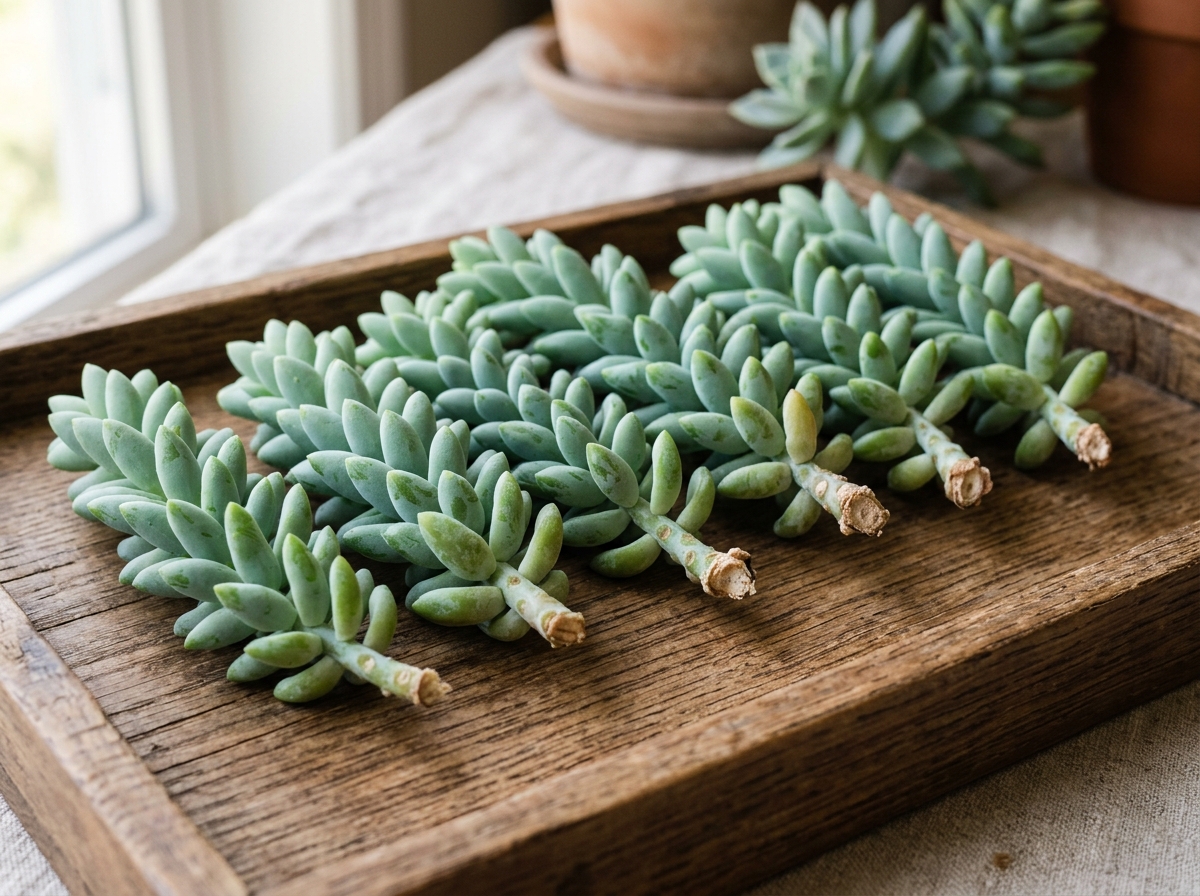
To begin, select a healthy, robust stem. We recommend taking clippings that are at least 5cm (about 2 inches) in length. Look for stems that might be getting too long or those that have already lost some leaves near the base—these are perfect candidates for a “haircut.”
One of the most important steps in burro tail propagation is the callusing process. When you snip a succulent, you create an open “wound.” If you stick that wet wound directly into moist soil, bacteria will move in, and your cutting will turn to mush. Instead, lay your cuttings on a dry tray in a shaded spot for 1 to 5 days. You’ll know they’re ready when the cut end feels dry and slightly hard to the touch.
Some enthusiasts like to dust the cut end with cinnamon. Why? Cinnamon is a natural antifungal agent that helps prevent rot during that vulnerable callusing phase.
| Method | Estimated Rooting Time | Success Rate |
|---|---|---|
| Soil Propagation | 4-8 Weeks | Very High |
| Water Propagation | 2-4 Weeks | High |
| Leaf Propagation | 8-12 Weeks | Moderate |
For more on the nuances of these methods, see our guide on succulent-propagation-techniques-for-every-home-gardener/ and learn about choosing-the-best-container-for-succulent-propagation/ to give your cuttings the best home.
Preparing Your Burro Tail Propagation Cuttings
Before you make the cut, ensure your tools are clean. Use sharp pruning snips or a knife disinfected with rubbing alcohol. This prevents the spread of pathogens from other plants.
Once you have your cutting, gently “peel” off the bottom third of the leaves. You want a bare section of stem that can be inserted into the soil. Don’t throw those removed leaves away! They can be used for leaf propagation (more on that later).
Sometimes, you might notice tiny pink or white “hairs” growing along the stem of your mother plant. These are aerial roots. If your cutting has these, you’re in luck! These stems often root much faster because the plant has already started the process for you. Remember to follow the the-dos-and-donts-of-succulent-propagation-2/ to avoid common pitfalls like over-handling the fragile leaves during this stage.
Rooting Burro Tail Propagation in Water
Can you propagate Burro’s Tail in water? Absolutely! While soil is traditional, water propagation (hydroponic rooting) allows you to watch the roots grow in real-time.
- The Setup: Take a 4-inch stem cutting and let it callus for 2 days.
- The Vessel: Use a tall, narrow glass. Fill it with filtered or distilled water (tap water often contains chlorine which can stun sensitive new roots).
- The Placement: Submerge only the bare bottom of the stem. Ensure no leaves are touching the water, as they will rot quickly.
- Maintenance: Change the water every week to keep it oxygenated and clear.
Once the roots reach about an inch or two in length, you can transition the plant to soil. Just be aware that “water roots” are more fragile than “soil roots,” so be extra gentle during the transplant.
Propagating from Individual Leaves and Offsets
There is something truly rewarding about growing a massive, 4-foot trailing plant from a single tiny leaf. Because Burro’s Tail leaves drop so easily, you will likely find “volunteers” already rooting in the pot of your mother plant.
The secret lies in the meristematic cells located at the very base of the leaf—the point where it attached to the stem. For a leaf to grow a new plant, it must be a “clean pull.” If the leaf snaps in half, it won’t propagate.
As the new plantlet forms, it draws all its water and nutrients from the “mother leaf.” You’ll notice the original leaf starting to shrivel and turn yellow or brown. Don’t pull it off! Let it fall off naturally once the new plant has exhausted its resources. For more tips on this delicate process, read how-to-propagate-a-succulent-from-a-leaf-without-killing-it/ and our easy-guide-to-propagate-succulents-from-leaves/.
Success with Burro Tail Propagation from Leaves
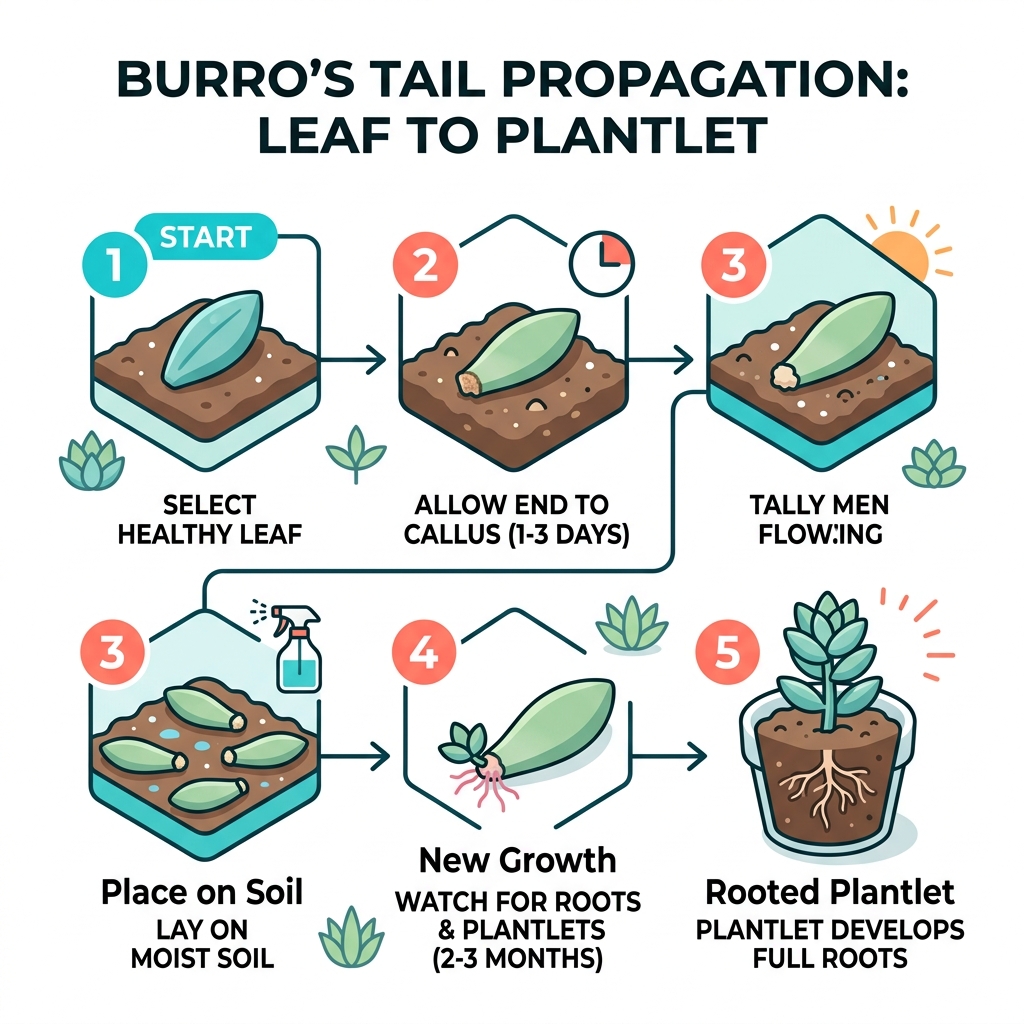
Leaf propagation requires the patience of a saint. Here is our proven method for success:
- The Bed: Fill a shallow tray with well-draining succulent mix.
- The Placement: Lay the leaves flat on the surface. Do not bury them!
- The Moisture: Mist the soil every 2-3 days. You want the surface to be slightly damp but never soggy.
- The Timeline: It typically takes 2 to 3 months for a visible plantlet to form. If you don’t see anything after a month, don’t worry—the roots usually grow first, hidden beneath the leaf.
Check out the-secret-to-growing-new-succulents-from-single-leaves/ for more “pro” secrets on maximizing your leaf-to-plant conversion rate.
Essential Tools and Troubleshooting Common Issues
To master burro tail propagation, you need the right kit. We suggest keeping a “propagation station” ready with the following:
- Cactus/Succulent Mix: Never use standard potting soil; it holds too much water. A mix of 1 part sand, 1.5 parts perlite, and 1.5 parts potting soil is ideal.
- Perlite or Pumice: Adding extra grit ensures the drainage is fast enough to prevent rot.
- Containers with Drainage: This is non-negotiable. Without holes, your cuttings are sitting in a death trap of stagnant water.
- Floral Pins: Because Burro’s Tail stems are heavy and “leafy,” they tend to fall out of the pot. Use U-shaped floral pins to anchor the stem to the soil until roots take hold.
Troubleshooting Common Problems
Even the best gardeners run into trouble. Here’s how to handle the most common “red flags”:
- Root Rot: This is the #1 killer. If the base of your cutting turns black and mushy, it’s rot. Cut the stem above the rot, let it callus again, and use fresh, dry soil. Reduce your watering frequency!
- Leaf Drop: If leaves are falling off your new cuttings in large numbers, you might be over-handling them or overwatering. “Look but don’t touch.”
- Mealybugs: These tiny white, cottony pests love the nooks and crannies of Burro’s Tail. Use a Q-tip dipped in rubbing alcohol to dab them away.
- Etiolation: If your new plantlets are looking “stretched out” and pale, they are crying for more light. Move them to a brighter spot gradually.
For a deeper dive into these issues, visit our guides on up-your-gardening-game-propagating-succulents-2/ and succulent-propagation-a-comprehensive-look-2/.
Frequently Asked Questions about Burro Tail Propagation
How long does it take for roots and new plantlets to form?
For stem cuttings, you can expect roots to establish within 4 to 8 weeks. For leaf propagation, it’s a longer journey—usually 2 to 3 months before you see a recognizable “mini-tail” forming. Environmental factors like heat and humidity play a massive role in this timeline.
Why are my Burro’s Tail leaves falling off during the process?
It’s perfectly normal! These plants are designed to shed leaves as a survival and reproduction tactic. However, if the stems are also turning yellow, you are likely overwatering. The soil should be bone-dry before you give it another drink.
Can I use rooting hormone to speed up growth?
Yes, you can. While not strictly necessary for Burro’s Tail because they root so easily on their own, a quick dip in rooting powder can provide a hormonal “boost” and often contains fungicides that help protect the cutting.
Conclusion
At FinanceBoostX, we believe that growing your own plant collection should be rewarding and cost-effective. Burro tail propagation is the ultimate way to turn one beautiful plant into a dozen hanging baskets over time.
Once your new plants have established strong roots (usually when you see significant new green growth at the tips), you can begin the transition to their final home. Move them slowly into more direct sunlight over a period of two weeks to avoid sunburn. With a little patience and the right drainage, you’ll have trailing stems reaching 4 feet or longer in just a few years.
Ready to expand your garden further? Explore more of our Propagation Tips and start your next green project today!
