
When Your Succulent Leaf Grows a Baby But No Roots
Succulent propagation leaves no roots more often than most guides admit — and it’s one of the most common frustrations for plant lovers.
Here’s the quick answer:
Why do succulent propagation leaves produce no roots?
- Too much moisture — water near the leaf reduces the plant’s need to grow roots
- Incomplete leaf removal — if the base wasn’t fully detached, roots can’t form
- Skipped callousing — leaves need 2–7 days to dry before touching soil
- Wrong timing — propagating outside spring/summer slows or stops root growth
- Wrong soil — dense, moisture-retaining soil discourages root development
The short version: roots grow when a leaf feels stressed and thirsty. If it has easy access to moisture, it has no reason to reach down into the soil.
The good news? This is almost always fixable. And a plantlet without roots isn’t dead — it’s just waiting for the right conditions.
It’s also completely normal to see uneven results. Three leaves started on the same day can take three totally different paths: one withers, one grows roots but no baby, and one grows a baby but never roots. That’s just how succulent propagation works.
Patience and the right environment matter more than any product or trick.
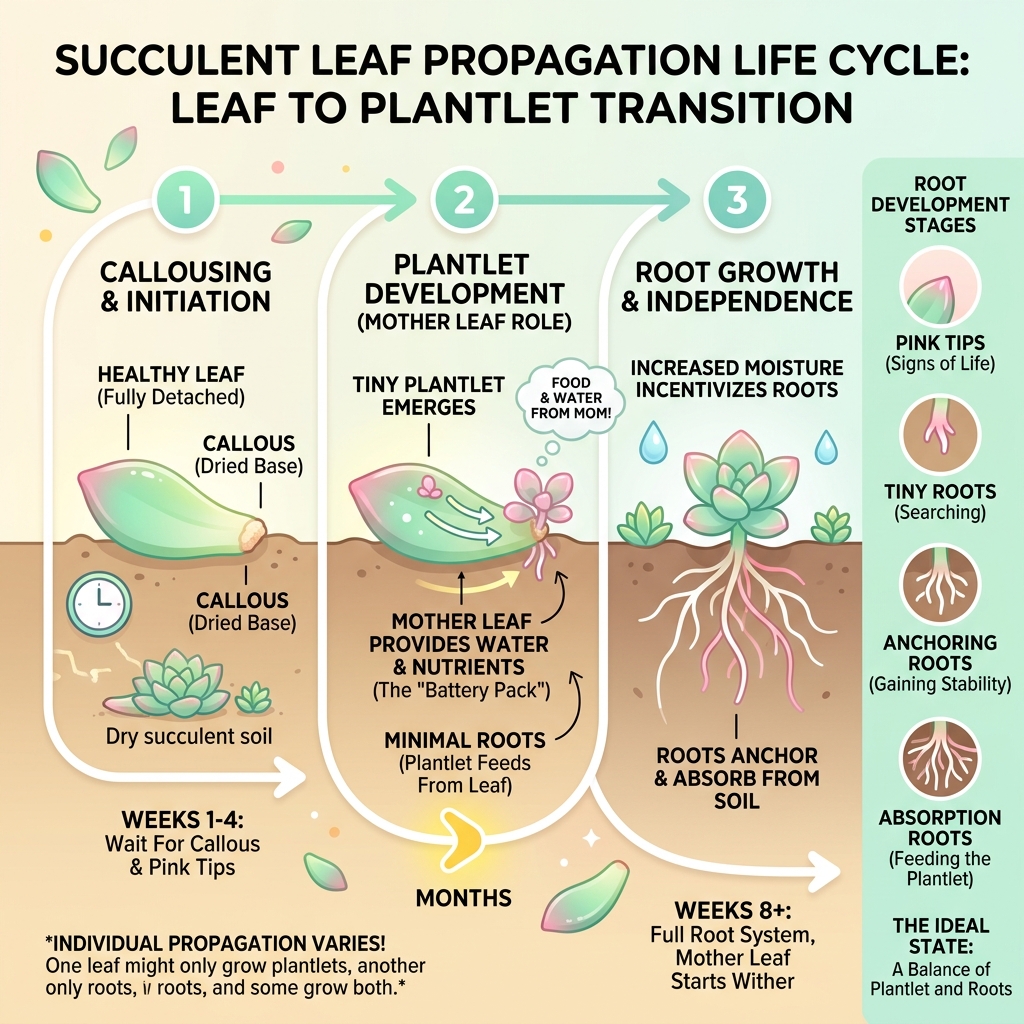
Why Your Succulent Propagation Leaves No Roots
It feels like a miracle when you see a tiny, pink, alien-looking baby sprouting from the end of a leaf. But that joy quickly turns to worry when weeks pass and there’s not a single root in sight. Why does this happen? To understand this, we have to look at the biology of the leaf itself.
Succulent leaves are like tiny battery packs. They come pre-loaded with all the water and nutrients (a “packed lunch,” if you will) that a new plantlet needs to get started. Because the mother leaf is providing everything, the baby plant isn’t in a rush to grow roots. In some cases, the leaf is so efficient at feeding the baby that the plantlet simply forgets it needs to anchor itself to the ground.
However, the most common biological reason for a lack of roots is the meristematic tissue. This is a group of undifferentiated cells located exactly where the leaf meets the stem. If you don’t get a “clean pull” when removing the leaf, these cells stay on the mother plant’s stem instead of coming away with the leaf. Without those specific cells, the leaf might still have enough energy to push out a few tiny leaves, but it won’t have the “blueprint” to build a root system.
This is why we emphasize the clean pull technique so heavily. If the base of your leaf is jagged, flat, or has a chunk of the stem missing, your chances of root success drop significantly. You want a perfect U-shaped or crescent-shaped base.
There is also the “zombie leaf” phenomenon. This is the opposite problem: a leaf that grows a massive root system but never produces a baby plant. Both issues stem from the same source—genetic variability and the specific health of the cells at the base of that individual leaf. According to our The No-Nonsense Succulent Leaf Propagation Guide, not all leaves will succeed; in fact, even experts expect some losses in every batch.

The Role of Indirect Hydration and Watering
One of the biggest “aha!” moments in succulent gardening is realizing that moisture can actually be the enemy of root growth. We often think that more water equals more growth, but for succulents, the opposite is often true.
Think of it like teaching a baby to walk by holding a toy just out of reach. If you give the baby the toy immediately, they have no incentive to move. Roots are the same way. If you mist your leaves daily or keep the soil damp, the leaf “senses” that hydration is readily available. It doesn’t need to work hard to find water, so it puts all its energy into growing the visible plantlet.
When succulent propagation leaves no roots, it’s often because they haven’t felt enough “drought stress.” By keeping the environment slightly dry, you trigger a survival mechanism. The leaf realizes its internal water supply is dwindling and sends out roots to “scout” for more.
Furthermore, succulent stomata (the tiny pores they use to breathe) behave differently than other plants. They typically open at night to preserve moisture. If you are misting during the day, you might just be creating a humid environment that encourages rot rather than helping the plant absorb water. For more on this balance, check out our guide on how to propagate a succulent from a leaf without killing it.
Why a “Clean Pull” and Callousing are Critical
We cannot stress enough how important the preparation phase is. If you’ve ever wondered why your leaves turn black and mushy before they even think about growing roots, it’s likely a callousing issue.
When you pull a leaf off a plant, you’re creating an open wound. Just like a scraped knee, that wound needs to form a scab (a callus) before it touches soil or water. This callus acts as a moisture barrier, preventing bacteria and fungi from entering the leaf and causing rot.
We recommend letting your leaves dry for anywhere from 3 to 7 days in a bright, dry spot. During this time, the end will shrivel slightly and turn a lighter, tan color. This “scab” is vital. Without it, the leaf will simply soak up too much water from the soil and explode at a cellular level, leading to that dreaded black mush. Our The Dos and Don’ts of Succulent Propagation highlights this as the #1 mistake beginners make.
How to Encourage Roots on Existing Plantlets
So, you already have a tiny baby plant sitting on a leaf, but it’s been rootless for weeks. Don’t panic! There are several ways to coax those stubborn pink nubs to appear.
The first step is soil contact. Sometimes, the baby plant is growing “up” and away from the soil, so the area where roots should form is suspended in the air. Gently nudging the leaf so the base is touching (but not buried in) the soil can provide the physical stimulus needed for root growth.
Light is another major factor. While you want to avoid harsh, direct noon sun that can fry a delicate baby, you do need bright, indirect light. If the light is too low, the plantlet will become “etiolated”—meaning it grows tall, skinny, and weak as it stretches for the sun. This takes energy away from root production.
Temperature also plays a role. Succulents are most active when temperatures are between 70°F and 85°F (21-29°C). If your propagation tray is in a cold drafty window in the middle of winter, the metabolism of the plant slows down significantly. You can find more detailed environmental tips in our Succulent Propagation: A Comprehensive Look.
Troubleshooting Succulent Propagation Leaves No Roots in Dry Climates
If you live in a very dry area (like Utah or Arizona), you might face the opposite problem: your leaves dry out and shrivel before they can even start growing. In these climates, the evaporation rate is so high that the “packed lunch” in the leaf disappears too quickly.
In dry climates, we suggest:
- Light misting: Only once roots are visible, you can mist the soil around the roots every 2-3 days.
- Enclosed propagation: Using a clear plastic lid over your tray can help retain a tiny bit of humidity, but you must be careful to provide air circulation so you don’t cook the plants.
- Timing: Focus your efforts on the spring. Research shows that spring propagations can grow two to three times faster than those started in the off-season.
Check out our Beginner’s Guide to Propagating Succulents for more regional advice.
Using Rooting Hormones and Soil Mediums
Do you really need rooting hormone? The short answer is: usually, no. Succulents are naturally packed with the hormones they need to clone themselves. However, if you are struggling with a particularly stubborn variety, a little help won’t hurt.
| Feature | Succulent/Cactus Mix | Multipurpose Compost |
|---|---|---|
| Drainage | Excellent (High grit/perlite) | Poor (Retains too much water) |
| Aeration | High | Low |
| Rot Risk | Low | High |
| Root Support | Best for dry-loving roots | Can suffocate succulent roots |
If you want to try a rooting aid, you don’t necessarily need to buy expensive powders. Some gardeners swear by a dab of honey or a sprinkle of cinnamon. Honey has natural antibacterial properties, while cinnamon acts as a mild fungicide. If you do use a commercial rooting powder, just a tiny dip is enough. Overloading the leaf base can actually hinder growth.
The soil medium is perhaps more important than the hormone. We recommend a mix of 60% potting soil and 40% perlite or grit. This ensures that when you eventually do start watering, the moisture doesn’t sit around the base of the leaf. For more on choosing the right setup, see our guide on choosing the best container for succulent propagation.
Common Mistakes and Variety-Specific Issues
One of the hardest lessons in succulent propagation is that not all succulents can be grown from a single leaf. If you are trying to propagate an Aeonium or a Sempervivum (Hens and Chicks) from a leaf, you will almost certainly fail. These varieties generally require stem cuttings or offsets (“pups”) to reproduce.
On the other hand, Echeverias, Sedums, and Graptopetalums are the superstars of leaf propagation. If you’re working with a variety like Echeveria agavoides, be aware that their leaves are very stiff and “crispy,” making them much harder to pull cleanly than a Jade plant.
Another common mistake is “burying” the leaf. We often see beginners stick the leaf base deep into the dirt like they are planting a bean. This is a recipe for rot. Succulent leaves should lay on top of the soil. The roots will find their way down naturally.
Why Some Succulent Propagation Leaves No Roots While Others Grow Only Roots
As we mentioned earlier, propagation is a bit of a “cloning glitch” in nature. It doesn’t always go perfectly.
- Energy Distribution: Sometimes the leaf’s “internal computer” gets confused. It puts 100% of its energy into the plantlet (the “leaves”) and 0% into the “plumbing” (the roots).
- Hormonal Balance: If the leaf was taken from a plant that was recently fertilized or under specific stress, its internal hormone levels might be skewed toward foliage growth.
- The Mother Leaf’s Health: A very plump, hydrated leaf might be too comfortable. It has so much water stored that it doesn’t feel the need to grow roots until it is almost entirely shriveled.
If you have a cluster of babies but no roots, the best thing you can do is wait. As long as the mother leaf is still plump or even slightly firm, it is still feeding that baby. Once the mother leaf starts to turn yellow, translucent, or crispy, that is the signal for the baby to start looking for its own food source.
Frequently Asked Questions about Rootless Propagations
When should I pot up a baby succulent that has no roots yet?
We don’t recommend potting up a rootless baby into its own “adult” pot. It’s best to leave it on the propagation tray until the mother leaf has completely dried up and fallen off. At that point, the baby should have at least some small roots. If it still has none, you can place it on very slightly dampened (not wet) soil to encourage them.
Can overwatering cause leaves to grow plantlets without roots?
Yes! As we discussed, if the environment is too humid or the soil is too wet, the plant has no biological “reason” to grow roots. It is receiving enough moisture through its skin/stomata or from the mother leaf that it doesn’t need to build a root system to survive.
Are there specific succulent varieties more prone to growing plants without roots?
Many hybrids and “fancy” Echeverias can be a bit more temperamental. Varieties with very thick, wax-covered leaves sometimes take much longer to produce roots because their water-retention is so high. They are so good at holding onto their “packed lunch” that they aren’t incentivized to root for a long time.
Conclusion
At FinanceBoostX, we want you to experience the “magic” of turning a single fallen leaf into a thriving new plant. While it’s frustrating when succulent propagation leaves no roots, this is a patience game.
Most leaves will eventually root if given the right combination of bright indirect light, a well-draining medium, and just the right amount of neglect. Don’t be afraid of a little “healthy stress”—sometimes, ignoring your propagation tray is the best way to make those roots appear.
If you’ve followed all the steps—clean pull, callousing, and dry soil—and you still have a rootless baby, just give it time. Nature usually knows what it’s doing. As long as the baby plantlet is green and the mother leaf hasn’t rotted, you are still in the game!
For more expert advice on expanding your indoor garden, explore our More propagation tips and tricks and join our community of successful succulent growers.
