
The Best Indoor Lighting for Succulents at a Glance
Indoor lighting for succulents is essential if you don’t have a bright, south-facing window — and most of us don’t.
Here are the top grow light picks for every setup:
| Setup Type | Best Light Format | Key Spec to Look For |
|---|---|---|
| Single pot / desk | Clip-on LED grow light | 500-1,000 lm, 5000K+ |
| Small shelf (2-4 plants) | LED bar or strip light | 2,000+ lm, full spectrum |
| Large collection | LED panel or shop light | 2,000-4,000 lm/sq ft |
| Stylish / display space | Floor lamp or pendant | Full spectrum, dimmable |
Quick rules of thumb:
- Run lights for 12-16 hours per day (14 hours is the sweet spot)
- Keep lights 6-12 inches from the top of your plants
- Look for 5,000-6,500K color temperature and full-spectrum output
- Give plants 8-10 hours of darkness every night
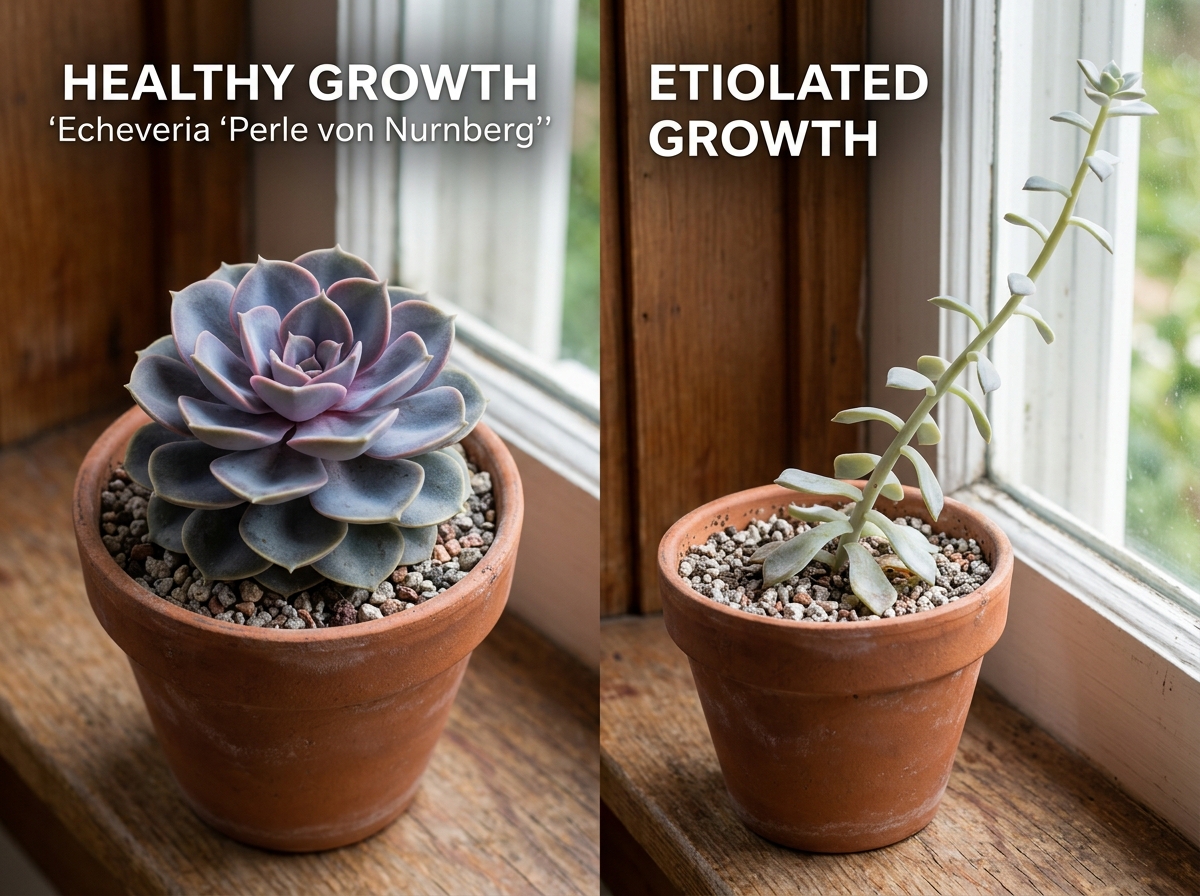
You bring home a gorgeous, compact Echeveria — tight leaves, rich colors, perfect rosette shape. A few weeks later? It’s a pale, spindly beanstalk reaching desperately toward the nearest window. Sound familiar?
This is one of the most common frustrations for indoor succulent owners. The problem isn’t your watering routine or your pot choice. It’s almost always light — or the lack of it.
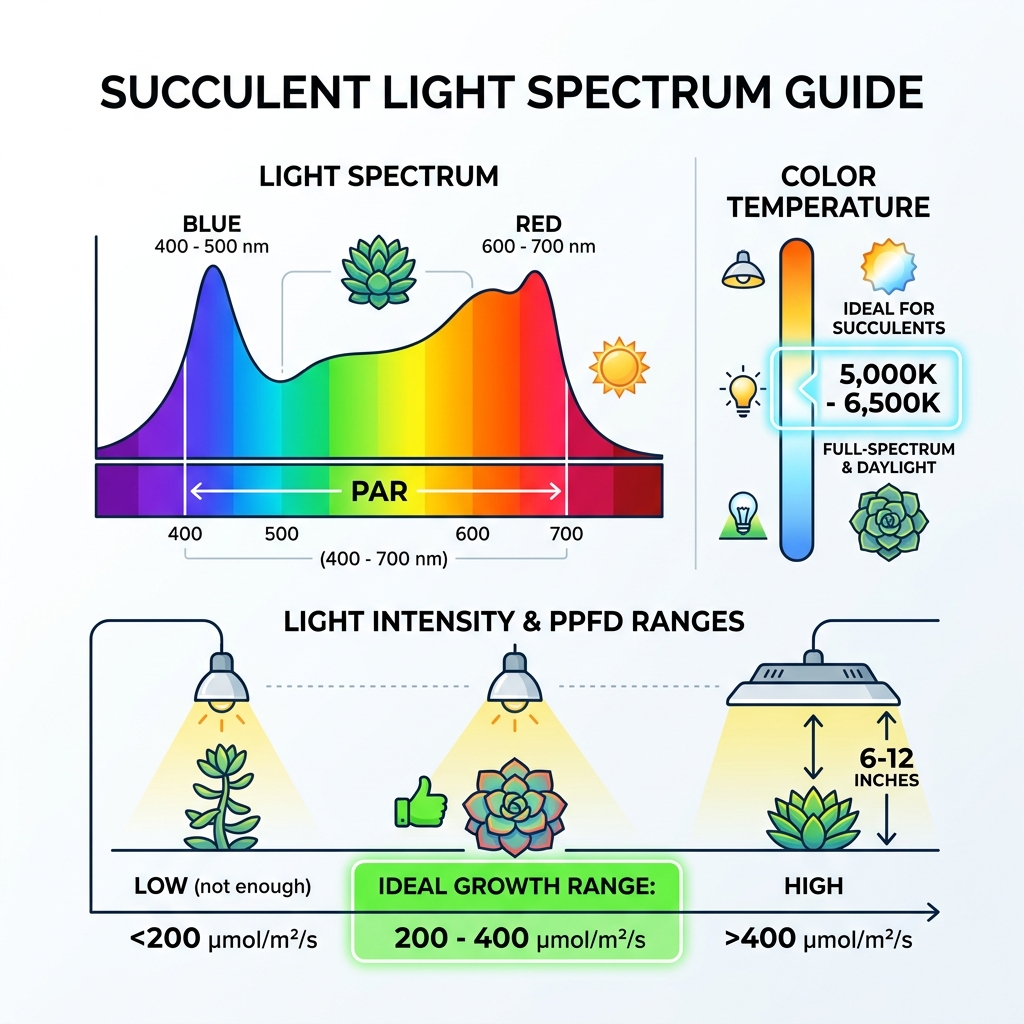
Succulents evolved in open deserts with intense, direct sun for hours every day. A typical indoor window delivers only a fraction of that. Even a bright south-facing window filters out key wavelengths and cuts intensity roughly in half compared to being outdoors. Most standard household lighting delivers far too little — only around 50-100 μmol/s/m² of usable light, when succulents need 200-400 μmol/s/m² just for healthy growth.
The good news: the right grow light solves this completely. And you don’t need an expensive, complicated setup to make it work.
Below, we’ve rounded up the best grow lights for succulents across every budget and living situation — from simple clip-on lights for a single pot to sleek full-spectrum panels for a whole shelf display.
Why Your Plants Crave Indoor Lighting for Succulents
If you have ever watched your beloved succulent collection turn pale and stretchy during the winter months, you are certainly not alone. Most succulents are sun-worshippers by nature, evolved to thrive under 6 to 12 hours of direct, high-intensity desert sunlight daily. When we bring them inside, we are essentially placing them in a “light cave.”
The Battle Against Etiolation
The most obvious sign that your plant is starving for energy is etiolation. This is the scientific term for “stretching.” When a succulent doesn’t get enough light, it stops producing compact leaves and starts putting all its energy into growing its stem as fast as possible to find a light source. This leads to wide gaps between leaves and a weakened structure. Unfortunately, etiolation cannot be reversed—once a stem stretches, it stays stretched. However, providing proper indoor lighting for succulents can stop the stretching in its tracks and ensure all new growth is tight and healthy.
CAM Metabolism and the Need for Darkness
Succulents are unique because many utilize Crassulacean Acid Metabolism (CAM). Unlike most plants that “breathe” during the day, succulents keep their pores (stomata) closed during the heat of the day to conserve water. They only open them at night to take in carbon dioxide. This means they absolutely require a dark period of 8–10 hours to complete their metabolic cycle. If you leave your grow lights on 24/7, you might actually stress the plant out by never letting it “exhale.”
Window Filtration and Fading Colors
Even if you have a window, glass is a surprisingly effective filter. It blocks a significant portion of the UV and infrared light that succulents use to produce “stress colors.” Those beautiful pinks, purples, and deep reds you see in professional photos are actually a healthy protective response to high-intensity light. Without supplemental lighting, these vibrant hues often fade back to a plain, dull green. To truly thrive, understand light preferences for indoor succulents and how artificial sources can bridge the gap that windows leave behind.
Choosing the Best Indoor Lighting for Succulents: Key Factors
When you start shopping for lights, the jargon can be overwhelming. Watts, Lumens, Kelvins, PPFD—what actually matters for your Echeveria? We break down the essentials so you can choose the right light for your indoor succulents with confidence.
The Power of PPFD and Lumens
For succulents, intensity is king. While standard household bulbs might look bright to human eyes, they are often “dim” to a plant.
- Lumens: Look for lights that emit at least 2,000 lumens per square foot. For optimal growth and color, 2,000–4,000 lumens is the “sweet spot.”
- PPFD (Photosynthetic Photon Flux Density): This measures how many “light particles” actually hit your plant. Aim for 200-400 μmol/s/m² for active growth. If you want those deep stress colors, you may even want to push toward 500 μmol/s/m².
Color Temperature (Kelvins)
The “color” of the light affects how your plants grow. For succulents, you want a light that mimics the midday sun. This is usually measured in Kelvins (K).
- 5,000K – 6,500K: This is known as “Daylight” or “Cool White.” It provides the full spectrum of light necessary for compact, healthy growth. Avoid “Warm White” (2,700K) bulbs as they often lack the blue wavelengths needed to prevent stretching.
Heat Dissipation and Efficiency
Old-school incandescent bulbs are terrible for succulents because they produce more heat than light, which can easily scorch fleshy leaves. Modern LED systems are the gold standard. They convert up to 90% of their energy into usable light and run much cooler.
| Feature | LED Grow Lights | Fluorescent T5 |
|---|---|---|
| Lifespan | 50,000+ Hours | 10,000-20,000 Hours |
| Heat Output | Very Low | Moderate |
| Energy Efficiency | High (90% conversion) | Medium |
| Spectrum | Highly Customizable | Fixed (requires specific bulbs) |
| Best For | All-purpose/Long-term | Large shelf setups |
Optimal Spectrum and Intensity for Indoor Lighting for Succulents
A “Full Spectrum” light is your best bet because it provides a balance of all colors. However, two specific wavelengths do the heavy lifting:
- Blue Light (400-500nm): This is the “anti-stretching” light. It encourages thick stems and compact leaf rosettes.
- Red Light (600-700nm): This stimulates blooming and helps enhance those coveted stress colors.
While old-fashioned “blurple” (pink/purple) lights work, they can be an eyesore in a living room. We recommend full-spectrum white LEDs that look natural to the eye but still provide the necessary red and blue peaks. You can rethink your indoor plant lighting by choosing fixtures that blend into your home decor while still delivering professional-grade intensity.
Professional Grade Indoor Lighting for Succulents
For the serious collector, “professional grade” doesn’t have to mean industrial-looking. Modern high-intensity LEDs now come in sleek designs like pendants or slim panels that provide a high-intensity output without turning your home into a laboratory. If you have a large collection, investing in top LED lights for your indoor succulent garden ensures that even the plants in the corners of your shelves get the energy they need to stay vibrant.
Top-Rated Grow Light Recommendations for Every Setup
Finding the right fit depends on your space. Here are the most effective formats for indoor lighting for succulents:
1. The Versatile Clip-On LED
Perfect for a desk or a small side table. These usually feature flexible goosenecks and built-in timers.
- Best for: 1-3 small pots or propagation trays.
- What to look for: A 360-degree gooseneck and at least 500-1,000 lumens per head.
- Product Insight: Look for options like the SANSI 5W LED Succulent House Lamps, which use a pot-clip design to keep the light source exactly where it needs to be.
2. The High-Output LED Panel
If you have a dedicated plant shelf, panels are the way to go. They provide an even “blanket” of light that prevents plants from leaning toward a single bulb.
- Best for: Shelving units, grow tents, or large flat surfaces.
- What to look for: Full-spectrum white light and a high PPFD rating.
- Product Insight: A 3ft Indoor Succulent Grow Light can cover a wide area, ensuring that a whole row of succulents stays compact and colorful.
3. Aesthetic Floor Lamps and Pendants
You don’t have to sacrifice style for science. Floor lamps designed for plants can act as a focal point in your room while providing the high-intensity light succulents crave.
- Best for: Large specimen plants (like a Jade tree) or groups of plants in living areas.
- Product Insight: A Floor Lamp for Plants offers a decorative solution that fits into your home’s aesthetic while preventing the “spindly beanstalk” look.
4. Professional Full-Spectrum Systems
For those who want the absolute best results, professional-grade pendants or bars offer the highest PAR levels. These are often used by growers to maintain rare varieties.
- Best for: Rare species, high-light cacti, and maximizing stress colors.
- Product Insight: Check out the latest in grow lights for succulents or explore the best grow lights for 2026 to find high-end options that combine power with design.
Managing Your Light Schedule and Placement
Once you have your lights, how you use them is just as important as the light itself. Poor placement can lead to either “sunburn” or continued stretching.
Distance Guidelines
The intensity of light drops off rapidly as you move the bulb away from the plant.
- The 6-12 Inch Rule: For most LED grow lights, you want the light to be between 6 and 12 inches from the top of the succulent.
- Adjusting for Intensity: If you see bleached, white, or crispy tan patches on the leaves, your light is too close (light burn). Move it back 3-5 inches. If the plant is still leaning or pale, move it closer, but never closer than 6 inches to avoid heat damage.
The 14-Hour Sweet Spot
Consistency is key. Succulents thrive when they have a predictable day/night cycle. We recommend using a smart timer to run your lights for 12-16 hours a day. 14 hours is often considered the “sweet spot” for mimicking summer growth conditions year-round. This duration helps bring indoor succulents to life by providing enough total energy (Daily Light Integral) for photosynthesis.
The Acclimation Process
Don’t blast a new plant with 14 hours of high-intensity light on day one! If your succulent is used to a dim nursery or a dark box from shipping, it needs to acclimate.
- Start with 3–4 hours of light per day.
- Increase the duration by 1–2 hours every few days.
- Monitor for signs of stress or burning during the first two weeks.
By using effective indoor succulent lighting ideas like automated timers and adjustable stands, you can create a “set it and forget it” system that keeps your plants happy while you go about your day.
Frequently Asked Questions about Succulent Lighting
How can I tell if my succulents are getting too much or too little light?
Your plants will tell you exactly how they feel if you know what to look for.
- Too Little Light: The plant starts stretching (etiolation), leaves point downward to increase surface area for light absorption, and the center of the rosette turns pale green or yellow. If you notice this, it’s time for shining a light on indoor succulent care by moving the light closer or increasing the duration.
- Too Much Light: You will see “light burn,” which looks like bleached or white patches on the leaves. In extreme cases, the leaves may become crispy or develop permanent brown scars.
What are the energy costs of running grow lights?
One of the best things about modern LED indoor lighting for succulents is how cheap it is to run.
- The Math: A typical 100W LED fixture running for 14 hours a day costs approximately $0.40 to $0.50 per month based on average U.S. electricity rates.
- Longevity: Quality LEDs last 50,000+ hours. If you run them 14 hours a day, that is over 10 years of use before you need to think about a replacement. You can truly boost your indoor succulent growth without breaking the bank.
Do different succulent varieties have different lighting needs?
Yes! While most love high light, there are exceptions.
- High-Light (Cacti, Echeveria, Sedum): These need the full 200-400 PPFD and 12-14 hours of light to stay compact.
- Low-Light Tolerant (Haworthia, Gasteria, Sansevieria): These can thrive with less intensity (100-200 PPFD). If you have a dim corner, check out the top succulent varieties for low light.
- Stress Colors: If you want your Graptosedum to turn bright orange or your Echeveria to stay deep purple, you must provide the higher end of the light intensity spectrum.
Conclusion
Providing the right indoor lighting for succulents is the single best thing you can do for your indoor garden. By mimicking the desert sun with high-intensity, full-spectrum LEDs, you can say goodbye to leggy, pale plants and hello to vibrant, compact rosettes that look like they belong in a magazine.
Light is just one piece of the puzzle. When using high-intensity grow lights, your plants will process water faster due to increased evaporation. Stick to a strict “soak and dry” watering routine, ensure you have good airflow to prevent pests, and always give your plants that essential 8–10 hours of darkness to rest.
Ready to transform your home into a succulent sanctuary? Explore more about indoor setup services and start building the radiant indoor garden your plants deserve!
