
Why Gritty Soil for Succulents Makes All the Difference
Gritty soil for succulents is a fast-draining, mineral-rich growing medium that mimics the rocky, arid conditions succulents naturally thrive in. Unlike standard potting mixes, it lets water move through quickly — protecting roots from rot while keeping plants healthy with minimal effort.
Here’s what you need to know at a glance:
- What it is: A mix of coarse inorganic particles (pumice, perlite, lava rock, calcined clay) often blended with small amounts of organic matter
- Why it works: Water drains in seconds, not hours — roots stay oxygenated and never sit in moisture
- Who it’s for: Succulents, cacti, bonsai, hoya, and caudex plants
- How often to water: Every 5–30 days depending on the plant and season
- Key benefit: Near-zero risk of overwatering, even for busy plant owners
Most succulents die from too much water, not too little. The problem is rarely the watering itself — it’s the soil holding that moisture against the roots for too long.
Gritty mixes solve this at the source.

Why Gritty Soil is Essential for Arid Plants
When we look at a succulent, we see thick, juicy leaves designed to store water. What we don’t always see is the complex root system beneath the surface that is evolutionarily programmed for “dry feet.” In the wild, these plants live in rocky crevices or sandy plains where rain is infrequent but heavy. When it does rain, the water vanishes almost instantly, leaving the roots damp but surrounded by air.
This is where gritty soil for succulents becomes a lifesaver. Traditional “big-box” potting soils are often peat-based. While great for ferns, peat stays wet for too long and eventually compacts into a brick-like substance that chokes off oxygen.
Oxygenation and Compaction Resistance
Roots need to breathe just as much as leaves do. A high-quality gritty mix maintains its structure over time. Because the particles are large—typically ranging from 1/8″ to 3/8″—they create permanent “macro-pores.” These air pockets ensure that even after a heavy watering, oxygen can reach the root zone. This resistance to compaction means you won’t have to repot as often, as the soil doesn’t “break down” and suffocate the plant.
The Magic of pH 5.5
Most succulents and bonsai are acid-loving plants. Research shows that an optimized pH of 5.5 is the “sweet spot” for nutrient uptake. When the pH is too high (alkaline), plants can’t access the minerals in the soil, leading to stunted growth and yellowing leaves. High-end gritty mixes are often formulated to hit this 5.5 mark precisely.
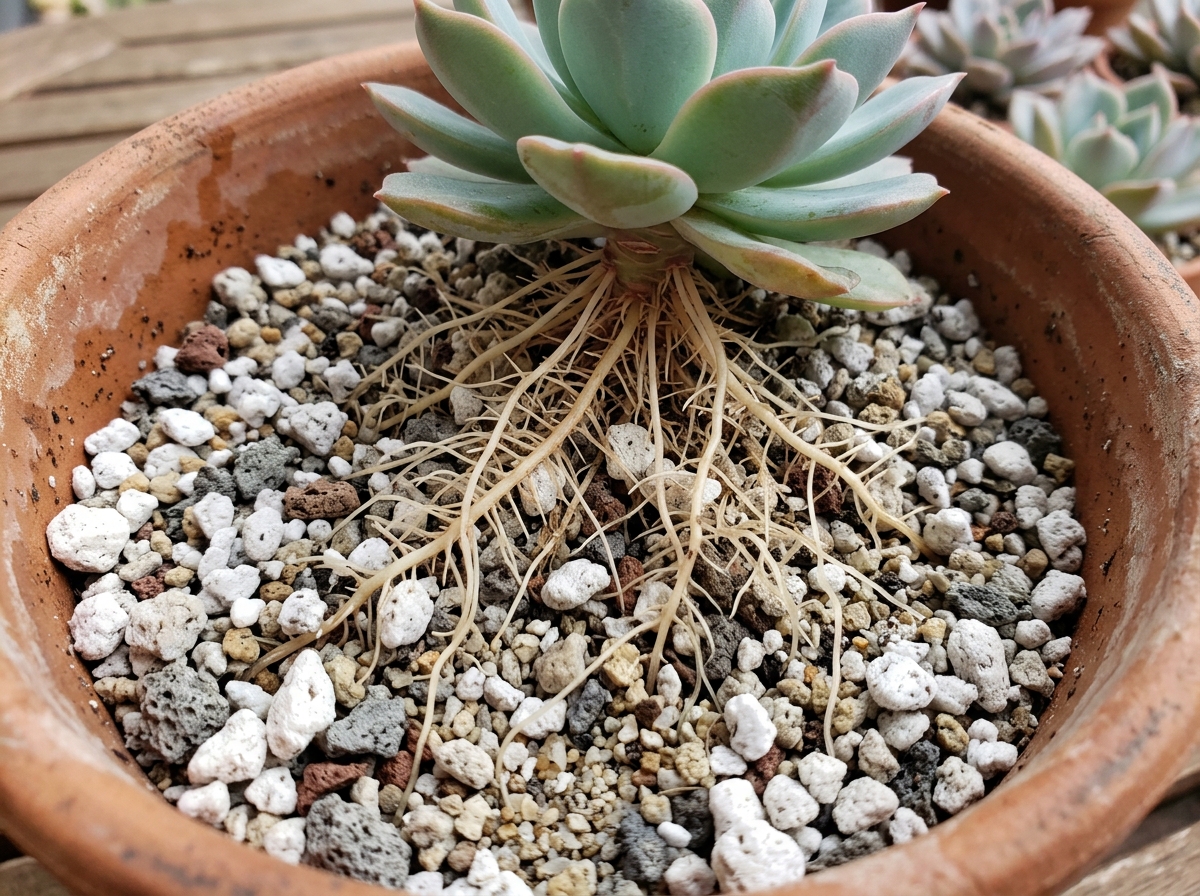
Understanding the role of drainage in succulent watering is the first step toward becoming a pro grower. Whether you are dealing with Echeveria, Haworthia, or even sensitive Caudex species, the drainage provided by grit is your best insurance policy against the dreaded root rot. Furthermore, using the right soil allows you to get more adventurous with your displays, even exploring beyond the plant pot: creative containers for succulents that might otherwise be risky in standard soil.
Key Ingredients in a High-Performance Gritty Soil for Succulents
Not all “grit” is created equal. If you were to look at a handful of premium gritty soil for succulents, you would see a diverse palette of colors and textures. Each ingredient serves a specific purpose, balancing moisture retention with ultra-fast drainage.
- Pumice and Perlite: These are the workhorses of aeration. Pumice is a volcanic rock that is full of tiny holes, allowing it to hold a small amount of water while remaining incredibly lightweight.
- Calcined Clay (Bonsai Block): This is clay fired at high temperatures so it won’t melt or turn back into mush. It excels at “cation exchange,” which is a fancy way of saying it holds onto nutrients so the plant can eat them later.
- Monto Clay (Montmorillonite): Often used in equal 33% ratios with bark and calcined clay, this ingredient helps stabilize the mix and provides essential minerals.
- Pine Bark Fines: This provides a small amount of organic matter and helps maintain that slightly acidic pH succulents love.
- Akadama and Hyuga: These are premium Japanese volcanic materials. Akadama is a clay-like mineral that breaks down very slowly, providing a visual cue for watering (it changes color when dry). Hyuga is even more porous and serves as an excellent amendment for sensitive bonsai.
- Granite: Crushed grey granite adds weight to the pot (preventing top-heavy plants from tipping) and provides zero water retention, ensuring the mix stays “gritty.”
The Sustainability of Gritty Soil for Succulents
Sustainability is becoming a major factor in how we choose our garden supplies. Did you know that roughly 50 million coconuts are produced globally every year? Interestingly, about 85% of those coconut husks are typically discarded as trash. Modern gritty mixes are turning this “waste” into a win for gardeners.
By repurposing coconut coir and husk chips, manufacturers create a sustainable alternative to peat moss. These fibers offer excellent aeration and are much easier to re-wet than dried-out peat. Some eco-friendly blends even incorporate recycled glass sand—crushed glass that is soft to the touch—and biochar to improve soil health while keeping waste out of landfills.
Benefits of a Soilless Gritty Soil for Succulents
Many of the best gritty mixes are actually “soilless.” This means they don’t contain traditional garden dirt, which can harbor pests, fungus gnats, and soil-borne diseases.
A soilless medium is often treated with steam sterilization (at 200°F) or pathogen controls like Bifenthrin to ensure you aren’t bringing hitchhikers into your home. Furthermore, premium mixes often include “probiotics” for your plants:
- Mycorrhizae: Beneficial fungi that attach to roots and help them absorb water and phosphorus.
- Rhizobacteria: Beneficial bacteria that build plant immunity and protect against harmful pathogens.
When you are choosing the best container for succulent propagation, starting with a sterile, soilless gritty mix gives your “pups” the best chance of survival by preventing rot before it starts.
Soilless vs. Soil-Based: Choosing the Right Mix
Choosing between a 100% inorganic soilless mix and a soil-based gritty mix depends on your environment and your watering habits.
If you live in a very humid climate or tend to “over-love” your plants with the watering can, a purely soilless mix is your best friend. These mixes have a low bulk density (often around 0.350 ounces per cubic inch), making them incredibly airy. Because they don’t hold much water, you might find yourself watering every 5 to 10 days.
On the other hand, if you live in a bone-dry desert or prefer to water only once a month, a mix with more organic matter (like coconut coir or pine bark) will provide the moisture-wicking properties needed to keep the plant hydrated between drinks.
| Feature | Soilless Gritty Mix | Soil-Based Gritty Mix |
|---|---|---|
| Pest Risk | Extremely Low | Moderate |
| Moisture Retention | Low (Dries in 1-5 days) | Moderate (Dries in 10-30 days) |
| Nutrient Density | Requires Fertilizer | Higher Initial Nutrients |
| Re-watering Frequency | High | Low |
| Best For | Expert growers, high humidity | Beginners, dry climates |
Practical Guide: Potting and Watering with Gritty Soil
Using gritty soil for succulents requires a slight shift in how you think about watering. Because the water moves through the pot so quickly, you can’t just give it a “sip.” You need to ensure the entire root ball gets hydrated.
How Much Soil Do I Need?
Before you start, it helps to know how much to buy. As a general rule of thumb:
- 1 Quart: Fills about one 5-inch nursery pot.
- 2 Quarts: Fills two 5-inch pots.
- 4 Quarts (1 Gallon): Fills about three 6-inch nursery pots.
The “Soak and Dry” Method
The best way to water a gritty mix is through uniform drainage or bottom-watering. Since the particles are large, water can sometimes “channel” straight through without hitting the roots.
To prevent this, try bottom-watering: place your pot in a tray with about an inch of water and let it sit for 30–60 minutes. This encourages strong downward root growth as the roots “reach” for the moisture. Afterward, let the pot drain completely. The importance of well-draining soil in watering succulents cannot be overstated; it is the difference between a plant that merely survives and one that thrives.
Frequently Asked Questions about Gritty Mixes
Can I use gritty soil straight from the bag?
Yes! Most premium gritty mixes are designed to be standalone potting mediums. However, they are also highly versatile. For example, if you are growing a “dry-footed” plant like a Haworthia or a Brazilian Raintree, you should use the grit at 100% concentration.
If you are growing something that likes a bit more moisture, like an Echeveria or a Bald Cypress, you can create a custom blend. A 50/50 mix of gritty soil and organic potting soil is often a great “middle ground” for standard indoor succulents.
How do I know if my gritty soil is pathogen-free?
High-quality manufacturers take plant health seriously. Look for products that are state-inspected and treated for pathogens. Common treatments include drenching the mix in Bifenthrin or using 200°F steam sterilization. These processes ensure the mix is free of larvae, fungi, and bacteria that could harm your collection. This is especially important if you live in a state with strict agricultural regulations, as these treatments allow the soil to be shipped legally across state lines.
Why does the price of gritty soil vary so much?
You might notice that gritty soil for succulents costs more than a standard bag of dirt at the grocery store. This is due to the quality of the ingredients. Components like Akadama and Hyuga are imported from Japan, and calcined clays require expensive high-heat processing.
Additionally, shipping weight plays a role. A 12-gallon bag of gritty mix can weigh upwards of 60 lbs! When shopping, look for brands that offer free shipping thresholds (often around $80) or bulk discounts to get the best value for your money.
Conclusion
At FinanceBoostX, we believe that the foundation of a great garden starts beneath the surface. Transitioning your collection to gritty soil for succulents is one of the single most impactful changes you can make for the long-term vitality of your plants. By prioritizing root health, aeration, and sustainable ingredients like recycled coconut husks, you are setting your succulents up for years of vibrant growth.
Ready to take your plant parenthood to the next level? Explore our complete guide to succulent care for more tips on lighting, propagation, and seasonal maintenance. Happy planting!
