
One Leaf, Infinite Succulents: What You Need to Know
How to propagate succulents from leaves is simpler than most people think. Here’s the quick version:
- Twist off a healthy, plump leaf from the base of the stem — clean break, no torn edges
- Let it dry on a paper towel for 3-5 days until the cut end seals over
- Lay it on top of dry, well-draining succulent soil — don’t bury it
- Place in bright, indirect light and mist the soil lightly every 2-3 days once roots appear
- Wait — roots and tiny baby plants (called pups) typically appear in 2-6 weeks
- Transplant the pup once the mother leaf has shriveled and the baby is about 1 inch across
There’s something almost unbelievable about it. You knock a single leaf off your Echeveria, leave it on a windowsill, and a few weeks later — tiny pink roots and a miniature rosette appear like magic.
That’s leaf propagation. And it’s one of the most cost-effective ways to multiply your plant collection without spending a cent.
The catch? It requires patience. Most varieties take 4-6 weeks to show roots or pups, and a full-sized plant can take 9 months to a year to reach 4-5 inches. First-timers should also expect some losses — it’s completely normal for more than half of a first batch to fail.
But once it clicks, it becomes genuinely addictive.
Essential Tools and Materials for Success
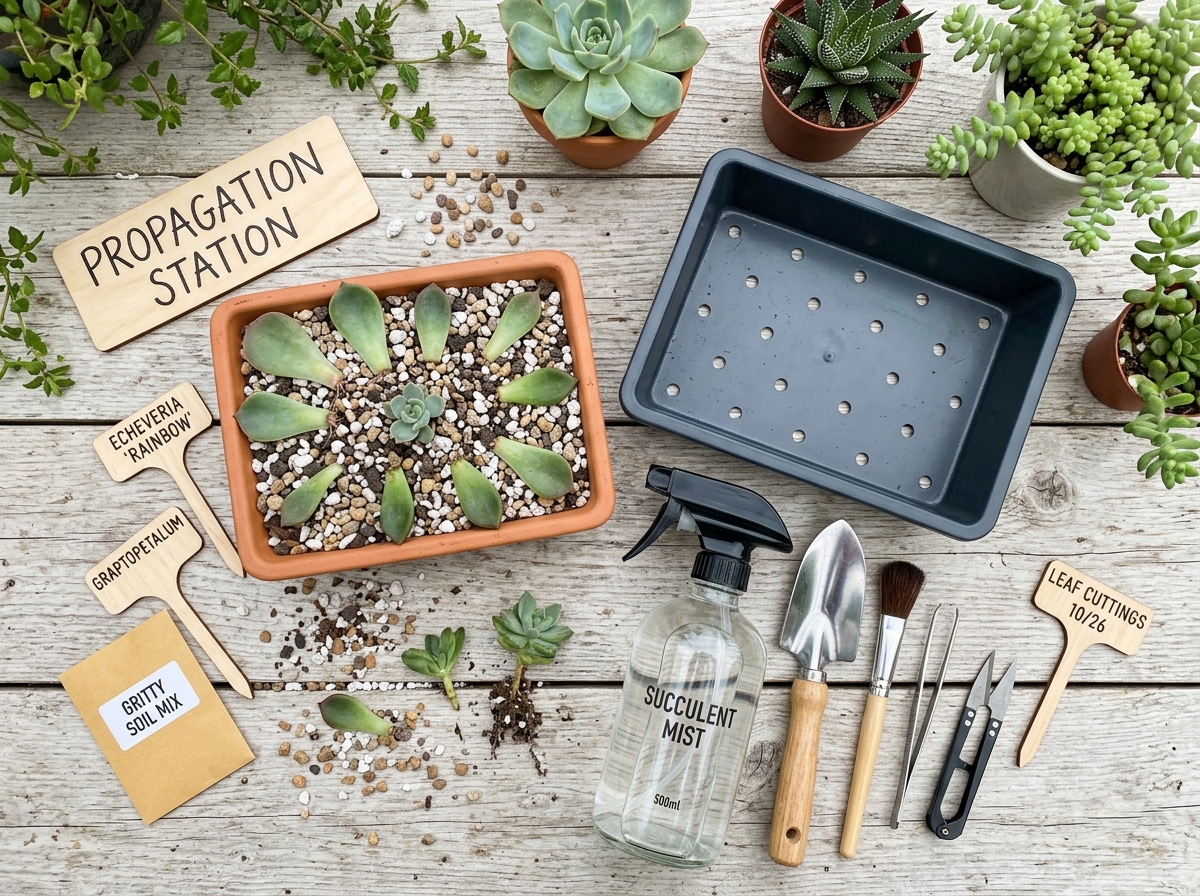
Before we dive into the “how-to,” let’s talk about the “with-what.” While succulents are famously hardy, they are also famously prone to rot if the environment isn’t just right. Having the correct supplies on hand is the difference between a tray full of baby plants and a tray full of mushy, black compost.
Here is what we recommend gathering before you start:
- A Healthy Parent Plant: You cannot grow a healthy baby from a sickly leaf. Choose a mature, plump succulent.
- Sharp Razor Blade or Craft Knife: While many leaves can be wiggled off by hand, some varieties benefit from a precise cut.
- Rubbing Alcohol: Use this to sterilize your tools. Bacteria is the number one enemy of a fresh “wound” on a plant.
- Cactus and Succulent Soil Mix: Regular potting soil holds too much moisture. You need something gritty and fast-draining. We often recommend a high-quality cactus soil mix to ensure the roots don’t sit in water.
- Shallow Nursery Trays or Flat Containers: You don’t need deep pots yet. A shallow tray allows for better airflow and easier misting. Choosing the Best Container for Succulent Propagation is a great resource if you aren’t sure what to use.
- Spray Bottle: For gentle misting once roots appear.
- Rooting Hormone (Optional): While not strictly necessary for most leaves, it can speed up the process for stubborn varieties.
- Paper Towels: These are perfect for laying your leaves out to dry during the callousing phase.
Step-by-Step: How to Propagate Succulents from Leaves
The process of how to propagate succulents from leaves starts with a concept called “meristematic tissue.” This is essentially the plant’s version of stem cells, located right where the leaf meets the stem. If you damage this area during removal, the leaf will never grow roots.
1. The Clean Snap Rule
To get a perfect leaf, grasp it firmly between your thumb and forefinger. Gently wiggle it back and forth, or give it a slight twist, until it “pops” off the stem. It must be a clean break. If the leaf tears or leaves a piece of itself behind on the stem, discard it. It needs that tiny U-shaped base to be intact. This is The Secret to Growing New Succulents From Single Leaves.
2. The Callousing Process
You might be tempted to put that fresh leaf straight onto damp soil. Don’t do it. A fresh leaf is like an open wound; if it touches moisture immediately, it will absorb too much and rot. Lay your leaves on a paper towel in a spot with indirect light. Wait 3-5 days (or up to a week in humid climates) until the end has dried and formed a “scab” or callus.
3. The Incubation Period
Once calloused, lay the leaves on top of your prepared soil. Do not bury the ends. In nature, leaves fall to the ground and sit on the surface; we are simply mimicking that. Place the tray in a warm spot with bright, indirect sunlight. Avoid direct, hot sun, which can literally cook the moisture out of the leaf before it has a chance to grow. For more on the general process, you can check out this guide on How To: Propagate Succulents.
Preparing the Soil for how to propagate succulents from leaves
The soil is the foundation of your new “succulent forest.” The goal is a medium that provides stability and a hint of moisture without staying soggy. We suggest a mix that is roughly 50% organic matter (like peat or compost) and 50% inorganic matter (like perlite, pumice, or coarse sand). This ensures that when you mist the soil, the water moves through quickly.
| Feature | Commercial Cactus Mix | DIY Succulent Mix |
|---|---|---|
| Drainage | High | Excellent (Adjustable) |
| Nutrients | Pre-added | You add as needed |
| Cost | Mid-range | Low |
| Best For | Convenience | Customization for humid/dry climates |
Using proper Succulent Propagation Techniques for Every Home Gardener involves understanding your local climate. If you live in a very dry area like Utah or Arizona, you might need a slightly more organic mix to prevent the roots from drying out too fast.
Watering and Light for how to propagate succulents from leaves
This is where most beginners fail. There is a golden rule in our community: No roots, no water.
Until you see those tiny pink or white threads emerging from the leaf base, the leaf does not need water. It is a “packed lunch” for the baby plant, containing all the hydration and nutrients the pup needs to start its life. Once roots appear, you can begin misting the soil every 2-3 days. Focus the water on the roots themselves, not the leaf.
Light is equally critical. If your tray is in too much shade, the new pups will grow tall, pale, and skinny—a process called etiolation. They are literally stretching to find the sun. If they are in direct, harsh sun, they will turn brown and shrivel. Aim for “bright indirect light,” like a spot a few feet away from a south-facing window. Understanding The Dos and Don’ts of Succulent Propagation will help you balance these environmental factors.
Which Succulents Work Best for Leaf Propagation?
Not all succulents are created equal when it comes to leaf propagation. Some are prolific “cloners,” while others simply refuse to grow from a single leaf.
The “Easy” List:
- Echeveria: These are the classic rosette-shaped plants. Most varieties, like ‘Perle von Nurnberg’ or ‘Lola’, propagate beautifully from leaves.
- Sedum (Stonecrop): These are incredibly hardy. Even a leaf that falls off accidentally while you’re dusting will often start a new plant on its own.
- Graptopetalum: Often called “Ghost Plants,” these are perhaps the easiest. They drop leaves easily, and almost every leaf has the potential to become a pup.
The “Difficult or Impossible” List:
- Aeonium: These typically require stem cuttings. A single leaf will almost always just shrivel and die.
- Sempervivum (Hens and Chicks): These are best propagated by removing the “chicks” (offsets) that grow around the mother plant.
- Aloe and Haworthia: While technically possible in a laboratory setting, these almost never grow from leaves for home gardeners. They are much easier to propagate via offsets.
If you are a novice, we recommend starting with a Beginner’s Guide Propagating Succulents to identify which plants in your collection are the best candidates.
Troubleshooting Common Propagation Problems
If you see a leaf turning black and mushy, don’t panic—but do act fast. This is a sign of rot, usually caused by too much moisture or a leaf that didn’t callous properly. Remove any mushy leaves immediately so the rot doesn’t spread to healthy neighbors.
Another strange phenomenon is the “Zombie Leaf.” This is a leaf that grows a massive, healthy system of roots but never produces a tiny plant (the pup). This usually happens when the meristematic tissue was slightly damaged. You can keep it as a “pet leaf,” but it will likely never become a full plant.
If your leaves are shriveling up and turning brown before any roots appear, they might be in a spot that is too hot, or the leaf itself might have been too young and lacked the stored energy to survive the wait. You can learn more about How to Propagate a Succulent From a Leaf Without Killing It to refine your technique.
Success rates vary. Even pros expect about a 50-60% success rate. If you start with 10 leaves and get 5 healthy plants, you are doing a fantastic job!
Frequently Asked Questions about Succulent Propagation
How long does it take for roots and pups to form?
Patience is the name of the game. Typically, you will see some action within 2-3 weeks. First come the roots (those “alien” pink hairs), followed shortly by a tiny rosette. By the 10-week mark, you should have a clearly defined baby plant. However, growth slows down significantly in the winter. For a deeper dive into the timeline, see Succulent Propagation: A Comprehensive Look.
When should I separate the new baby succulents?
The “mother leaf” is the baby’s lifeline. It provides all the water and nutrients while the pup is small. Eventually, the mother leaf will shrivel up, turn brown, and become paper-thin. This is nature’s way of saying the baby is ready to be independent. We recommend waiting until the baby is at least 1 inch in diameter and the mother leaf falls off with a gentle touch before moving it to its own pot. Maximize Your Garden: How to Propagate Succulents offers more tips on this transition.
Can I propagate succulents in water instead of soil?
Yes, you can! This is called “water propagation.” You suspend the calloused leaf just above (not touching) a container of water. The humidity encourages roots to grow down toward the water. While this is fun to watch, “water roots” are different from “soil roots.” They are more fragile, and the plant often goes into shock when you eventually move it to soil. For most people, soil propagation is the more reliable method. Check out our Easy Guide to Propagate Succulents From Leaves for a comparison of these methods.
Conclusion
Learning how to propagate succulents from leaves is a journey of observation and patience. There is a deep sense of satisfaction in seeing a tiny, perfect plant emerge from a single leaf that might otherwise have been thrown away. Whether you are looking to expand your own indoor garden or create handmade gifts for friends, propagation is the ultimate gardening “hack.”
Remember to keep your tools clean, your soil dry (at first!), and your expectations realistic. Not every leaf will make it, but the ones that do will be a testament to your growing “plant wizard” skills.
For more detailed strategies, don’t miss The No-Nonsense Succulent Leaf Propagation Guide or explore our More succulent care tips to keep your new babies thriving for years to come. Happy planting!
