
Why Your Indoor Desert Needs the Best Artificial Light for Cacti
The best artificial light for cacti is a full-spectrum LED grow light with a color temperature of 5000K–6500K and a PPFD of 600–1,000 µmol/m²/s (or 1,500–2,000+ lumens per square foot), run for 12–16 hours per day.
Quick answer — top choices by setup size:
| Setup Size | Recommended Light Type | Key Specs to Target |
|---|---|---|
| Small (1–2 plants) | Full-spectrum LED bulb | 2,000+ lumens, 5000K–6500K |
| Medium collection | T5HO fluorescent panel or LED panel | 20–30W per sq ft, full spectrum |
| Large collection | High-output LED grow panel | 600–1,000+ PPFD, 5000K–6500K |
Here’s a problem most cactus owners don’t see coming: your indoor space is far dimmer than it looks.
A bright, sunny room might deliver 100–500 lumens per square foot. A desert cactus in its natural habitat gets 10,000+ lumens per square foot for hours every day. That’s not a small gap — it’s an enormous one.
Your cactus won’t die right away. But without enough light, it starts to stretch, fade, and weaken — a process called etiolation. And unlike other houseplants that tolerate dim corners, cacti evolved under brutal, unfiltered desert sun. They need intensity that a window simply cannot provide.
The good news? The right grow light can bridge that gap completely — without complicated setups or hours of maintenance.
The Difference Between Cacti and Other Succulents
While we often group them together, cacti are the high-performance athletes of the plant world when it comes to light consumption. On average, a desert cactus requires about 20% more light than your typical succulent, like a Jade plant or Haworthia.
Most succulents can maintain their shape and color with 300–800 lumens per square foot. Cacti, however, are evolutionarily hardwired for the extreme intensity of the open desert. If you’ve noticed your Echeveria looks great under a specific light but your Prickly Pear is starting to look a bit “pointy” at the top, it’s because the cactus is still starving. For a deeper dive into these nuances, check out our guide on Understanding Light Preferences for Indoor Succulents.
Signs Your Cactus is Starving for Sunlight
Cacti are stoic; they don’t wilt like a peace lily when they’re unhappy. Instead, they give us subtle (and then not-so-subtle) clues.
- Etiolation (The “Stretching” Look): This is the most common sign. If your round cactus is suddenly turning into a cone, or your columnar cactus is getting skinny at the top, it’s desperately reaching for a light source it can’t find.
- Weak Spines: Spines aren’t just for protection; they act as a shade cloth for the plant. Under low light, a cactus may produce smaller, thinner, or fewer spines because it’s trying to let in as much light as possible.
- Pale Color: A healthy cactus should be a deep, vibrant green (or blue, or purple, depending on the species). If it’s turning a sickly lime green or yellowish-white, it’s struggling to photosynthesize.
- Leaning: If your plant is pulling a “Michael Jackson lean” toward the nearest window, it’s a cry for help.
If you see these signs, it’s time to upgrade your setup. You can explore more about identifying these issues in our article on Best Lighting Options for Indoor Succulents.
Technical Requirements: Lumens, PPFD, and Spectrum
When shopping for the best artificial light for cacti, you’ll run into a lot of “alphabet soup”-PPFD, PAR, CCT, and Lumens. Let’s break down what actually matters for your spiky friends.
| Metric | Desert Cacti Requirement | Tropical Cacti (e.g., Christmas Cactus) |
|---|---|---|
| Lumens/sq ft | 1,500-2,000+ | 500-800 |
| PPFD (µmol/m²/s) | 600-1,000+ | 200-400 |
| Daily Duration | 12-16 Hours | 10-12 Hours |
| Spectrum | Full Spectrum (White) | Full Spectrum (White) |
While lumens measure how bright a light is to human eyes, PPFD (Photosynthetic Photon Flux Density) measures how much “food” (photons) is actually hitting the plant’s surface. For desert cacti, you want the highest PPFD you can reasonably provide without melting the plant. For more technical tips, see Choosing the Right Grow Light for Your Cacti. If you want a neutral overview of how plant light is measured, the Photosynthetically active radiation article on Wikipedia is a helpful reference.
Understanding Color Temperature and Kelvin
The “color” of your light is measured in Kelvin (K). For cacti, we want to mimic the sun as closely as possible.
- 5000K-6500K (Cool White/Blue): This range is essential for vegetative growth. It keeps your cactus compact and prevents that dreaded stretching (etiolation).
- 3000K (Warm White/Red): This range encourages flowering. While cacti are mostly about the green body, the red spectrum helps them build the energy reserves needed to produce those spectacular desert blooms.
The best artificial light for cacti is almost always a “Full Spectrum” light, which includes a mix of these to cover all life stages. Learn more about this in our guide on How to Choose the Right Light for Your Indoor Succulents.
Why Wattage Isn’t the Only Metric That Matters
In the old days, we just looked at wattage. “Give me a 100W bulb!” we’d say. But with modern LEDs, wattage only tells you how much electricity the light uses, not how much light it produces.
Instead, look for efficacy (µmol/J). A high-quality LED might only use 30 watts but produce more usable light than an old 100W incandescent bulb that mostly just produces heat. For a list of high-efficiency options, check out Grow Lights That Will Make Your Succulents Beam.
Comparing Technologies and Choosing the Best Artificial Light for Cacti
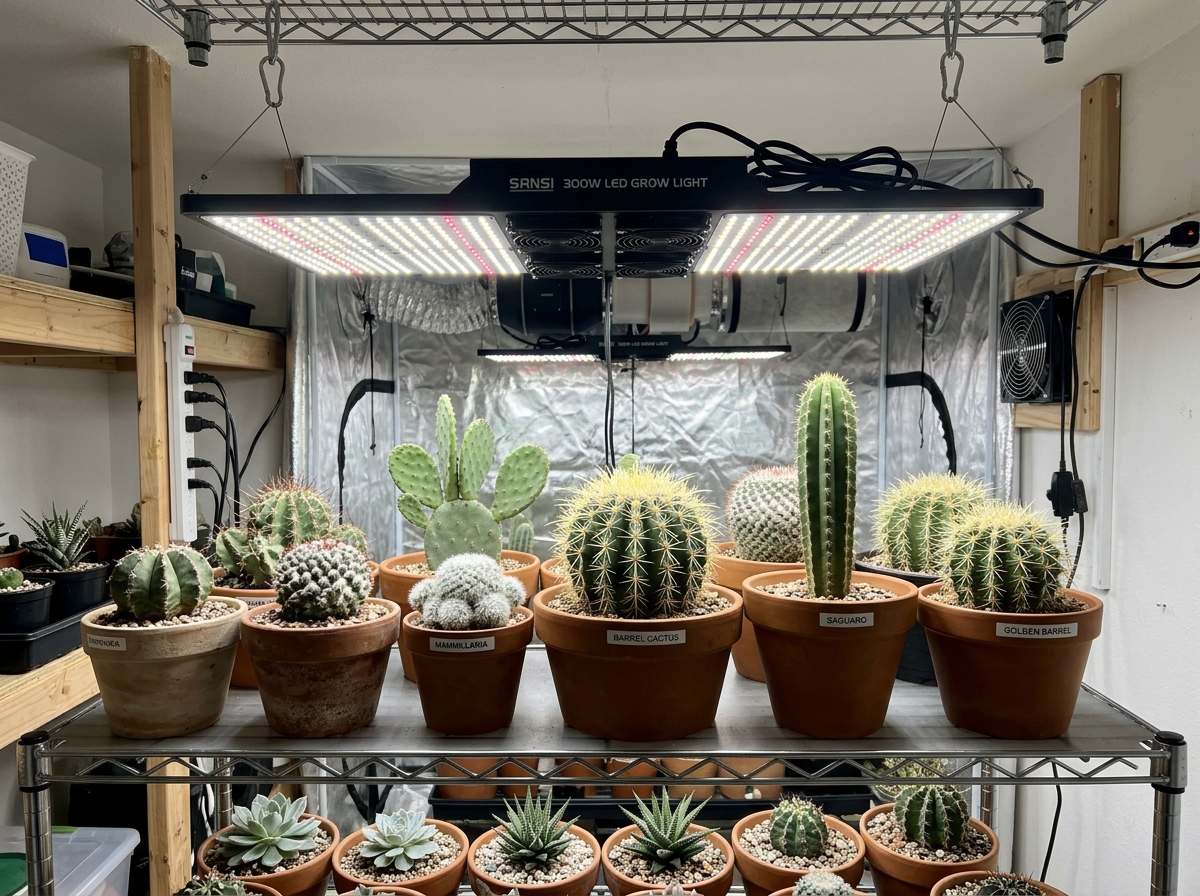
Not all lights are created equal. Here is how the main technologies stack up for cactus care.
Choosing the Best Artificial Light for Cacti: LED vs. Fluorescent
LED (Light Emitting Diode): This is the gold standard in 2025. LEDs are incredibly efficient, stay cool to the touch, and can last over 50,000 hours. That is over 10 years of use if you run them 14 hours a day! They allow you to get the light very close to the plant (6–12 inches) without scorching the skin. High-quality horticultural LED panels are favorites for a reason—they deliver high PPFD for a reasonable price.
Fluorescent (T5HO): T5 High Output (HO) tubes are a classic choice for seedlings and medium collections. They provide very even coverage across a shelf. However, they lose their intensity over time and need to be replaced every 6–12 months to remain effective for high-light plants like cacti.
Metal Halide (HID): These are the “heavy hitters.” They produce massive amounts of light and heat, which cacti actually love. However, they are expensive to run, require special fixtures, and can be a fire hazard if not managed correctly. Most home growers prefer LEDs for safety and cost.
For a curated list of top-tier LEDs, see Top LED Lights for Your Indoor Succulent Garden and Our Top Recommended Grow Lights for Cacti.
Compact Bulbs: The Best Artificial Light for Cacti in Small Spaces
If you only have one or two plants on a desk, you don’t need a massive 4-foot panel. High-output LED “screw-in” bulbs are excellent. Look for bulbs that offer at least 2,000 lumens and a 5000K color temperature. You can even find stylish options like adjustable LED plant lights that blend into your decor.
For more small-space ideas, visit Compact Grow Light Solutions for Small Spaces.
Setup Guide: Positioning, Timing, and Maintenance
Getting the light is only half the battle; how you set it up determines if your cactus thrives or just survives.
Positioning Your Lights
- Distance: For most LED panels, aim for 6–12 inches from the top of the cactus. If the light is too far away, the intensity drops off exponentially.
- Rotation: Cacti will lean toward the light. Rotate your pots a quarter-turn every week to ensure perfectly symmetrical growth.
- Reflectors: Using white walls or Mylar film can increase the light reaching your plants by 20–30% without using any extra electricity.
The Photoperiod (Timing)
Cacti need a day-night cycle. We recommend 12–16 hours of light during the growing season (Spring through Autumn). Use a digital timer to automate this—consistency is key! You can find more setup tips at How to Choose the Right Light for Your Indoor Succulents 2.
Managing Seasonal Changes and Dormancy
In the winter, many cacti go into dormancy. They stop growing and “rest.” During this time:
- Reduce Light: Drop the timer to 8–10 hours.
- Lower Temperature: If possible, keep the room cooler (50°F–60°F).
- Stop Watering: Most cacti need zero water in the winter if they are truly dormant.
This “winter chill” combined with shorter days is often what triggers the cactus to produce flowers in the spring. For species-specific advice, see Grow Lights for Prickly Pear Cactus.
Preventing Light Burn and Heat Stress
Can you have too much of a good thing? Yes! If you move a cactus from a dark corner directly under a high-intensity LED, it will get a “sunburn.” This appears as yellowing, splotchy white patches, or permanent brown scarring.
The Solution: Acclimate your plants. Start with the light 24 inches away, or run it for only 6 hours a day, and gradually increase the intensity over two weeks. Also, ensure you have a small fan for airflow; moving air helps dissipate heat and prevents pests like mealybugs.
Frequently Asked Questions about Cactus Lighting
Do cacti need grow lights if they are near a window?
Usually, yes. Standard window glass filters out a significant portion of the light spectrum, and unless you have a large, unobstructed South-facing window (in the Northern Hemisphere), your cactus is likely getting less than 10% of the light it would receive in the desert. Supplemental lighting ensures they stay compact and healthy year-round.
Can I use regular LED shop lights for my cacti?
You can, but it’s not ideal. Regular shop lights are designed for human tasks, meaning they lack the specific red and blue wavelengths plants need for photosynthesis. They also usually lack the “punch” (PPFD) required for desert species. If you use them, you’ll need to place the plants almost touching the bulbs, which can lead to uneven growth.
How do I know if my grow light is too close?
Perform the “hand test.” Place your hand at the top of your cactus. If you feel any heat on your skin after 30 seconds, the light is too close and may cause heat stress. Also, look for “bleaching”—if the top of the cactus is turning white or very pale, it’s a sign of light intensity overload.
Conclusion
At FinanceBoostX, we believe that everyone should be able to enjoy the rugged beauty of a thriving indoor desert. Finding the best artificial light for cacti is an investment in the long-term health and vibrancy of your collection. By focusing on full-spectrum LEDs, maintaining a consistent 12–16 hour light cycle, and monitoring your plants for signs of etiolation, you can transform a dim apartment into a blooming oasis.
Ready to expand your collection? Check out the Top Succulent Varieties for Low Light if you have a corner that even a grow light can’t reach, or check out our full guide on succulent care for more expert tips.
