
Why Indoor Succulent Lighting Makes or Breaks Your Plants
Indoor succulent lighting is the single biggest factor standing between a plump, vibrant plant and a pale, leggy one that’s slowly falling apart.
Here’s a quick answer to help you choose the right lighting setup:
| What You Need | Recommendation |
|---|---|
| Light intensity | 2,000+ lumens per sq ft |
| Color temperature | 5,000K-6,500K (cool white/daylight) |
| Daily duration | 12-16 hours with a timer |
| Light distance | 6-12 inches above plants |
| Best light type | Full-spectrum LED grow light |
| PPFD target | 200-400 μmol/m²/s |
Most succulents evolved in bright desert environments with 6-8 hours of intense direct sun every day. Indoors, even a sunny south-facing window delivers maybe 50% of that intensity. North-facing rooms? Far less.
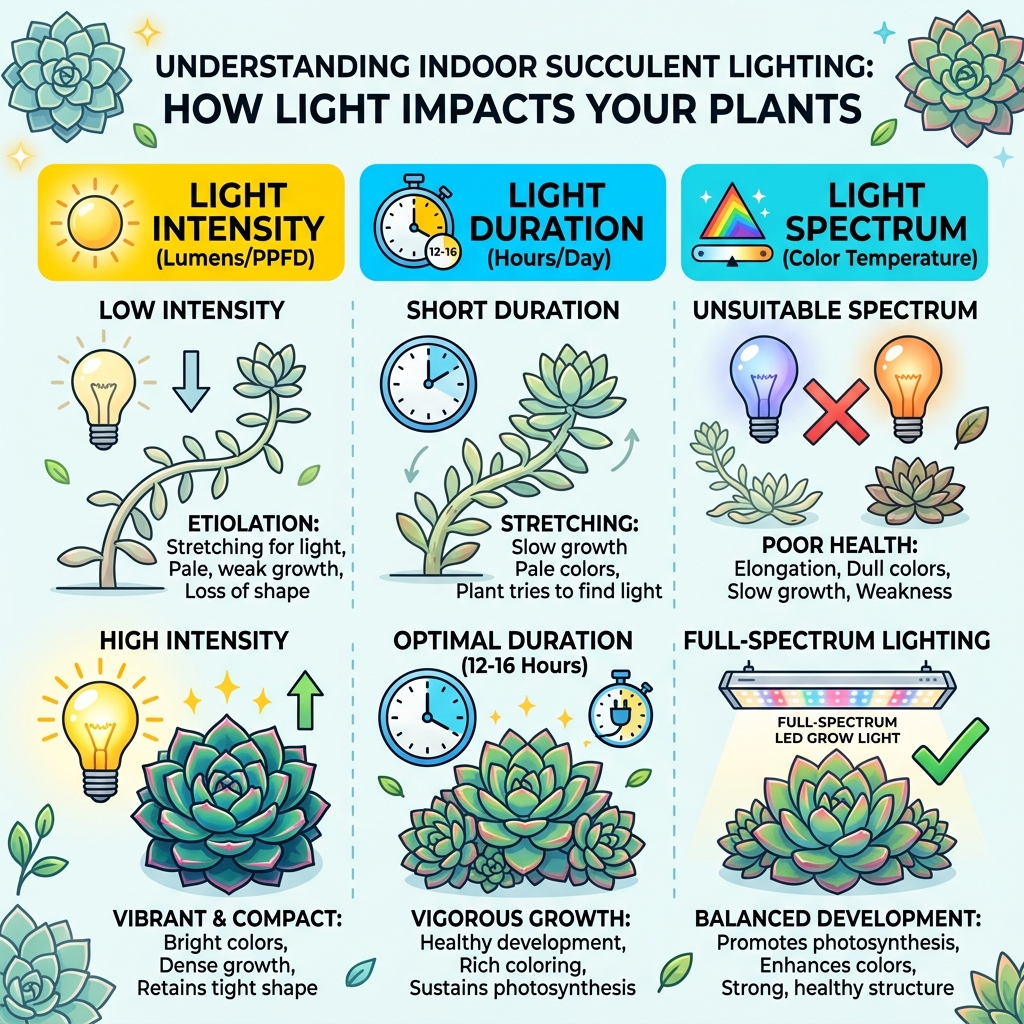
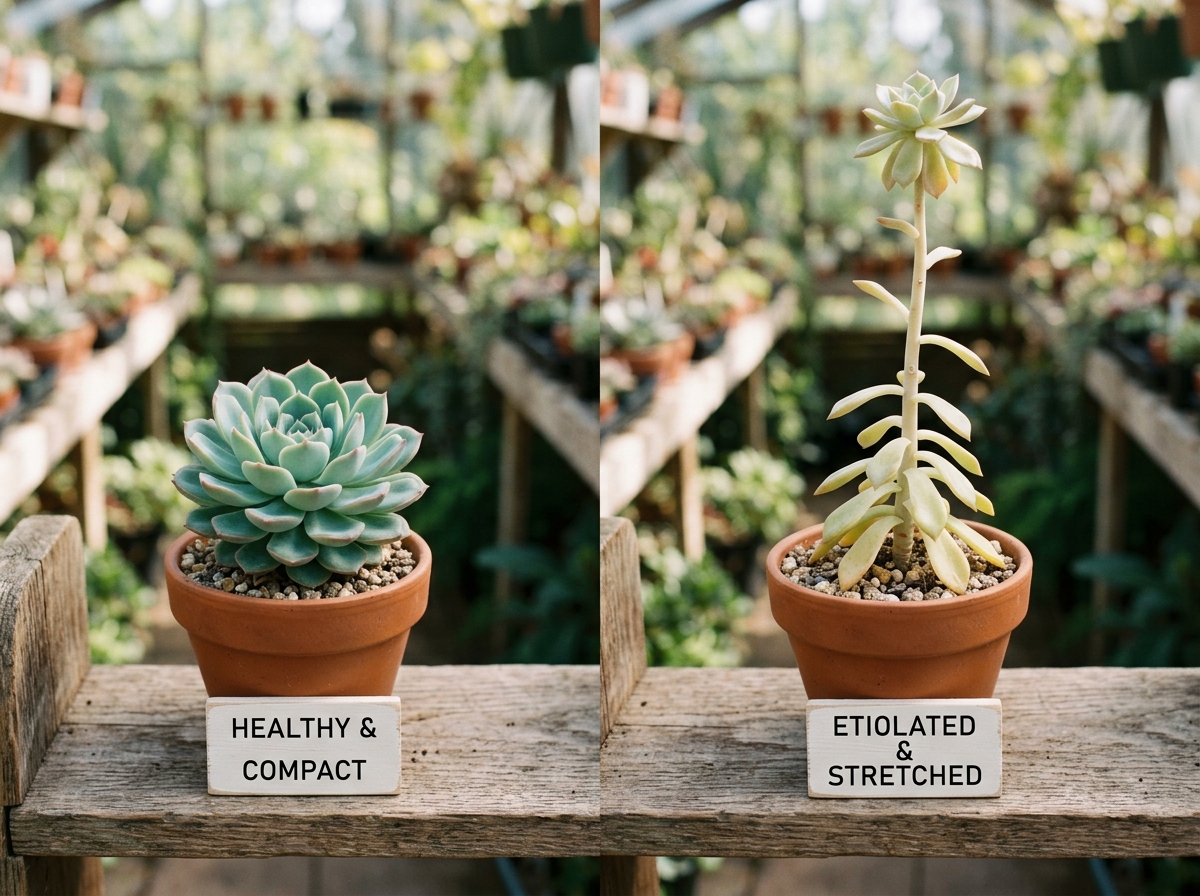
The result is a common problem: your succulent starts stretching toward the nearest light source, loses its rich color, and grows weak floppy stems. This is called etiolation — and once it happens, that distorted growth is permanent.
The good news is that a proper grow light fixes this fast. Two weeks under the right light can transform a struggling plant into something genuinely striking — no green thumb required.
Understanding Indoor Succulent Lighting Requirements
To truly master indoor succulent lighting, we first need to understand the biology of these sun-loving survivors. Most succulents utilize a specialized form of photosynthesis called CAM (Crassulacean Acid Metabolism). Unlike your average houseplant, they keep their pores (stomata) closed during the heat of the day to prevent water loss, opening them at night to collect CO2. However, they still require intense light during the day to process that stored energy.
In their native habitats, succulents are often bathed in up to 10,000 lumens per square foot at high noon. When we bring them inside, we are essentially trying to replicate the sun with a lightbulb. To keep a succulent thriving and compact, we should aim for a minimum of 2,000 lumens per square foot. If you provide anything less, the plant begins to panic, thinking it’s buried under debris or shaded by a larger neighbor.
For a deeper dive into why your current setup might be falling short, check out our guide to Rethink Your Indoor Plant Lighting: Succulent Edition.
Identifying Signs of Poor Indoor Succulent Lighting
We’ve all seen it: a beautiful, tight rosette of an Echeveria slowly begins to unravel. The center grows pale, the leaves point downward, and suddenly the plant is three inches taller but half as wide. This is etiolation. It’s the plant’s way of “doing yoga” to reach for the sun, but unfortunately, it’s not a healthy look.
Common signs that your indoor succulent lighting is insufficient include:
- Leaning: The plant grows at a sharp angle toward the window.
- Color Fading: Vibrant reds, purples, and oranges turn into a dull, uniform green as the plant produces more chlorophyll to capture what little light is available.
- Sparse Leaves: The distance between leaves on the stem (internodes) increases, making the plant look “leggy.”
If you notice these symptoms, it’s time to act. Learn more about how to bring indoor succulents to life with proper lighting before the stretching becomes irreversible.
Sunburn and Light Stress
On the flip side, can you have too much of a good thing? Absolutely. While succulents love light, they can get “sunburned” if they are moved from a dim corner to a high-intensity LED overnight.
Signs of light stress and sunburn include:
- Crispy Patches: White or brown calloused spots on the leaves that feel dry to the touch.
- Bleaching: Leaves turning a ghostly white or yellow.
- Stunted Growth: The plant stops growing entirely to protect itself from the heat.
To avoid this, we recommend a gradual acclimation process. Start your new lights a bit further away or run them for fewer hours, increasing the intensity over 1-2 weeks. It’s much easier to prevent a burn than to wait for a succulent to grow out of its scars!
Comparing the Best Grow Light Types for Succulents
Not all lightbulbs are created equal. When shopping for indoor succulent lighting, you’ll generally encounter three main technologies. Each has its own “personality” and price point.
| Feature | LED Grow Lights | Fluorescent T5 | HID (Metal Halide) |
|---|---|---|---|
| Efficiency | Excellent (40-70% less energy) | Moderate | Low |
| Heat Output | Very Low | Moderate | High |
| Lifespan | 50,000+ Hours | 10,000-20,000 Hours | 5,000-10,000 Hours |
| Spectrum | Full-Spectrum / Customizable | Fixed (usually 6500K) | Broad but hot |
| Best For | Everything | Seedlings / Small Shelves | Large Greenhouse Ops |
For a list of products that really shine, take a look at these grow lights that will make your succulents beam.
LED Grow Lights
LEDs are the gold standard for the modern indoor gardener. They convert nearly 90% of their energy into light rather than heat, which means you can keep them close to your plants without cooking them. They are incredibly cost-effective, often costing less than $1 per month to run for 12 hours a day.
Modern LEDs provide a “full-spectrum” white light that mimics natural sunlight. This is much better for your home aesthetic than the older “blurple” (pink/purple) lights that made your living room look like a sci-fi movie set. If you’re ready to upgrade, explore the top LED lights for your indoor succulent garden.
Fluorescent T5 Fixtures
Before LEDs took over, T5 fluorescent tubes were the kings of succulent care. They are still a fantastic, affordable option, especially for wide shelving units. A 2-foot HO (High Output) T5 bulb typically uses about 24 watts and provides 2,000 lumens, while a 4-foot version can pump out 5,000 lumens.
They are best kept at a color temperature of 6,500 Kelvins to provide that “cool daylight” feel that succulents crave. If you’re on a budget, learning how to choose the right light for your indoor succulents often leads to these reliable workhorses.
Technical Specifications for Optimal Growth
When you’re looking at the back of a grow light box, the terminology can feel like a physics exam. Let’s break down the specs that actually matter for your plants.
- PPFD (Photosynthetic Photon Flux Density): This measures how many “photons” of light actually hit your plant every second. For succulents, we want a PPFD of 200-400 μmol/m²/s for healthy growth. If you want those vibrant “stress colors” (the pinks and reds), you might even push toward 500 μmol/m²/s.
- Color Temperature: Measured in Kelvins (K). Aim for 5,000K to 6,500K. This mimics the bright, blue-heavy light of a clear midday sky, which keeps succulents compact.
- Lumens: While PPFD is more accurate for plants, lumens tell us how bright the light appears to humans. Aim for 2,000-4,000 lumens per square foot for a high-intensity setup.
For more technical tips, our illuminating ideas: indoor succulent lighting guide has you covered.
Choosing the Best Indoor Succulent Lighting Specs
When we select a light, we should prioritize efficiency over wattage. A 20-watt LED can often provide more usable light for a plant than a 100-watt traditional bulb. Look for lights labeled “Full Spectrum” or “Daylight.” These ensure your succulents get the blue wavelengths (for compact leaves) and red wavelengths (for potential blooming).
Check out these effective indoor succulent lighting ideas to see how these specs translate into real-world setups.
Variety-Specific Light Needs
Not all succulents are sun-worshippers to the same degree. We can generally categorize them into three groups:
- High-Light (The Sun-Seekers): Cacti, Echeveria, Agave, and Sedum. These need the highest intensity (1,500-2,000+ lumens/sq ft) and will etiolate the fastest if light is low.
- Medium-Light: Jade plants (Crassula), Aloe Vera, and some Senecio. They prefer bright light but can handle slightly less intensity.
- Low-Light Tolerant: Snake plants (Sansevieria), Haworthia, and ZZ plants. These are perfect for office desks or north-facing windows. They only need 300-800 lumens per square foot to stay healthy.
If you have a darker home, you might want to focus on the top succulent varieties for low light.
Setting Up Your Indoor Succulent Garden
Placement is everything. Because of the Inverse Square Law, light intensity drops off dramatically as you move the light further away. If you double the distance between the light and the plant, the plant receives only one-fourth of the light.
For most LED and T5 setups, we find the “sweet spot” is between 6 and 12 inches above the tops of the plants. If your succulents start turning red or brown (stress colors), move the light up an inch or two. If they start stretching, move it closer.
Need help deciding on a layout? See the best lighting options for indoor succulents for inspiration on shelving and desk setups.
Managing the Light Cycle
Plants, like people, need to sleep. Succulents require a period of darkness to complete their CAM photosynthesis cycle. We recommend running your indoor succulent lighting for 12 to 16 hours a day.
Consistency is key. We highly suggest using a digital timer. Setting your lights to turn on at 7 AM and off at 9 PM mimics a natural day-night cycle and takes the guesswork out of your morning routine. During the winter, you may want to increase the duration to 14-16 hours to compensate for the lack of natural sunlight from nearby windows.
Get more advice on scheduling in our guide on shining a light on indoor succulent care.
Using Grow Tents and Reflectors
If you have a large collection or live in a particularly dark climate, a grow tent is a game-changer. These tents are lined with reflective Mylar, which bounces light back onto the plants from all angles.
Benefits of a grow tent include:
- 20-30% Intensity Boost: No light is wasted on your walls or floor.
- Pest Control: A contained environment makes it harder for gnats or mealybugs to find your plants.
- Environmental Control: It’s easier to manage airflow with clip fans and maintain the ideal temperature (60-80°F).
Using a tent ensures indoor succulent success by creating a perfect microclimate where light is maximized.
Frequently Asked Questions about Indoor Succulent Lighting
Can I use regular household LED bulbs for my succulents?
This is a common question! The short answer is: yes, but with caveats. A standard 60W-equivalent LED bulb from the hardware store usually only provides about 800 lumens. To reach the 2,000-lumen threshold, you would need several bulbs very close to the plant. Furthermore, household bulbs often lack the specific red and blue wavelengths found in horticultural LEDs. While they are better than a dark corner, they aren’t a long-term solution for high-light plants like Echeveria.
For a deeper comparison, read about understanding light preferences for indoor succulents.
How many hours of grow light do succulents need daily?
As we mentioned, 12-14 hours is the “sweet spot” for most collections. If you are trying to “overwinter” plants (just keeping them alive until spring), 10-12 hours may suffice. However, if you want active growth and bright colors, aim for 14-16 hours. Just remember never to leave the lights on 24/7; your plants will eventually become stressed and exhausted without a dark period.
You can boost your indoor succulent growth with the right light duration by adjusting based on the season.
How far should the grow light be from my plants?
Generally, 6-12 inches is ideal for most LEDs. A great way to check is the “hand test.” Place your hand at the level of the plant’s leaves. If the light feels uncomfortably warm on your skin after 30 seconds, it’s too close and might burn the plant. If you can barely feel any warmth, you might be able to move it closer.
For more placement hacks, check out revamp your indoor garden: lighting tips for succulents.
Conclusion
At FinanceBoostX, we believe that every indoor gardener deserves a thriving, colorful oasis. Mastering indoor succulent lighting is the most rewarding step you can take in your plant parent journey. By choosing the right spectrum, maintaining a consistent 12-16 hour cycle, and keeping your lights at the proper distance, you’ll see your succulents transform from “surviving” to “thriving.”
Lighting is just one piece of the puzzle. Pair your new lights with well-draining soil, a “soak and dry” watering routine, and good airflow to prevent pests. If you’re ready to build the ultimate indoor garden, explore more indoor setup solutions and start your collection’s glow-up today!
