
Why Indoor Succulent Lovers Are Turning to Light Bars
Succulent collection light bars are the single most effective upgrade for growing healthy, compact, colorful succulents indoors — especially in vertical or shelf setups.
Here are the best options based on your setup:
| Setup Type | Best Light Bar Style | Key Feature |
|---|---|---|
| Small desk or terrarium | Slim magnetic bar (e.g., 11-16″) | Touch dimming, warm white light |
| Medium shelf collection | Linkable LED strips | Daisy-chain expansion, IP65 rated |
| Large vertical garden | High-output bar (80W-100W) | High PPF, dimmable driver |
| Aesthetic home decor | Flush-mount or bamboo-framed | App control, natural white light |
Picture this: you bring home a tight, rose-shaped Echeveria. A few weeks later, it looks like a spindly green beanstalk. That’s etiolation — and it’s one of the most common problems for indoor succulent growers.
The cause is almost always the same. Indoor windows provide only a fraction of the light intensity succulents get in their native desert habitats. Even a bright south-facing window rarely delivers the 6 to 12 hours of high-intensity light these plants need every day.
That’s exactly where light bars come in. A well-chosen LED bar mounted to a shelf or vertical rack can:
- Prevent stretching and keep rosettes tight
- Trigger beautiful stress colors like pink, red, and purple
- Support propagation and seedling growth
- Cover an entire collection evenly — not just the plants closest to the window
The good news? The market has exploded with options for every budget and aesthetic — from sleek magnetic bars that blend into your shelving to high-output horticultural units for serious growers.
This guide cuts through the noise and shows you exactly which light bars work best for different vertical succulent setups.
Why Your Indoor Succulent Collection Needs Light Bars
To understand why we need succulent collection light bars, we have to look at how these plants function. Most succulents are native to arid, high-sunlight environments. Indoors, even the “brightest” window often fails because glass filters out significant portions of the light spectrum.
Photosynthesis and CAM Metabolism
Succulents are unique because many of them utilize Crassulacean Acid Metabolism (CAM). Unlike most plants that breathe during the day, CAM plants keep their pores (stomata) closed during the heat of the day to prevent water loss. They only open them at night to take in carbon dioxide.
Because of this specialized cycle, succulents need 8-10 hours of darkness every night to complete their metabolic processes. If you leave your succulent collection light bars on 24/7, you actually prevent the plant from “exhaling” and resting, which can lead to stunted growth. According to our research, providing 12–14 hours of light followed by a dedicated dark period is the “sweet spot” for indoor health. You can learn more about this in our guide on how to bring-indoor-succulents-to-life-with-proper-lighting.
The Magic of Stress Colors
One of the main reasons we love succulents is their vibrant hues. Those pinks, reds, and deep purples aren’t actually their “normal” color; they are “stress colors.” High-intensity light triggers the production of anthocyanins, which act like a sunscreen for the plant. Without the intense output of a quality light bar, your Echeveria or Sedum will likely revert to a plain, dull green.
Preventing Etiolation
When a succulent doesn’t get enough light, it enters survival mode. It begins to stretch its stem rapidly to reach for the nearest light source. This results in wide gaps between leaves and a weak, spindly structure. Once a plant has etiolated, it cannot “shrink” back. The only fix is to behead the plant and start over. Using succulent collection light bars ensures that the light is delivered directly from above, mimicking the overhead desert sun and keeping those rosettes tight and compact.
Choosing the Best Succulent Collection Light Bars
When we go shopping for light bars, it’s easy to get overwhelmed by technical jargon. Here is a breakdown of what actually matters for your plants.
Full-Spectrum and Color Temperature
We recommend looking for “full-spectrum” lights. This means the light contains a balance of wavelengths that mimic natural sunlight.
- Blue light is essential for vegetative growth and keeping plants compact.
- Red light encourages flowering and root development.
For succulents, a color temperature between 3,000K and 6,000K is ideal. Lights in the 5,000K–6,000K range provide a crisp, daylight feel that is excellent for growth, while 3,000K offers a warmer glow that is often more pleasant in living areas.
Lumens, PPF, and Efficacy
- Lumens: For succulents, aim for 300 to 800 lumens per square foot of shelf space.
- PPF (Photosynthetic Photon Flux): This measures how much “plant-usable” light the bar puts out per second. High-end bars might produce around 295 µmol/s.
- Efficacy: This tells us how efficiently the light converts electricity into plant energy. Modern LEDs often reach an efficacy of up to 2.9 µmol/J, which means more light for less money on your power bill.
To dive deeper into these specs, check out our article on how-to-choose-the-right-light-for-your-indoor-succulents.
Durability and Features
Since we often mist our plants or use “soak and dry” watering methods, an IP65 waterproofing rating is a huge plus. This protects the LEDs from dust and water splashes. Additionally, look for bars with aluminum bodies for efficient heat dissipation; LEDs stay cool to the touch, but they still need to vent heat away from the diodes to last their full 50,000 to 60,000-hour lifespan.
Aesthetic Succulent Collection Light Bars for Home Decor
If your succulent collection is in your living room or kitchen, you probably don’t want it looking like a high-tech laboratory.
- Sleek Designs: Many modern bars are incredibly slim (less than an inch thick), making them invisible when mounted under a shelf.
- Magnetic Mounting: This is a game-changer for metal shelving units. You can simply “snap” the bar into place and move it as your plants grow.
- Bamboo and Furniture Quality: Some options, like the 3-Tier Bamboo Stand with LED Grow Lights for Succulents and Seeds | Gardener’s Supply., use sustainable materials to create a piece of furniture that happens to be a powerhouse for plants.
- Flush-Mount Fixtures: These are designed to sit flat against the underside of a cabinet, providing a clean, “built-in” look. The Smart Growbar | Full-Spectrum LED Grow Light | Sleek Flush-Mount Metal Fixture | Modern Sprout is a perfect example of this aesthetic approach.
High-Intensity Succulent Collection Light Bars for Large Shelving
If you have a massive vertical garden or a dedicated grow room, you need power and scalability.
- Daisy-Chaining: This allows you to link multiple bars together (sometimes up to 16 units) using a single power outlet. This prevents a “spiderweb” of cords behind your shelves.
- Powerful Drivers: For deep shelves, a 100W driver ensures the light reaches even the plants in the back corners. Products like the 100W Full-Spectrum Supplemental LED Light Bar – PHOTONTEK offer high-intensity output that matches the quality of professional greenhouse fixtures.
- Linkable Lamps: The Spider Farmer® Glow80 80W LED Grow Light Bars are designed specifically for this, offering waterproof, linkable bars that provide even coverage across long shelves.
Optimizing Growth and Maintenance
Once you have your succulent collection light bars installed, the real work begins. Placement and timing are everything.
The Distance and Duration Table
Different succulents have different tolerances. Use this table as a starting point:
| Succulent Type | Light Distance | Daily Duration | Signs of Success |
|---|---|---|---|
| High Light (Echeveria, Sedum, Cacti) | 6–8 inches | 12–14 hours | Deep stress colors, tight rosettes |
| Medium Light (Aloe, Jade, Gasteria) | 8–12 inches | 10–12 hours | Steady growth, vibrant green/mottled patterns |
| Low Light (Haworthia, Sansevieria) | 12–18 inches | 8–10 hours | Dark green leaves, no “bleaching” |
As we discuss in our guide on shining-a-light-on-indoor-succulent-care, it is always better to start with the light further away and move it closer over a week to “acclimatize” your plants.
Propagation and Seedling Care
Light bars are a secret weapon for propagation. Leaf cuttings and tiny seedlings don’t need the scorching intensity of a 100W bar, but they do need consistency.
- Leaf Cuttings: Place them at the edges of your light bar’s coverage where the intensity is slightly lower. This encourages root growth without drying out the mother leaf too quickly.
- Seedlings: Use a dimmable light bar or place them at least 12 inches away initially. As they develop their first set of “true” leaves, you can gradually increase the intensity.
Impact on Watering and Airflow
Adding high-intensity succulent collection light bars will change your care routine.
- Watering: More light equals faster photosynthesis, which means the plant will drink more water. You will likely find your soil drying out faster than it did on a windowsill. Always stick to the “soak and dry” method—only water when the soil is bone dry.
- Airflow: Even though LEDs are cool, a large collection of them can slightly raise the temperature around your shelves. We recommend adding a small clip-on fan to your vertical garden to ensure fresh air reaches the center of the rosettes, preventing rot.
Troubleshooting: Signs of Light Stress
Even with the best succulent collection light bars, things can go wrong. Your plants will tell you exactly what they need if you know what to look for.
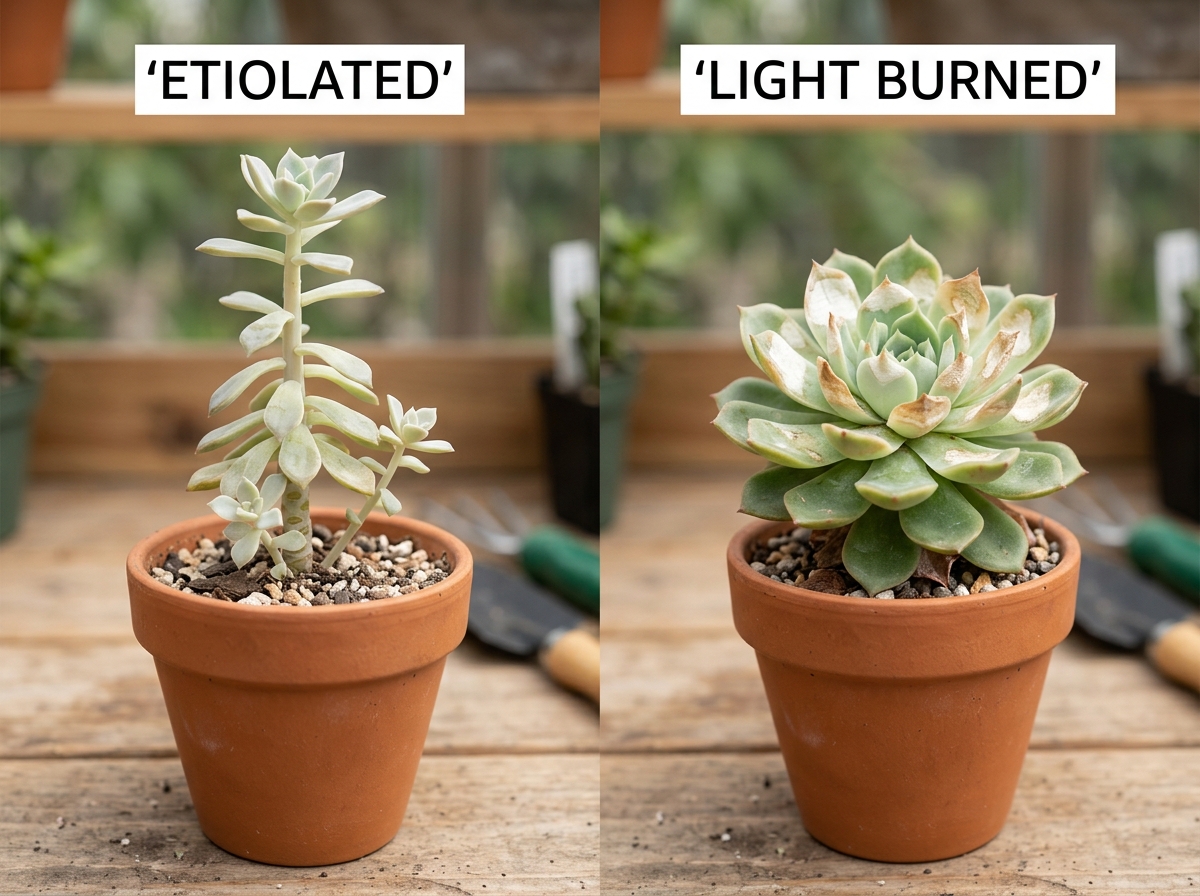
Too Much Light (Light Burn)
If your light bar is too close, you might see “sunburn.”
- Symptoms: Bleached white patches, crispy tan spots, or leaves that look “faded.”
- The Fix: Move the light bar 3–5 inches further away or reduce the daily “on” time by 2 hours. You can read more about recovery in our post on how to boost-your-indoor-succulent-growth-with-the-right-light.
Too Little Light (Etiolation)
This is the most common issue in indoor gardening.
- Symptoms: Downward-pointing leaves (trying to increase surface area), pale green centers, and “stretching” between leaf nodes.
- The Fix: Move the light bar closer (aim for the 6-inch mark) or increase the duration to 14 hours. If the plant is already very stretched, it’s time for a “haircut”—cut the top off, let it callous, and replant it closer to the light.
Using Timers for Consistency
We cannot stress this enough: consistency is key. Succulents thrive on routine. If you turn the lights on at 8 AM one day and 11 AM the next, the plant’s metabolic cycle gets confused. Most modern light bars, like the Smart Growbar | Full-Spectrum LED Grow Light | Sleek Flush-Mount Metal Fixture | Modern Sprout, come with app-controlled timers. If yours doesn’t, a simple $10 outlet timer from the hardware store will do the trick.
Frequently Asked Questions about Succulent Lighting
How far should a light bar be from my succulents?
For most standard LED succulent collection light bars, the sweet spot is 6 to 12 inches from the top of the plants. If you have very light-hungry species like Echeveria, stay closer to the 6-inch mark. If you notice the leaves turning pale or developing tan spots, move the light back to 10 or 12 inches.
Can I leave my grow lights on 24/7?
No. As we mentioned earlier, succulents use CAM photosynthesis. They need a “rest” period of 8–10 hours of total darkness to process the energy they collected during the day. If you leave the lights on 24/7, the plant will eventually become stressed, stop growing, and may even die.
Do light bars work for succulent propagation?
Absolutely. In fact, they are often better than windowsills because they provide a stable, non-fluctuating environment. For leaf propagation, keep the lights about 12 inches away to prevent the delicate new roots from drying out. Once the “pup” is established, you can move it closer to the main light source.
Conclusion
Building a thriving indoor succulent collection is all about recreating the desert sun in a way that fits your home. Whether you choose a high-output horticultural bar for a massive vertical rack or a sleek, app-controlled flush mount for your bookshelves, the right succulent collection light bars will transform your plants from “surviving” to “thriving.”
At FinanceBoostX, we believe that sustainable, beautiful indoor gardening should be accessible to everyone. By investing in quality lighting, you aren’t just buying a gadget—you’re ensuring the long-term health and vibrant color of your plant family.
Ready to take your indoor garden to the next level? Explore more indoor setup guides to find the perfect shelving and accessories for your collection.
