
The Best Grow Lights for Indoor Succulents at a Glance
Grow light for succulents is one of the smartest investments you can make if you want healthy, compact, colorful plants indoors — especially if your home doesn’t get much direct sun.
Here are the top options to know about:
| Grow Light Type | Best For | Lumens | Approx. Cost |
|---|---|---|---|
| LED shop light (4-ft) | Large collections, shelves | 3,200+ per fixture | $17–$30 |
| Full-spectrum LED bulb | Small setups, desk lamps | 1,600+ | $26–$45 |
| T5 HO fluorescent (4-ft) | Serious growers, efficiency | 5,000 per bulb | $30–$60 |
| LED panel | Big collections, high output | 14,000 | $70–$80 |
| Clip-on LED grow light | Beginners, single plants | 500–1,600 | $15–$55 |
| Designer/tabletop LED | Style-focused setups | 2,000 | $150–$230 |
Quick setup rules:
- Place lights 6–12 inches above your plants
- Run them 12–18 hours per day
- Choose a color temperature of 5,000K–6,500K
- Aim for at least 2,000 lumens per square foot
Most succulents are desert plants. They evolved under intense, direct sunlight — often receiving the equivalent of 10,000 lumens per square foot at midday. Your windowsill simply can’t compete with that.
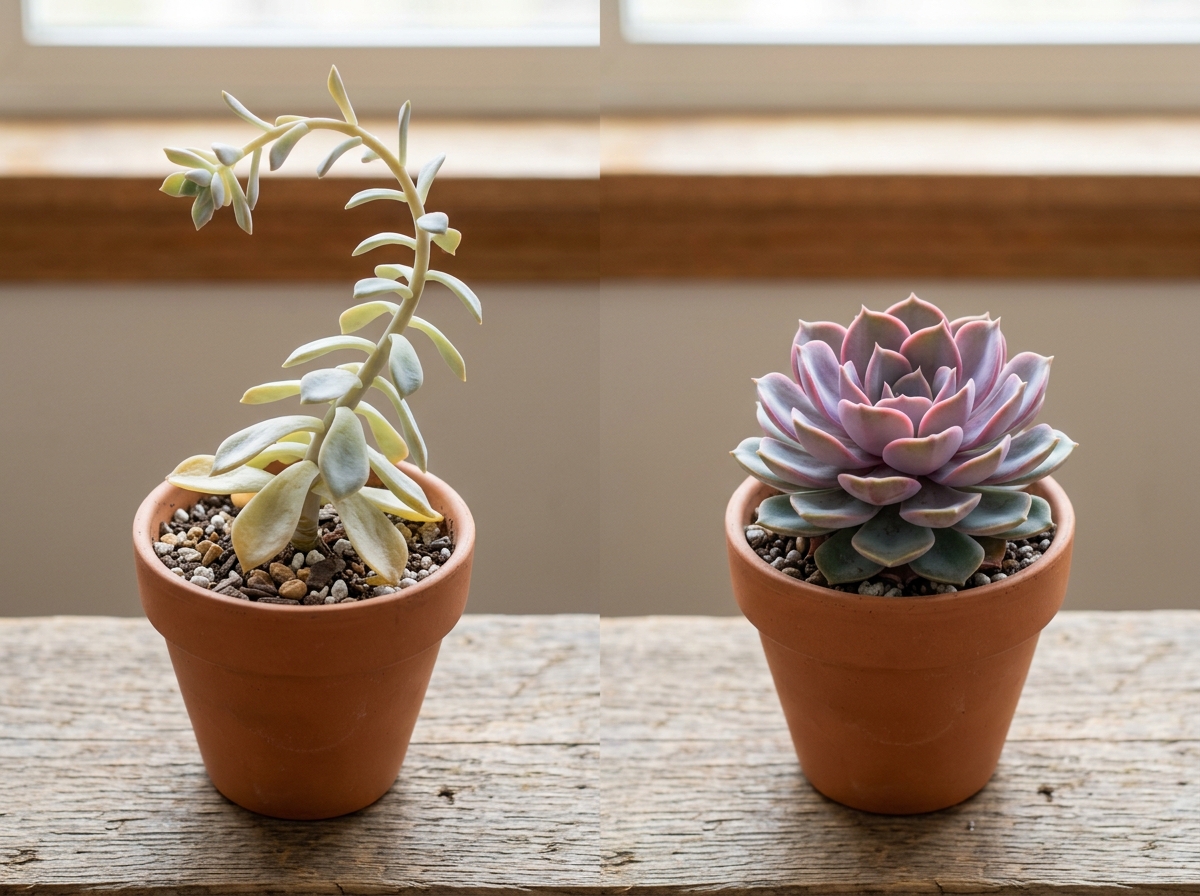
Without enough light, succulents do something called etiolation — they stretch upward, reaching desperately for more light. Rosette types like Echeveria lose their tight, sculptural shape. Colors fade. The plant looks leggy and sad instead of the bold, architectural accent you wanted.
The good news? A well-chosen grow light fixes this completely. You don’t need an expensive setup or a green thumb — just the right light, the right distance, and a simple timer.
This roundup covers the best grow lights for succulents available right now, so you can pick the one that fits your space, budget, and style.

Why You Need a Grow Light for Succulents
If you’ve ever noticed your beautiful, tight Echeveria rosette suddenly looking like a miniature pine tree, you’ve witnessed etiolation. This is the scientific term for spindly, weak growth caused by a lack of light. When succulents don’t get enough “food” from the sun, they stretch their stems to find a light source, often losing their vibrant pinks, purples, and reds in favor of a dull, washed-out green.
To thrive, these plants need to perform photosynthesis efficiently. This requires specific wavelengths of light. While we might think a bright room is enough, glass windows filter out much of the usable energy plants need. By using a grow light for succulents, we can bring indoor succulents to life with proper lighting by providing the full spectrum they crave.
Succulents specifically benefit from a combination of red and blue light. Blue light is the “builder,” helping with chlorophyll synthesis and keeping the plant compact and sturdy. Red light is the “energizer,” promoting flowering and healthy root development. When you provide these via a high-quality light source, you aren’t just keeping the plant alive; you are maintaining its color retention and structural integrity.
Technical Specs: Lumens, Kelvin, and Spectrum
Choosing a grow light for succulents can feel like a physics lesson, but we can break it down into three simple numbers: Lumens, Kelvin, and Spectrum.
- Lumens: This measures visible light. While humans see brightness, succulents need intensity. For indoor success, we recommend at least 2,000 lumens per square foot. In contrast, a sunny day at noon provides about 10,000 lumens.
- Kelvin (Color Temperature): This tells you the “color” of the light. For succulents, the sweet spot is 5,000K to 6,500K. This range mimics natural daylight and provides the crisp, white light that keeps plants from stretching.
- Spectrum: “Full spectrum” is the gold standard. It includes all colors of the rainbow, ensuring your plants get the blue and red wavelengths necessary for every stage of growth.
| Light Type | Energy Efficiency | Heat Emission | Best Use Case |
|---|---|---|---|
| LED | Excellent | Very Low | Year-round, multi-shelf setups |
| Fluorescent (T5) | Good | Moderate | Large seedling trays, wintering |
| HID | Poor | Very High | Commercial greenhouses (not for homes) |
Modern LED technology has revolutionized indoor gardening. LEDs offer superior energy efficiency and excellent heat dissipation, meaning you can place them closer to your plants without the risk of “cooking” those delicate leaves.
Choosing the Right Grow Light for Succulents: LED vs. Fluorescent
For years, T5 HO (High Output) fluorescent bulbs were the industry standard. They are reliable and provide a great balance of lumens and wattage. A 4-foot T5 bulb typically puts out about 5,000 lumens at 54 watts. They are fantastic for large collections because they distribute light evenly over a wide area.
However, many hobbyists are switching to top LED lights for your indoor succulent garden because they last longer and use significantly less electricity. For example, a standard 4-foot LED shop light can produce 3,200 lumens while using only a fraction of the power of an old-school bulb.
Can you use a regular household bulb? Technically, yes—if it is a “daylight” LED bulb (6500K) with a high lumen count. However, specialized grow lamps are often designed with better lenses to direct light downward toward the plant canopy rather than scattering it around the room.
Top-Rated Grow Light for Succulents: Product Recommendations
When it comes to picking the actual hardware, your choice depends on the size of your “plant family.”
High-Quality LED Grow Bulbs If you only have a few plants on a desk, a high-intensity LED bulb like the Sansi 15W or 36W is a game-changer. These fit into standard lamp sockets and provide a powerful 1,600+ lumens. They are perfect for localized “spotlighting” of your favorite specimens.
Efficient LED Panel Lights For those with a dedicated plant shelf, LED panels (like those from Durolux) are the heavy hitters. These can pump out a staggering 14,000 lumens, covering up to 8 square feet. They are thin, lightweight, and can be hung directly from wire shelving.
Designer Grow Lights If your plants are part of your home decor, you might want something more stylish. Options like the Soltech Aspect or The Sill’s Versa Tabletop Light offer a sleek, “gallery” look while still providing the 2,000 lumens needed for healthy growth. These are excellent for living rooms where a purple “blurple” light would be an eyesore.
Clip-On and Flexible Options For ultimate versatility, Growsun Plant Grow Lights offer 360-degree goosenecks and built-in timers. These are ideal for awkwardly shaped spaces or for plants at different heights. Similarly, the SANSI 5W LED Succulent House Lamps come in convenient multi-packs for small pots.
Full-Spectrum Bar and Hanging Lights If you are looking for professional coverage, a 4ft Indoor Succulent Grow Light or a Full Spectrum 20W Hanging Light ensures that even the lower leaves of your plants receive adequate illumination. This prevents the “top-heavy” look where only the top of the plant looks healthy while the bottom leaves shrivel and drop.
How to Set Up Your Indoor Lighting System
Setting up your grow light for succulents is about more than just plugging it in. You need to create an ecosystem.
- Shelving and Arrangement: Group your plants by height. Taller plants should be at the ends of the light bar, while shorter ones (or those that need the most light, like Echeverias) should be directly under the center of the light.
- Digital Timers: Consistency is key. We recommend using a digital timer or a smart plug to ensure your lights are on for the same window every day. Most succulents thrive on a 12 to 14-hour “day.”
- Airflow and Temperature: Lights generate a small amount of heat. Using a small clip fan helps circulate air, which prevents pests like mealybugs and mimics the breezy conditions of their natural habitat.
- Acclimation: Don’t blast a new plant with 14 hours of max-intensity light on day one. Start with 4-6 hours and gradually increase the duration over two weeks to prevent leaf scorch.
- Watering Adjustments: When you shining a light on indoor succulent care, more light often means the plant will dry out faster. Check the soil every week; if it’s bone dry, it’s time for a soak.
Optimizing Your Grow Light for Succulents: Distance and Duration
The most common mistake we see is hanging the light too high. Light intensity drops off significantly as you move the bulb away.
- Distance: For most LED and T5 lights, aim for 6 to 12 inches from the top of the plant. If you notice the leaves turning brown or getting “crispy” spots, move the light back. If the plant starts leaning or stretching, move it closer.
- Duration: Aim for 12–18 hours daily. Since artificial light is less intense than the sun, we have to leave it on longer to provide the plant with the same total “Daily Light Integral” (DLI).
- Dormancy: During winter, you can slightly reduce the “daylight” to 10 or 12 hours to allow the plant a rest period, though many indoor growers keep the same cycle year-round with great success.
For more effective indoor succulent lighting ideas, consider using reflective Mylar or white shelving to bounce “wasted” light back onto the sides of your plants.
Frequently Asked Questions about Succulent Lighting
Can I use regular LED shop lights for succulents?
Yes! This is one of the best-kept secrets in the hobby. Many grow lights that will make your succulents beam are actually just high-quality shop lights. The trick is to look for “Daylight” spectrum bulbs (usually labeled 6500K) and a high lumen output (at least 3,000 lumens for a 4-foot fixture). They are incredibly cost-effective, often costing less than $20 per fixture.
How do I fix a succulent that has already stretched?
Unfortunately, you cannot “un-stretch” a succulent. Once the stem has elongated, it stays that way. However, you can rethink your indoor plant lighting succulent edition and perform a “beheading.” You simply cut the healthy top rosette off, let it callous for a few days, and replant it in fresh soil. It will grow new roots and stay compact under your new grow lights. You can even leave the bare stem in the pot; it will often sprout tiny “pups” along the sides!
Do all succulents need the same amount of light?
Not at all. This is where knowing your species helps.
- High Light: Echeveria, Sedum, and most “colorful” cacti. These will stretch almost immediately without a strong grow light for succulents.
- Low Light: Haworthia, Gasteria, and Sansevieria (Snake Plants). These are the top succulent varieties for low light and can actually get “sunburned” if placed too close to a high-powered LED. If your Haworthia turns dark brown or red, it’s likely “sun-stressed” and might prefer the edge of your lighting setup rather than the center.
Conclusion
At FinanceBoostX, we believe that indoor gardening shouldn’t be a struggle. By choosing the right grow light for succulents, you can transform a dim corner into a thriving desert oasis. Whether you opt for a budget-friendly shop light or a high-end designer fixture, the key is consistency: provide enough lumens, keep the color temperature in the daylight range, and maintain a steady daily schedule.
With the right setup, your succulents will reward you with compact growth, vibrant stress colors, and perhaps even a few indoor blooms. For more tips on building the perfect environment for your plants, check out our more info about indoor succulent setups. Happy growing!
