
Why Light Is the Make-or-Break Factor for Indoor Succulents
Light for succulents indoors is the single most important factor in keeping these plants healthy, compact, and vibrant. Most succulents need 6 to 10+ hours of bright light daily — far more than a typical indoor space naturally provides.
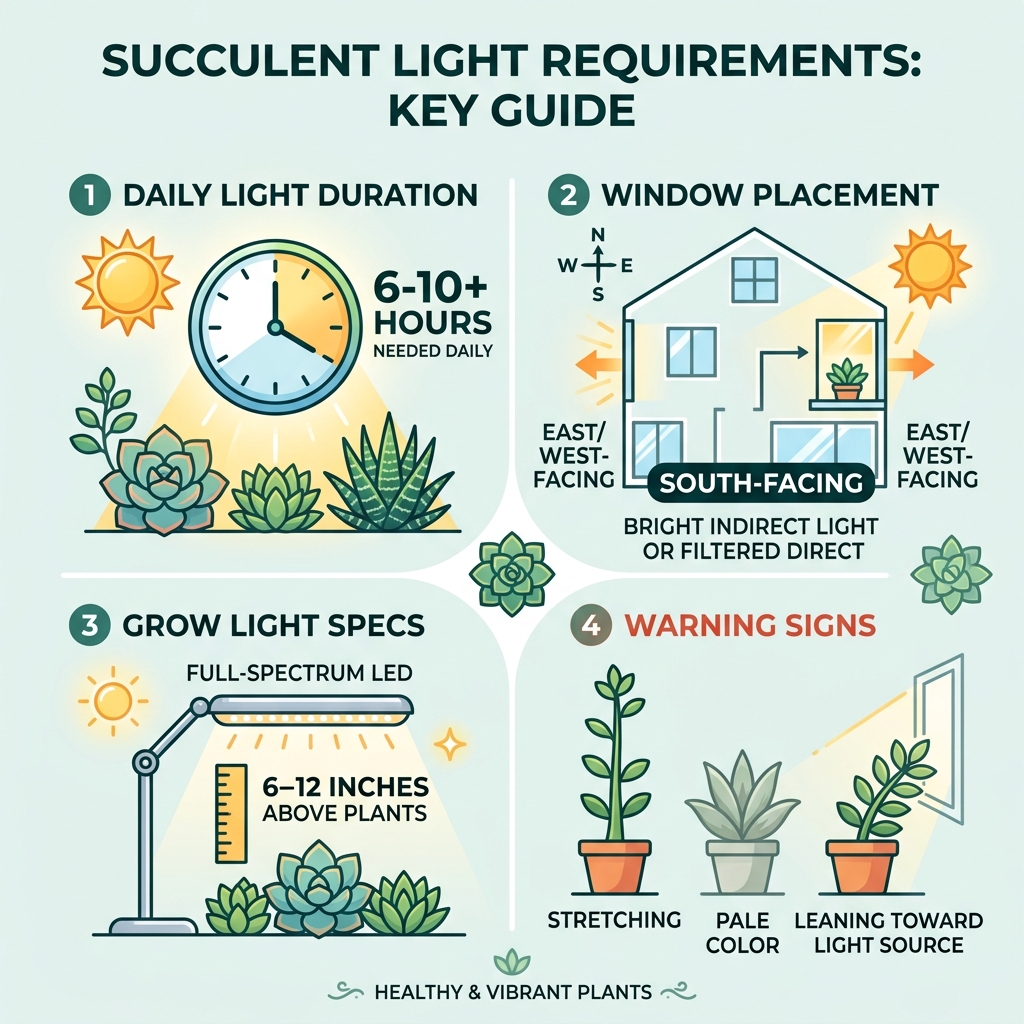
Here’s a quick summary of what your succulents need:
| Light Factor | What Succulents Need |
|---|---|
| Daily duration | 6-10+ hours of bright light |
| Light type | Bright indirect light (or filtered direct) |
| Best window | South-facing |
| Grow light alternative | Full-spectrum LED, 6-12 inches above plants |
| Signs of too little light | Stretching, pale color, leaning toward light source |
You’ve probably seen it happen: a tight, rose-shaped succulent comes home looking perfect, then slowly turns into a tall, spindly stem over a few weeks. That’s not bad luck — it’s a light problem.
Succulents evolved in open, sunny desert environments. Indoors, even a bright room delivers only a fraction of that intensity. Glass windows filter out key wavelengths and can cut outdoor light intensity by roughly half.
The good news? Whether you’re relying on natural sunlight or adding a grow light, a few simple adjustments can make a big difference — and won’t add much to your weekly routine.
Understanding the Importance of Light for Succulents Indoors
To truly master light for succulents indoors, we have to understand how these plants “eat.” Unlike us, succulents use photosynthesis to turn light into energy. Many species have also developed a specialized process called Crassulacean Acid Metabolism (CAM). This allows them to keep their pores closed during the heat of the day to save water and open them at night to breathe. This desert-born efficiency means they are absolute light-gluttons.

When we don’t provide enough light, the plant enters a state called etiolation. You might know it as “legginess.” The plant stops producing as much chlorophyll in its lower sections and starts stretching its stem rapidly, searching for a sunnier spot. This isn’t just an aesthetic issue; etiolated plants have weaker cell structures and are more prone to pests and snapping.
Beyond just staying compact, light is responsible for those gorgeous “stress colors” we love. When succulents receive high-intensity light, they produce protective pigments called anthocyanins. These turn the leaves shades of pink, red, purple, or blue. Without sufficient light, these colors fade back to a dull, pale green. If you want to dive deeper into the science, you can read more about indoor-succulent-success-the-role-of-light. Proper lighting also fuels nutrient absorption, ensuring the plant can actually use the minerals in its soil to grow strong roots.
Maximizing Natural Sunlight in Your Home
If we want to rely on the sun, we have to be strategic. Not all windows are created equal. In the Northern Hemisphere, a south-facing window is the “gold standard” because it receives the most consistent, intense light throughout the day.
However, even a sunny window has its limits. Glass acts as a filter, often blocking out 50% of the light intensity found just outside. It also filters out certain UV wavelengths that succulents use to trigger those vibrant colors.
Window Orientation Comparison Table
| Window Facing | Light Quality | Best For |
|---|---|---|
| South | High intensity, direct sun | Cacti, Echeveria, Sedum |
| West | Intense afternoon heat/light | Agave, Kalanchoe |
| East | Gentle morning light | Haworthia, Gasteria, Aloe |
| North | Low intensity, indirect | Not recommended without grow lights |
Seasonal shifts also play a role. In the winter, the sun sits lower in the sky and the days are shorter. We might find that a spot that worked in July is a dark cave by December. During these times, heat management is also key; a succulent pressed against a freezing windowpane can suffer cold damage, even if the light is bright.
Optimizing Natural Light for Succulents Indoors
To make the most of what the sun gives us, we recommend a few “pro moves”:
- The Rotation Rule: Succulents naturally lean toward their light source. To prevent a lopsided plant, give the pot a quarter-turn every time you water.
- The Shadow Test: If you place your hand between the plant and the window and it doesn’t cast a clear, sharp shadow, the light is likely too weak for sun-loving species.
- Proximity Matters: Light intensity drops off significantly just a few feet away from a window. Keep your “sun-worshippers” within 12 inches of the glass for the best results.
For more tips on placement, check out how to bring-indoor-succulents-to-life-with-proper-lighting. “Bright indirect light” means the plant is in a very bright room but the sun’s rays aren’t hitting the leaves directly (which can cause sunburn through glass).
Choosing the Best Light for Succulents Indoors
Sometimes, the sun just isn’t enough—especially if you live in a rainy climate or have a “window-challenged” apartment. This is where supplemental light for succulents indoors becomes a game-changer.
When shopping for grow lights, ignore the “blurple” (pink/purple) lights if you want your home to look like a home and not a secret laboratory. Instead, look for full-spectrum LED lights. These mimic the 6000K-6500K color temperature of natural daylight and provide all the wavelengths needed for both growth and flowering.
Key specs to look for:
- Lumens: This measures brightness. For succulents, aim for at least 2,000 to 4,000 lumens per square foot of growing space.
- Kelvin (K): This is the “color” of the light. 5,000K to 6,500K is ideal for mimicking the sun.
- CRI (Color Rendering Index): A CRI of 90 or higher will make your plants’ colors pop naturally.
- Wattage: Modern LEDs are highly efficient. A 15W to 25W LED can often outperform an old 100W fluorescent bulb.
You can find our curated list of top-led-lights-for-your-indoor-succulent-garden to help narrow down your choices.
Setting Up Supplemental Light for Succulents Indoors
Once you have your light, the setup is critical. You can’t just hang it from the ceiling and expect results.
- PPFD & PAR: These technical terms refer to the actual amount of “food” (light particles) hitting the leaves. Succulents generally need a PPFD of 200–400 μmol/s/m² for steady growth.
- Hanging Height: Most LED grow lights should be positioned 6 to 12 inches above the tops of the succulents. If the light is too far away, they will still stretch. If it’s too close, you might see “bleaching” or light burn.
- Light Cycles: Succulents are not fans of the 24/7 party. Because of their CAM metabolism, they must have a period of darkness (8–10 hours) to complete their respiratory cycle. We recommend using an automatic timer set for 12 to 14 hours of light per day.
Integrating Lighting with Your Care Routine
Light doesn’t exist in a vacuum. It interacts directly with how you water and feed your plants. When you increase the light for succulents indoors, you are essentially “speeding up” the plant’s engine.
- Watering Frequency: More light means more evaporation and faster photosynthesis. You will likely need to water more often under grow lights than you would in a dim corner. Always follow the “soak and dry” method—wait for the soil to be bone-dry before drenching it.
- Soil and Drainage: High light levels demand excellent drainage. If the soil stays soggy while the plant is working hard under lights, you’re inviting root rot. Ensure your mix is at least 50% mineral (perlite, pumice, or grit).
- Airflow: Grow lights, even LEDs, can generate a small amount of heat. A small clip-on fan can prevent stagnant air, which keeps pests like mealybugs at bay.
- Fertilizer: Think of light as the meal and fertilizer as the multivitamin. During the active growing season (spring and summer), use a diluted succulent-specific fertilizer once a month. To see how these factors work together, check out how to boost-your-indoor-succulent-growth-with-the-right-light.
Frequently Asked Questions about Indoor Succulent Lighting
How many hours of light do succulents need daily?
Most succulents thrive with 10 to 14 hours of bright light when using artificial sources. If relying purely on natural sun, aim for at least 6 hours of the brightest light possible. Cacti and Echeverias typically sit at the higher end of that scale, while Haworthias can get by on the lower end.
Can I leave grow lights on 24/7?
No! This is a common mistake. Succulents need a “rest” period of 8 to 10 hours of darkness to perform CAM photosynthesis. Leaving lights on 24/7 can stress the plant, lead to stunted growth, and eventually cause the plant to fail because it cannot properly exchange gases.
What are the signs of light burn on succulent leaves?
Light burn (or sunburn) usually appears as permanent white, tan, or brown patches on the leaves. These patches often feel dry or “crispy.” If you see this, move your light a few inches further away or add a sheer curtain to your window. Always acclimate plants slowly when moving them from a dark corner to a high-light setup.
Conclusion
At FinanceBoostX, we believe that gardening should be a source of joy, not stress. Mastering light for succulents indoors is the “secret sauce” that turns a struggling collection into a thriving indoor oasis. By choosing the right window, selecting a quality full-spectrum LED, and maintaining a consistent 12-hour light cycle, you’ll see your plants transform with tighter growth and more brilliant colors.
Ready to take the next step in your plant journey? Explore our complete guide to indoor succulent setups for more expert advice on soil, containers, and advanced care techniques. Happy growing!
