
Why Sand Blasted Wooden Signs Are the Gold Standard for Custom Signage
Sand blasted wooden signs are custom dimensional signs made by blasting high-pressure abrasive media against masked wood — typically cedar or redwood — to carve away the surface and reveal a striking, three-dimensional grain texture.
Quick answer: What to know before you buy:
| Factor | Details |
|---|---|
| Best materials | Western Red Cedar, Redwood |
| Typical thickness | 1.5″ to 3″ |
| Blast depth | Up to 1/2″ deep |
| Lifespan outdoors | 10 to 25+ years |
| Production time | 2 to 4 weeks after proof approval |
| Starting price | ~$125 per sq ft (varies by provider) |
| Best uses | Business signs, parks, resorts, residential, monuments |
Few sign styles have stood the test of time like sandblasted wood. Before plastic and neon took over the streetscape, hand-crafted wooden signs were the mark of a serious, established business. That tradition hasn’t faded — it’s evolved.
Today, modern computer-guided masking meets age-old sandblasting craft to produce signs with razor-sharp detail and decades of outdoor durability.
Whether you want a rustic cabin nameplate or a bold business entrance sign, sandblasted wood delivers a handcrafted, three-dimensional look that flat vinyl or printed signs simply can’t match.
Below, we break down everything you need to choose the right sign — material, size, finish, cost, and more.
The Art and Science of Sand Blasted Wooden Signs
When we talk about the “anatomy” of sand blasted wooden signs, we are looking at a beautiful marriage of erosion and art. The process isn’t just about blowing sand at a board; it’s a controlled technique that uses high-pressure air to propel abrasive media—like fine-grained sand or crushed glass—against the wood’s surface.
The secret lies in the “mask.” Before any blasting begins, a thick, protective rubber stencil (the sandblast mask) is applied to the wood. This mask covers the areas we want to remain raised, such as your logo or business name. The exposed areas, or “negative space,” are then hit with the abrasive stream. Because the softer summerwood between the harder growth rings erodes faster, the process reveals a stunning, natural wood grain relief that is usually about 1/4″ to 1/2″ deep.
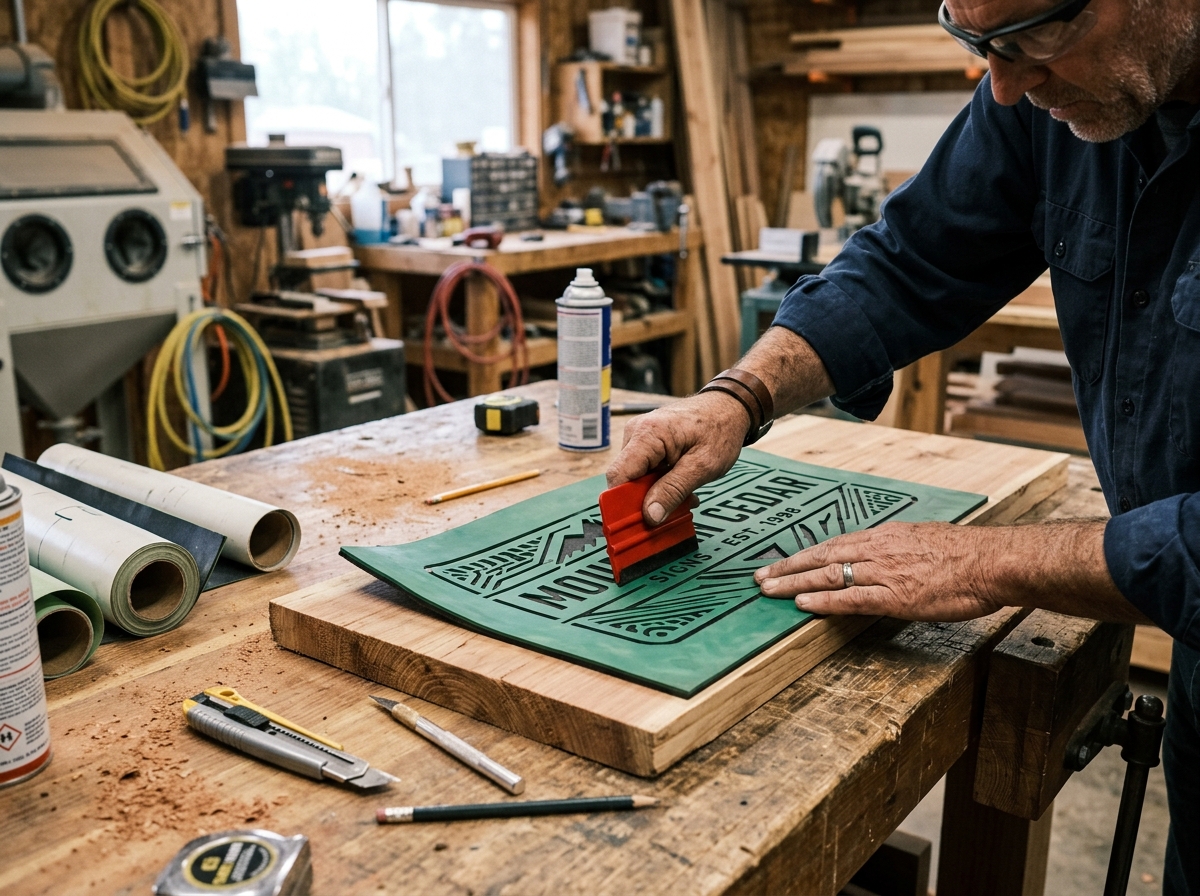
This creates a “2.5-D” effect. While 3-D signs might have rounded, sculptural surfaces, 2.5-D signs feature flat-topped text and graphics that stand out from a deeply textured background. It’s a look that screams “quality” and tells the world your business is here to stay.
The Manufacturing Process
Creating a masterpiece takes more than a few minutes in a blast cabinet. At our level of craftsmanship, the journey from raw lumber to finished sign involves several critical steps:
- Material Selection and Preparation: We start with kiln-dried planks. Kiln-drying is essential because it removes excess moisture, preventing the sign from warping or “cupping” once it’s installed outdoors.
- Bonding: For larger signs, multiple planks are joined together using high-grade, waterproof epoxy resin and internal “biscuits” or dowels. This creates a solid, stable “blank” that won’t pull apart.
- Masking: A computer-guided machine cuts your design into a heavy-duty rubber mask. This ensures that even the most intricate fonts and logos are reproduced with 100% accuracy.
- The Blast: The sign enters the blast booth where the magic happens. The craftsman carefully monitors the depth to ensure an even, beautiful texture across the entire surface.
- Finishing: Once blasted, the mask is removed. The sign is hand-sanded to remove any burrs, then treated with multi-stage priming. We use high-quality primers to seal the wood grain before applying automotive-grade paints or stains.
Choosing Your Canvas: Redwood vs. Cedar vs. HDU
Selecting the right material is the most important decision you’ll make. While wood is the traditional choice, modern synthetics like High-Density Urethane (HDU) have become popular for specific applications.
| Feature | All-Heart Redwood | Western Red Cedar | High-Density Urethane (HDU) |
|---|---|---|---|
| Aesthetic | Elegant, tight grain | Rustic, bold texture | Smooth or “sandpaper” finish |
| Durability | Naturally rot-resistant | Excellent weather resistance | 100% waterproof/insect-proof |
| Weight | Heavy/Sturdy | Lightweight | Very Lightweight |
| Sustainability | Scarce/Premium | Abundant/Sustainable | Petroleum-based |
| Best For | High-end luxury | Classic business signs | Budget-friendly/Low maintenance |
Redwood and HDU sandblasted outdoor signs both offer unique advantages, but the choice often comes down to the specific “vibe” you want to achieve. If you want a quick background on the wood itself, Western Red Cedar is widely valued for its natural decay resistance and dimensional stability.
Why Western Red Cedar is the Industry Standard
Western Red Cedar is the “workhorse” of the sign industry for good reason. It has been used by Indigenous societies in the Pacific Northwest for over 10,000 years for everything from totem poles to canoes because of its incredible rot resistance.
Standard sand blasted wooden signs made from cedar are typically 1.5″ to 1.75″ thick. Cedar is naturally lightweight, making it easier to mount on posts or hang from brackets. It also features a “wow factor” grain pattern that looks breathtaking when stained. Because it is more readily available than old-growth redwood, it is often a more budget-friendly way to get a “real wood” sign. High-quality sandblasted signs made of 100% Western Red Cedar are a testament to how this material can withstand even the harshest coastal environments.
The Redwood Advantage for Premium Signage
If you are looking for the absolute “top of the line,” Redwood is the gold standard. We’re talking about “all-heart” vertical grain redwood. This wood is incredibly stable – it’s less likely to warp or split than almost any other species.
Redwood signs can be ordered in impressive thicknesses of 3″ or even more, giving them a massive, structural presence. It is a very strong material that is rarely affected by high winds, making it ideal for large monument signs at the entrance of luxury apartments or golf courses. While the cost is higher due to the scarcity of old-growth timber, the natural elegance of a redwood sign is truly hard to beat.
Customization Options for Sand Blasted Wooden Signs
One of the best things about sand blasted wooden signs is that they are almost infinitely customizable. You aren’t stuck with a rectangular board; we can cut wood into ovals, arched tops, or even custom shapes that follow the contour of your logo.
Design Elements for Sand Blasted Wooden Signs
When designing your sign, think about the levels of relief. Most signs feature:
- Raised Elements: Your text, borders, and main graphics stay at the original surface height of the wood.
- Recessed Background: The area around the text is blasted away, revealing the grain.
- Color Contrast: We often paint the raised text a bright, readable color while staining the background a darker wood tone to make the “grain pop.”
- Gold Leafing: For a touch of luxury, we can apply 23k gold leaf to the raised letters. This doesn’t just look expensive—gold doesn’t tarnish, meaning those letters will shine for decades.
For those who need professional help with their layout, you can find more info about sign design services to ensure your vision translates perfectly to wood.
Sizing and Mounting Versatility
Size is rarely an issue. While popular sizes range from small 12″ x 18″ residential signs to massive 48″ x 96″ commercial displays, we can go even larger by using internal steel reinforcement. This prevents large signs from sagging over time.
Mounting options are just as varied:
- Post Mount: Between two wooden or vinyl posts (perfect for HOAs).
- Monument Style: Set into a stone or brick base.
- Hanging: Using eye hooks and ornamental iron brackets.
- Flush Mount: Using “French cleats” or stud inserts to mount the sign directly against a wall.
Durability and Maintenance: Making Your Investment Last
A high-quality sandblasted sign is an investment, and like any investment, it deserves a little care. While we often see heartwood redwood signs last 25 to 50 years if properly maintained, the average outdoor lifespan for a well-made cedar sign is about 10 to 20 years before it needs a “refresh.”
The biggest enemy of any outdoor sign isn’t rain—it’s the sun. UV rays can break down paint and wood fibers over time. That’s why we recommend using automotive-grade paints (like Matthews MAP) and high-level solar protection clear coats. These coatings act like a “SPF 50” for your sign, keeping the colors vibrant for much longer.
Maintenance Best Practices
To keep your sand blasted wooden signs looking brand new, follow these simple steps:
- The 5-Year Checkup: Every five years, give your sign a close inspection. Look for any tiny cracks in the paint or areas where the wood might be exposed.
- Cleaning: Use a soft brush and mild soapy water to remove dirt or bird droppings. Avoid pressure washers, as they can damage the delicate wood grain relief.
- Repainting: Most signs will benefit from a fresh coat of paint or sealer every 5 to 7 years. This prevents moisture from getting into the wood and causing rot.
- Re-Sealing: If your sign is stained rather than painted, a fresh coat of UV-resistant clear sealer will keep the wood from turning grey.
Professional material specs often highlight that using the right primers is the most important part of the longevity equation. If the primer fails, the paint fails.
Ordering Your Sand Blasted Wooden Signs
Ready to pull the trigger? Here is what you can expect during the ordering process:
- Design and Proofing: You’ll provide your artwork (ideally in EPS vector format). We’ll create a digital proof so you can see exactly what the grain and colors will look like.
- Production Time: Because these are handcrafted, expect a turnaround time of about 4 weeks. This allows time for the wood to be bonded, blasted, and for multiple coats of paint to dry properly.
- Shipping: Signs are crated securely to prevent damage. For orders over a certain size, freight shipping is usually required.
- Rush Orders: If you’re on a tight deadline for a grand opening, some shops offer rush production for an additional fee.
Frequently Asked Questions about Sand Blasted Wooden Signs
How long do sandblasted wooden signs last outdoors?
With proper care, a high-quality Western Red Cedar sign can last 15–20 years, while “All-Heart” Redwood can last 30–50 years. The key is the quality of the paint and the use of kiln-dried wood. If you ignore maintenance, the lifespan may drop to 7–10 years in harsh climates.
What is the price difference between wood and HDU?
Generally, HDU (High-Density Urethane) is about 20% to 30% less expensive than real wood. This is because HDU is easier to blast (no knots or inconsistent grain) and requires less hand-sanding. However, many people feel the “authentic” look of real wood grain is worth the extra cost. Industry standards provide a good baseline for pricing, noting that double-sided signs typically cost about 75% more than single-sided ones.
Can I customize the depth of the wood grain texture?
Yes! While a standard blast depth is around 1/4″ to 3/8″, we can blast deeper (up to 1/2″ or more) for a more aggressive, rustic look. Just keep in mind that the deeper the blast, the more “fragile” the raised letters become, so there is a balance to maintain for structural integrity.
Conclusion
At FinanceBoostX, we know that a strong visual identity matters. Sand blasted wooden signs offer a classic combination of durability, craftsmanship, and curb appeal that can help a business, property, or organization make a memorable first impression.
From the deep, tactile grain to the vibrant, automotive-grade finishes, these signs offer a level of sophistication that modern flat signs simply cannot replicate. They can bring rustic charm to a mountain resort, a welcoming feel to a neighborhood entrance, or a polished presence to a professional office.
If you are exploring signage options and want a dimensional look with long-term outdoor performance, get started with your custom sign project today.
