
Why Your Indoor Plants Are Struggling (And How Grow Lights Fix It)
The best grow lights for indoor plants can make the difference between a thriving green space and a collection of sad, leggy stems — especially if your home doesn’t get much natural light.
Quick answer: The best grow lights for indoor plants by type:
| Plant Type | Best Light Type | Lumens Needed |
|---|---|---|
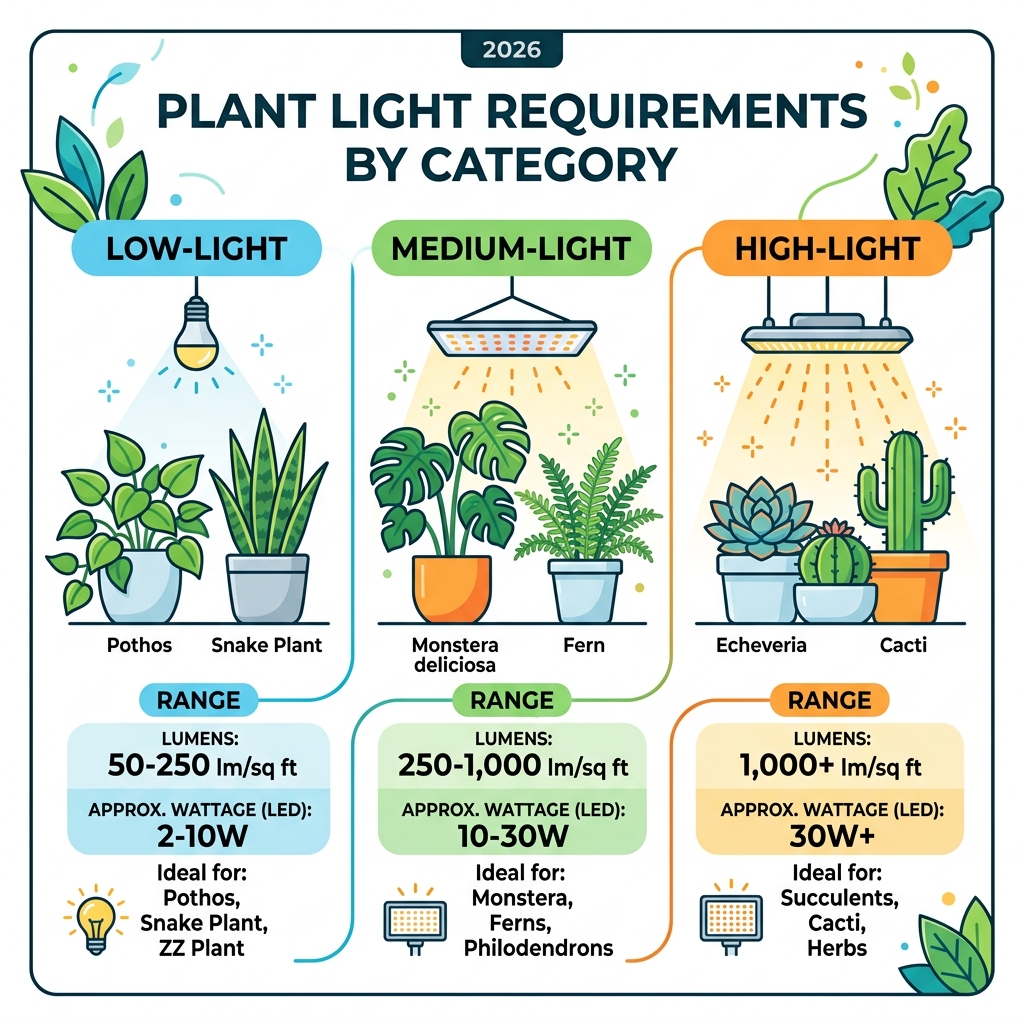
| Low-light plants (pothos, snake plant) | Full-spectrum LED bulb | 50-250 lm/sq ft |
| Medium-light plants (tropical foliage) | Full-spectrum LED panel or clip-on | 250-1,000 lm/sq ft |
| High-light plants (succulents, cacti, herbs) | High-intensity full-spectrum LED | 1,000+ lm/sq ft |
| Seedlings | T5 or compact LED strip | 2,000-3,000 lm |
| Flowering/fruiting plants | Red-spectrum LED panel | 1,000+ lm/sq ft |
Most indoor spaces simply don’t provide enough light for plants to photosynthesize properly — especially in winter or in rooms with few windows. The result? Stretched stems, small leaves, faded colors, and slow growth.
The good news: modern LED grow lights have made it easy and affordable to fix this. They run cool, use very little electricity, and last for years. You don’t need a dedicated grow room or complicated setup.
Whether you’re keeping a few succulents on a shelf or growing herbs in your kitchen, there’s a grow light that fits your space and your lifestyle.
Why LED Technology is the Top Choice for Indoor Gardens
If you’ve spent any time researching how to keep your indoor jungle alive, you’ve likely noticed that LEDs are the “cool kids” of the gardening world. But why is everyone ditching their old fluorescent tubes for these little semiconductors?
LED stands for “light-emitting diode.” At its simplest, it’s a semiconductor that produces light when an electrical current flows through it. Unlike traditional incandescent bulbs that use a filament, LEDs are incredibly efficient. In fact, the Department of Energy notes that LEDs use about half the energy of fluorescent bulbs. When we are looking for the best grow lights for indoor plants, efficiency is a major factor in keeping our monthly utility bills from skyrocketing.
One of the most impressive statistics in indoor gardening is heat management. LEDs run up to 80% cooler than fluorescent fixtures. This is a game-changer for two reasons:
- You won’t accidentally cook your delicate ferns or succulents if the light is placed a little too close.
- You don’t have to worry about your grow space becoming a literal sauna in the middle of summer.
Furthermore, the longevity of these lights is staggering. A quality LED grow light can last up to 50,000 hours. To put that in perspective, that is about five times longer than a standard fluorescent bulb. If you run your lights for 12 hours a day, you’re looking at over 11 years of use before you need a replacement. For those of us focused on Top LED Lights for Your Indoor Succulent Garden, this reliability means we can set up our displays and enjoy them for a decade without constant maintenance.
How to Choose the Best Grow Lights for Indoor Plants
Choosing the right light isn’t just about picking the brightest bulb on the shelf. We need to consider the specific needs of our plants and the constraints of our living space. Not every plant wants to bake under a high-intensity panel, and not every apartment has room for a four-tier industrial stand.
1. Plant Type and Light Intensity
Before buying, we must categorize our plants. Are they “sun-worshippers” or “shade-dwellers”?
- Low-Light Plants: Think Snake Plants or Pothos. They only need about 10-15 watts or 50-250 lumens per square foot.
- Medium-Light Plants: Most tropical foliage falls here. They thrive with 15-20 watts or 250-1,000 lumens per square foot.
- High-Light Plants: Succulents, cacti, and most herbs are in this group. They require more than 20 watts or over 1,000 lumens per square foot.
Understanding Indoor Succulent Success: The Role of Light is crucial here, as succulents are often the first to suffer when light intensity drops below their preferred threshold.
2. Available Space and Mobility
Where are your plants located? If they are on a cluttered bookshelf, a compact tabletop model like the Ultimate LED Grow Light for Indoor Plants | Vego Garden might be perfect. If you have a dedicated corner for a larger collection, a multi-tier stand or a powerful hanging panel like the Spider Farmer® SF4000 450W Full-Spectrum LED could be the better investment.
For those who like to rearrange their furniture (we’ve all been there!), mobility is a key factor. Some grow light stands come with castors or wheels, allowing you to roll your garden to a different room without breaking your back or scratching the floors.
3. Wattage vs. Lumens
Don’t get caught up solely in “wattage.” Wattage tells you how much power the light consumes, while lumens tell you how much visible light it emits. With modern LEDs, a 10W bulb can often produce as much light as an old 50W halogen. When learning How to Choose the Right Light for Your Indoor Succulents, look for the lumen output and the “Photosynthetic Photon Flux” (PPF) to ensure your plants are getting the energy they need for photosynthesis, not just a bright glow.
Understanding Light Spectrum, Temperature, and Intensity
Plants don’t see light the way we do. While we might prefer a “warm white” glow for our living room, plants are hungry for specific wavelengths. This is where “Full Spectrum” lighting comes in.
Full-spectrum LEDs are designed to mimic natural sunlight. They include a blend of blue, red, and even green wavelengths.
- Blue Light: Crucial for vegetative growth. It helps plants stay stocky and prevents them from getting “leggy” or stretched.
- Red Light: The “blooming” light. It encourages flowering, fruiting, and root development.
- Green Light: While often dismissed, green light actually penetrates deeper into the plant canopy, ensuring the lower leaves get some energy too.
We also talk about Color Temperature, measured in Kelvin (K).
- 3000K-4000K: These lights have a warmer, yellowish glow. They are great for living areas because they feel cozy to humans but still provide the red wavelengths plants love.
- 5000K-6500K: These are “daylight” bulbs with a cooler, bluish tint. They are excellent for leafy greens and starting seeds.
For those seeking Effective Indoor Succulent Lighting Ideas, a light with a high Color Rendering Index (CRI) is a bonus. A CRI of 95, like that found in some GooingTop models, ensures your plants look vibrant and true-to-life under artificial light, rather than washed out or purple.
Best Grow Lights for Indoor Plants for Seedlings and Herbs
If you are starting a kitchen herb garden or prepping your vegetable seeds for spring, you need high intensity but low heat. Seedlings are delicate; if the light is too far away, they will stretch and fall over. If it’s too hot, they’ll wither.
We recommend aiming for 2,000 to 3,000 lumens for seedlings. T5 LED strips are the gold standard here. They are thin, can be mounted under cabinets, and provide a very even distribution of light. This prevents the “edge effect” where plants on the outside of the tray struggle while the ones in the middle thrive.
Best Grow Lights for Indoor Plants for Flowering Varieties
For the indoor gardener trying to get their Hoya to bloom or growing indoor peppers, you need “punch.” Flowering requires significantly more energy than just maintaining leaves.
High-intensity panels, such as the Gorilla Xi220 Full Spectrum LED Grow Light, are designed for this. These lights often feature specialized “BudBooster” infrared (IR) wavelengths. While IR is invisible to us, it triggers a response in plants that tells them it’s time to focus on reproduction (flowers and seeds).
Essential Tips for Growing Plants Under Artificial Light
Buying the best grow lights for indoor plants is only half the battle. How you use them determines your success.
1. Distance is Everything
A common mistake is hanging the light and forgetting it. As your plants grow, they get closer to the light source. If they get too close, they can suffer from “light burn” or heat stress.
- Houseplants: Generally keep LEDs 6-12 inches away.
- Seedlings: Can be as close as 5-12 inches, but watch for signs of wilting.
- High-power panels: Models like the Gorilla Xi750 Smart LED are so powerful they may need to be 24-36 inches away to avoid overwhelming the plants.
2. Give Them a Bedtime
Plants, like humans, need rest. Photosynthesis is a 24-hour cycle that includes a “dark phase.” Most indoor plants thrive on a 12-to-16-hour light cycle. Using a simple plug-in timer or a smart app (like those compatible with the Gorilla Xi330 LED Grow Light) ensures your plants get consistent “sunlight” without you having to remember to flip a switch. This consistency is a major factor when you Revamp Your Indoor Garden: Lighting Tips for Succulents.
3. Airflow and Safety
Even though LEDs run cool, they still generate some heat. Ensure there is adequate airflow around your fixtures to prevent the internal electronics from overheating. This also helps prevent stagnant air around your plants, which can lead to fungal issues.
When it comes to eye safety, don’t stare directly into your grow lights. They are significantly brighter than standard household bulbs. If you’re working in your garden for a long time, consider wearing “grow room glasses” that block intense UV and IR rays.
Frequently Asked Questions about Indoor Grow Lights
How can I tell if my plants need more light?
Your plants are actually very good at communicating—you just have to know what to look for! The most common sign is “etiolation,” which is a fancy word for leggy, stretched-out growth. If your plant is leaning desperately toward a window or has huge gaps between its leaves, it’s hungry for light.
Other signs include:
- Loss of Variegation: If your beautiful white-and-green variegated plant starts turning solid green, it’s producing more chlorophyll to try and catch every bit of available light.
- Small New Leaves: If the new growth is significantly smaller than the old leaves, the plant doesn’t have enough energy to build bigger ones.
- Yellowing Lower Leaves: While this can be a watering issue, it often happens because the plant is “sacrificing” its lower leaves to provide energy for the top ones closer to the light.
If you notice these signs, it’s time to Boost Your Indoor Succulent Growth with the Right Light.
Are grow lights safe for human eyes?
Generally, yes, but with a few caveats. Grow lights are much more intense than your average desk lamp. Looking directly at the diodes can cause temporary “spots” in your vision, similar to looking at a camera flash.
If you are using high-end lights with UV (ultraviolet) or IR (infrared) channels, like the Gorilla Xi220 Smart LED Grow Light, you should be more cautious. Prolonged exposure to UV can be irritating to the eyes and skin. Position your lights so the “spill” doesn’t hit your face while you’re sitting on the couch. Opting for “full spectrum white” lights rather than the old-school “blurple” (blue/purple) lights is also much easier on the eyes and makes your home feel more natural.
How much does it cost to run grow lights?
You might be surprised at how affordable it is. Because LEDs are so efficient, the impact on your electric bill is usually minimal. For example, a GooingTop LED light that consumes about 10 watts and runs for 12 hours a day will cost roughly $2 per month in electricity.
Even a more powerful 450W panel like the Spider Farmer SF4000 is designed to maximize “micromoles per joule” (efficacy), meaning you get the most plant-growth-power for every penny spent. To save even more, look for lights with dimming functions so you can lower the intensity (and the power draw) when your plants are in a dormant phase.
Conclusion
Bringing the sun indoors has never been easier or more efficient. By choosing the best grow lights for indoor plants based on your specific needs—whether that’s a stylish tabletop light for your office or a high-performance panel for your hobby greenhouse—you can ensure your indoor garden thrives year-round.
At FinanceBoostX, we believe that a green home is a happy home. Investing in the right technology today saves you money on replacement plants and high energy bills tomorrow. Ready to take your indoor garden to the next level? Explore More info about indoor setup services to find the perfect configuration for your space. Happy growing!
