
What You Need to Know About Succulent Leaves Growing Back
Succulent leaves growing back is one of the most common questions plant owners have — and the short answer might surprise you.
Quick Answer:
- Leaves do NOT regrow in the exact same spot after falling off or being removed
- The plant seals the wound and redirects energy to new growth elsewhere
- New leaves grow only from the top (the growing tip, called the apical meristem)
- Bare stems can still produce offshoots or pups over time
- Fallen leaves can be used to propagate entirely new plants
So while your succulent won’t patch itself up like a starfish, it’s far from a lost cause.
Succulents are remarkably resilient. Whether you’ve accidentally overwatered a gift plant, noticed a few mushy yellow leaves dropping off, or ended up with a long bare stem that looks more like a tiny palm tree than a rosette — there are real, practical ways to bring your plant back to life.
This guide covers exactly what’s happening inside your plant, what’s causing the leaf loss, and how to fix it — step by step.
The Truth About Succulent Leaves Growing Back
When we see a leaf drop, our first instinct is to hope a new one will sprout right where the old one lived. Unfortunately, succulent anatomy works a bit differently than a traditional deciduous tree. Once a leaf detaches, the plant immediately begins a biological “lockdown” at that site.
Why leaves don’t regrow in the exact same spot
The moment a leaf falls off, the plant works to protect itself from infection and water loss. It does this by forming a callous over the wound. This scarring process is vital for the plant’s survival, but it also means the specific “socket” where the leaf was attached is now sealed shut.
Succulents possess specialized tissues called meristems. Most of the leaf-producing action happens at the apical meristem, which is the very center or “head” of the rosette. Because the plant’s energy is hardwired to push growth upward and outward from this central point, it doesn’t have the biological mechanism to go back and “patch” a hole in the middle of a stem.
How bare stems produce new growth
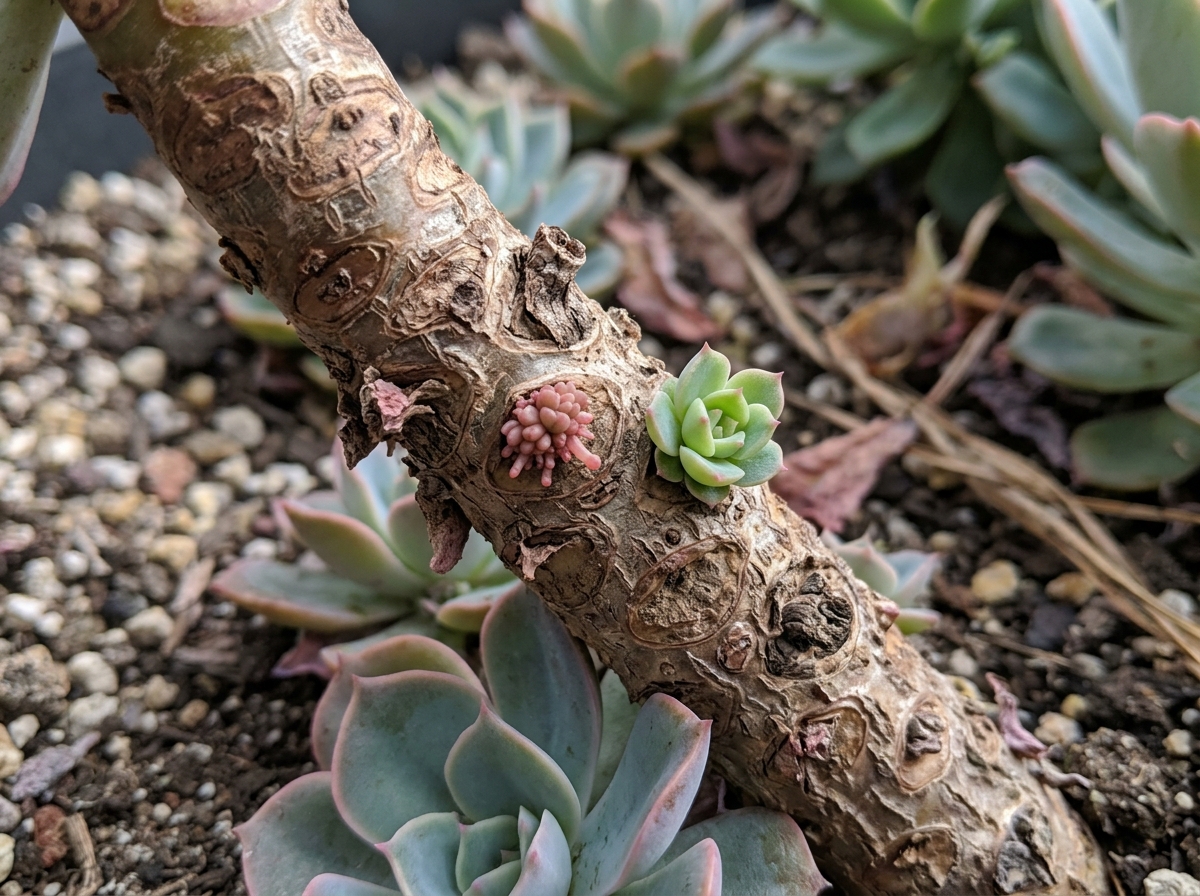
While you won’t see succulent leaves growing back in the old spots, a bare stem isn’t necessarily a dead end. If the stem remains healthy and the root system is intact, the plant may activate axillary buds. These are dormant growth points located just above where the old leaves used to be.
Instead of a single leaf, these buds often produce pups or offshoots. Over time, these small “baby” succulents will grow into full branches, eventually covering the bare stem and giving the plant a fuller, bushier appearance. This is how some species, like Sedum or Echeveria, eventually turn into “succulent trees” or sprawling clusters.
Diagnosing Why Your Succulent is Losing Leaves
Before we can fix a leggy or balding plant, we have to play detective. Why did those leaves fall off in the first place? Succulents are vocal plants; they tell us exactly what’s wrong through the color and texture of their foliage.
| Symptom | Likely Cause | Texture |
|---|---|---|
| Yellow, translucent, mushy leaves | Overwatering | Soft and squishy |
| Brown, crispy, shriveled leaves | Underwatering | Dry and papery |
| Stretched stem with wide leaf gaps | Low Light (Etiolation) | Weak and leaning |
| Black spots or “sooty” residue | Pests (Mealybugs/Mites) | Sticky or fuzzy |
| White crust on soil surface | Over-fertilization | Gritty/Salty |
Identifying overwatering and root rot
Overwatering is the #1 succulent killer. When a succulent gets too much water, its cells literally burst because they can’t store any more moisture. This leads to leaves that look pale, yellow, or almost “see-through.” If you touch them, they often fall off with the slightest bump.
If the stem starts turning black at the base, you’re likely dealing with root rot. In this case, the priority shifts from aesthetics to survival. You may need to learn how to propagate a succulent from a leaf without killing it to save the genetics of the plant before the rot claims the whole thing.
Environmental stressors and pests
Sometimes the issue isn’t water, but the environment.
- Temperature Shock: Most succulents thrive between 41°F and 77°F (5°C to 25°C). If they are hit by a sudden frost or a heatwave above 86°F, they may drop leaves as a stress response.
- Pests: Mealybugs and spider mites love to hide in the nooks where leaves meet the stem. If you see white “cottony” spots, it’s time for a neem oil treatment (diluted 1:500) or a swab of rubbing alcohol.
- Nutrient Burn: Too much fertilizer can cause a white salt crust on the soil and lead to leaf drop. If you suspect this, flush the soil with distilled water or repot in fresh mix.
How to Fix Leggy Stems and Promote New Growth
If your succulent looks like a long, spindly neck with a tiny tuft of leaves at the top, it has become “leggy” (scientifically known as etiolation). This happens when the plant is literally “reaching” for more light. Since succulent leaves growing back on that long stem won’t happen naturally, we have to take matters into our own hands.
The “Beheading” method for rejuvenation
Don’t let the name scare you! Beheading is the most effective way to reset a leggy succulent.
- Cut: Using a sterilized blade, cut the “head” (the healthy rosette at the top) off, leaving about an inch of stem attached.
- Callous: Place the head in a dry, shaded spot for 3 to 7 days. This allows the cut to dry and form a “scab” to prevent rot.
- Replant: Stick the calloused stem into fresh, dry succulent soil. Do not water for at least two weeks while it grows new roots.
- The Mother Plant: Don’t throw away the old bare stem! If you keep watering it sparingly, it will often sprout multiple new “pups” along the sides.
For a deeper dive into this process, check out the no-nonsense succulent leaf propagation guide for professional-level tips.
Optimizing light and soil for recovery
To prevent your succulent from getting leggy again, you must fix its “diet” of light and soil.
- Light: Most succulents need 6–8 hours of bright, indirect light. If you’re growing indoors, a south-facing window is usually best. If your home is dark, consider a full-spectrum LED grow light.
- Soil: Forget standard potting soil. We recommend a mix of 50% potting soil and 50% coarse sand, perlite, or pumice. This ensures the roots never sit in “wet feet.”
- Watering: Use the “soak and dry” method. Water the soil until it runs out the bottom, then wait until the soil is bone-dry (usually 10–14 days) before watering again.
Propagation: Succulent Leaves Growing Back as New Plants
One of the miracles of the succulent world is that a single fallen leaf isn’t “trash”—it’s a potential new plant. While that leaf won’t jump back onto the parent stem, it can grow its own root system and a tiny baby rosette.
Step-by-step leaf propagation
This is the ultimate way to see succulent leaves growing back in a new form.
- The Clean Pull: Gently twist a healthy leaf off the stem. It must be a “clean” pull—if the leaf snaps in the middle, it won’t grow. You need the “heel” (the part where it touched the stem) to be intact.
- The Wait: Lay the leaves on a tray in indirect light. In 2–7 days, the ends will callous.
- The Sprouting: After a few weeks, you’ll see tiny pink roots or a microscopic baby plant (a pup) emerge from the heel.
- The Planting: Once roots appear, place the leaf on top of well-draining soil and mist it occasionally.
If you want to master this, we have a detailed walkthrough on the secret to growing new succulents from single leaves and another guide on how to propagate succulents from a single leaf to help you avoid common beginner mistakes.
Caring for “baby” succulents
Baby succulents are more delicate than their parents. They need more frequent misting because their tiny roots dry out quickly. However, the “mother leaf” actually provides most of the nutrients and water for the first few months. Eventually, the mother leaf will shrivel up and fall off—this is normal! It means the baby is now independent and ready for its own small pot.
Frequently Asked Questions about Succulent Leaves Growing Back
Can I salvage a damaged succulent before gifting it?
Yes! If you bought a gift and accidentally overwatered it, don’t panic. First, remove any mushy or yellow leaves. If the stem is still firm, you can “top-dress” the soil with decorative pebbles to hide the bare stem. If it’s very leggy, behead it and present the “new” plant in a beautiful pot. It takes about 2–4 weeks for a beheaded succulent to look “gift-ready” again.
Is window lighting enough for succulent leaves growing back?
It depends on the window. A north-facing window usually isn’t enough and will cause the plant to stretch again. A south or west-facing window is ideal. If you notice the plant leaning toward the glass, rotate the pot every few days to ensure even growth. If you see the vibrant reds and purples fading to a dull green, that’s a sign the plant needs more light.
What should I do with broken Aloe Vera leaves?
Aloe Vera is a bit different. Unlike many other succulents, a broken Aloe leaf won’t grow a new plant from a single leaf pull very easily. If a leaf is bent or broken, it’s best to cut it off cleanly at the base. The plant will seal the wound and grow a brand-new leaf from the center. You can find more on this in our easy guide to propagate succulents from leaves.
Conclusion
At FinanceBoostX, we believe that plant care is a journey of patience and observation. While succulent leaves growing back in the exact same spot might be a myth, the reality of succulent resilience is even more exciting. Through beheading, leaf propagation, and proper environmental adjustments, you can turn one “failing” plant into a whole nursery of new growth.
Remember: a bare stem isn’t a failure—it’s an opportunity for offshoots. A fallen leaf isn’t waste—it’s a new beginning. With the right soil, light, and a little bit of restraint with the watering can, your succulents will thrive for years to come.
Hungry for more green-thumb wisdom? Check out More expert tips on succulent care to keep your indoor garden flourishing!
