
Your Succulents Are Stretching — Easy Install Succulent Lights Can Fix That Fast
Easy install succulent lights are plug-and-play grow lights that require zero tools, no wiring, and no drilling to set up. Here are the best no-fuss options to get your plants thriving today:
- USB Angel Ring Lights (e.g., Fridja USB Angel Ring) — plug into any USB port, stake into soil, done. From ~$4.69.
- Clip-On Gooseneck Lights (e.g., Sansi 10W Pot Clip) — clamp onto the pot rim, bend to position, plug in. From ~$26.
- Plug-In Hanging Pendants (e.g., FSLiving 10W Swag Light) — hang from a hook, plug into a standard outlet. From ~$44.99.
- Linkable LED Strip Bars (e.g., Feit Electric 24 in.) — stick or hang above a shelf, link multiple units together. No wiring needed.
- Flexible LED Strip Lights — wrap around planters or tuck into tight spaces, water-resistant options available.
If you’ve ever watched a once-plump echeveria slowly stretch toward the nearest window like it’s reaching for help, you already know the problem. This leggy growth, scientifically known as etiolation, occurs because indoor light simply isn’t enough for most succulents. Window glass filters a significant portion of sunlight, and during winter months, even a south-facing sill can leave your plants starved for the spectrum they need.
The good news? You don’t need an electrician, a power drill, or even a YouTube tutorial to fix it.
Today’s easy-install succulent lights are designed for exactly this situation — small spaces, busy schedules, and zero tolerance for complicated setups. We’re talking USB-powered rings that stake right into the soil, clip-on arms that bend to any angle, and strip lights that stick under a shelf in minutes.
No tools. No wiring. No problem.
What Defines Easy Install Succulent Lights?
When we talk about easy install succulent lights, we aren’t talking about heavy industrial panels that require a mounting bracket and a dedicated circuit. We are looking for “plug-and-play” solutions. But what exactly makes a light “easy”?
First, the power source is key. Most of these beginner-friendly options use a USB interface. This is a game-changer because it means you can power your plants using a spare phone charger, a laptop, or even a portable power bank. There’s no complex wiring involved; if you can charge your phone, you can grow a Graptopetalum.
Second, the mounting must be tool-free. We look for lights that utilize:
- Adhesive backing: High-strength tape that lets you stick light strips under kitchen cabinets or bookshelves.
- Pot clips: Heavy-duty clamps that grip the edge of a ceramic or plastic pot.
- Soil stakes: Acrylic or metal rods that slide directly into the potting mix.
By removing the need for a drill, these lights become “tenant-friendly.” You can brighten up a dark apartment corner without worrying about your security deposit. For more inspiration on how to integrate these into your home, check out these effective-indoor-succulent-lighting-ideas.
Top Tool-Free Mounting Options for Every Space
Not every succulent setup is the same. You might have a single “propigation station” on your desk or a massive three-tier shelf in the living room. Choosing the right mounting style ensures your plants get the light they need without creating an eyesore.
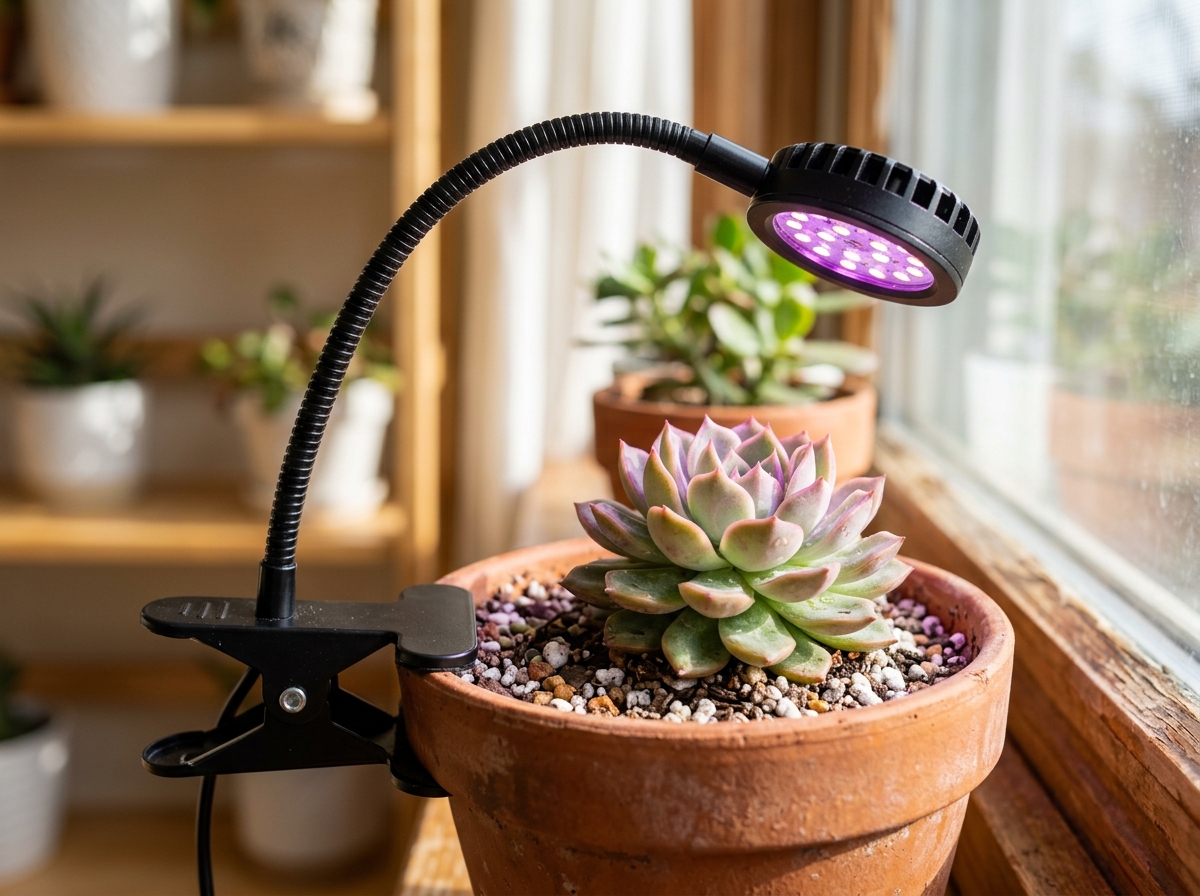
| Mounting Method | Best For | Pros | Cons |
|---|---|---|---|
| Clip-on | Desks, side tables | Highly adjustable; portable | Can be bulky; needs a ledge |
| Soil Stake | Individual pots | Minimalist; moves with the plant | Only lights one or two plants |
| Adhesive Strip | Bookshelves, cabinets | Hidden; covers wide areas | Harder to move once stuck |
| Hanging/Swag | Corners, high ceilings | Stylish; covers large floor pots | Requires a ceiling hook |
If you are unsure which direction to go, our guide on how-to-choose-the-right-light-for-your-indoor-succulents can help you narrow down the technical specs.
USB Angel Rings: The Ultimate Easy Install Succulent Lights
If you want the most “Instagrammable” setup possible, the USB Angel Ring (often called a “Halo” light) is the gold standard. These lights, like the Fridja or Halo 360 models, feature a circular LED head attached to an adjustable acrylic or metal rod.
The installation is literally a two-second process:
- Assemble the rod and light head.
- Push the stake into the succulent’s soil.
- Plug the USB cord into a power source.
These are perfect for keeping shining-a-light-on-indoor-succulent-care-2 simple. They provide a full spectrum of light (often a pleasant natural white) that doesn’t just help the plant grow—it makes it look like a piece of living art. Many models even include an opening in the ring to help support the plant’s stem as it grows taller.
Linkable LED Strips for Larger Collections
For the serious collector with rows of Echeveria and Sedum, individual rings won’t cut it. You need coverage. This is where linkable LED bars, such as those from Feit Electric, shine.
These bars often come in 24-inch lengths and are designed to be “daisy-chained.” This means you plug the first light into the wall, and the second light plugs into the first one. You can often link 5 to 8 units together on a single plug! Most of these come with double-sided adhesive tape or wire harnesses that snap onto wire shelving. If you’re building a “succulent wall,” these are the top-led-lights-for-your-indoor-succulent-garden to consider.
Step-by-Step: How to Set Up Your Easy Install Succulent Lights
Setting up your lights correctly is the difference between a thriving garden and a burnt leaf. Even though these are “easy,” there is a bit of a science to the placement.
Step 1: Clean the Surface If you are using adhesive strips, wipe the underside of the shelf with rubbing alcohol first. Dust and oils from your hands will prevent the tape from sticking long-term.
Step 2: Position for Proximity Succulents are “high light” plants. For most 10W to 20W LED lights, you want the light to be 6 to 12 inches away from the top of the plant. If the light is 24 inches away, the intensity drops off significantly, and your plants might still stretch.
Step 3: Cable Management Use small adhesive cable clips or even simple twist-ties to tuck the wires away. This prevents you from accidentally knocking over a pot when you walk by.
Step 4: Set the Timer Most easy install succulent lights come with built-in timers (typically 3, 9, or 12-hour cycles). Set it and forget it! Consistency is vital for boost-your-indoor-succulent-growth-with-the-right-light.
Optimizing Your Setup for Maximum Growth
To get those vibrant “stress colors”—the pinks, purples, and deep reds that make succulents so famous—you need more than just “some” light. You need the right light.
- Spectrum: Look for “Full Spectrum” or “Sunlike” LEDs. These provide the blue wavelengths (for compact, bushy growth) and red wavelengths (for flowering and root health). Avoid “blurple” (pink/purple) lights if you want your home to look normal; modern white LEDs are just as effective and much easier on the eyes.
- Brightness: Aim for a light that provides between 300 and 800 lumens per square foot. High-intensity lights like the Sansi 10W can provide even more, which is great for desert cacti.
- Duration: Succulents need a “sleep” cycle. We recommend running your lights for 12 to 14 hours a day. Use a timer to ensure they get 8 to 10 hours of total darkness to complete their metabolic processes.
Understanding indoor-succulent-success-the-role-of-light will help you adjust your duration based on the season. In the winter, you might run them longer to compensate for the gloomy weather.
Frequently Asked Questions about Easy-to-Install Lighting
Can I use regular LED bulbs for succulents?
Technically, a standard “daylight” LED bulb from the hardware store can help, but it usually isn’t enough. Horticultural LEDs are designed with higher PAR (Photosynthetically Active Radiation) values. Regular bulbs are designed for human eyes to see; grow lights are designed for plants to “eat.” For the best results, stick to lights labeled specifically for plant growth.
How far should the light be from my plants?
As a rule of thumb, 6 to 12 inches is the “sweet spot.” If you notice the leaves turning brown or looking “crispy,” move the light further away. If the plant is still stretching (etiolating) or losing its vibrant color, move the light closer.
Do these lights need special wiring or outlets?
No! That is the beauty of easy install succulent lights. Most are low-voltage (5V or 24V) and use standard USB ports or two-prong wall plugs. They are incredibly safe and consume very little electricity—often costing less than $1.00 per month to run.
Conclusion
At FinanceBoostX, we believe that indoor gardening should be a source of joy, not a home renovation project. By choosing easy install succulent lights, you can transform a dim bookshelf into a thriving desert oasis in the time it takes to make a cup of coffee.
Remember to monitor your plants as they adjust to their new “sun.” Rotate them every week so they grow evenly, and keep an eye on the soil moisture, as grow lights can cause the soil to dry out slightly faster than natural light.
Ready to dive deeper into plant care? Visit our Succulent Care Pillar Page for more guides on watering, soil, and advanced cultivation tips. Happy growing!
