
When Too Much Love Kills: What You Need to Know About Overwatered Succulent Recovery Steps
Overwatered succulent recovery steps can mean the difference between saving your plant and losing it entirely. Here’s what to do right now:
- Stop watering immediately
- Remove the plant from its pot and wet soil
- Let the roots air dry for 1-3 days
- Trim any black or mushy roots with clean scissors
- Repot in fresh, well-draining cactus mix
- Wait at least a week before watering again
- Propagate healthy leaves or stems if rot is severe
Succulents are built for drought. They store water in their thick, fleshy leaves – a survival trick developed over thousands of years in arid desert environments. That same superpower is also their weakness.
When you water too often, those leaves fill up past capacity. The cells burst. The roots suffocate. And what started as a stylish, low-maintenance plant turns soft, yellow, and mushy – fast.
The good news? Most overwatered succulents can be saved – even ones that look pretty far gone. The key is acting quickly and knowing exactly what to do.

Identifying the Signs of a Drowning Plant
Before we dive into the overwatered succulent recovery steps, we need to be sure that overwatering is actually the culprit. We’ve all been there: you see a leaf looking a bit “off,” and your first instinct is to grab the watering can. Stop! If the plant is already drowning, more water is the final nail in the coffin.
The most common sign of an overwatered succulent is a change in leaf texture and color. While a healthy succulent has firm, plump leaves, an overwatered one starts to look “translucent” or “glassy.” This happens because the plant has absorbed so much water that its internal cell walls are literally bursting.
You might also notice:
- Mushy texture: The leaves feel like wet sponges or “mushy peas.”
- Yellowing foliage: A general loss of color, often starting from the bottom of the plant.
- Leaf drop: Leaves fall off at the slightest touch, even if they still look somewhat green.
- The “Melting” Look: In severe cases, the entire plant seems to collapse or “melt” into the soil.
- Unpleasant Smell: If you notice a swampy, rotting odor coming from the pot, bacteria have already moved in.
Overwatering vs. Underwatering: The Great Debate
It can be tricky to tell the difference because both issues can make a plant look “stressed.” However, the tactile cues are very different. Understanding succulent watering needs is the first step in avoiding this confusion.
| Feature | Overwatered Succulent | Underwatered Succulent |
|---|---|---|
| Leaf Texture | Soft, squishy, bloated, and mushy. | Shriveled, wrinkled, and “deflated.” |
| Leaf Color | Translucent, yellow, or blackening. | Usually stays the same color or turns brown/crispy. |
| Leaf Drop | Leaves fall off easily while still moist. | Old leaves at the bottom dry up and stay attached. |
| Soil Condition | Damp, soggy, or waterlogged. | Bone dry, often pulling away from the pot edges. |
If your plant looks like it’s had “one too many sips,” it’s time to transition into rescue mode.
Immediate Overwatered Succulent Recovery Steps
Once you’ve confirmed the diagnosis, you must act. Time is the enemy when it comes to rot. The longer a succulent sits in “wet socks” (saturated soil), the faster the rot travels up the stem to the heart of the plant.
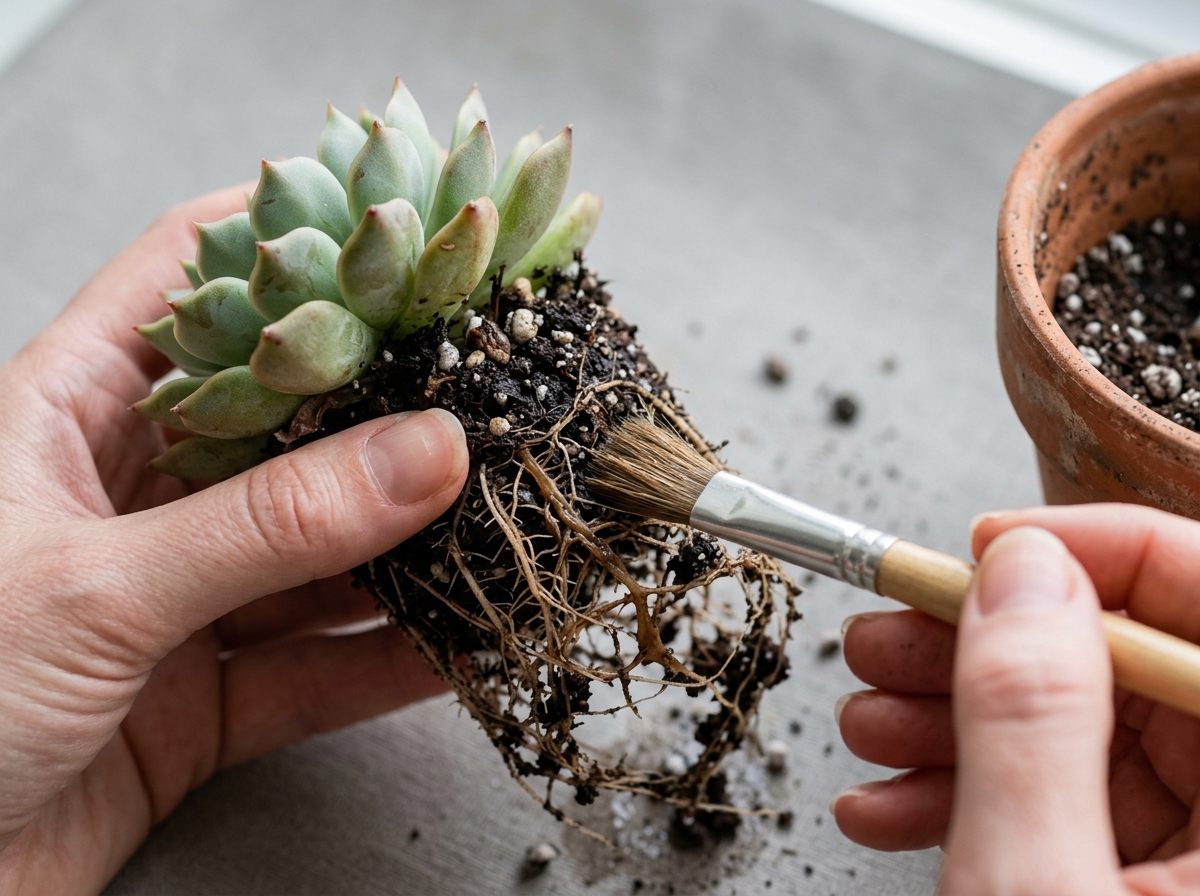
Step 1: Evacuation
The very first of our overwatered succulent recovery steps is to get the plant out of the danger zone. Gently tip the pot and slide the succulent out. If the soil is a muddy mess, don’t worry about keeping the root ball intact. Our goal is to separate the plant from the moisture.
Step 2: Soil Removal
Use your fingers or a soft brush to remove as much of the wet soil as possible. We want the roots to be exposed to the air. If the soil is sticking stubbornly, you can gently rinse the roots under lukewarm water—just be sure to pat them dry with a paper towel afterward.
Step 3: The Air Dry
This is the hardest part for many “plant parents”: doing nothing. Place your bare-rooted succulent on a tray or a dry paper towel. Keep it in a bright spot with good airflow, but out of direct sunlight. Direct sun can scorch the already stressed tissues. Let it sit there for 1 to 3 days. We want the roots to feel dry to the touch before we even think about putting it back in a pot. For more on the basics, check out our guide on proper-watering-techniques-for-succulent-plants.
Inspecting and Treating Root Rot
While the plant is air-drying, it’s time for “plant surgery.” This is where we determine if the root system is still viable.
Healthy vs. Rotted Roots
Healthy roots are usually white, cream, or light tan. They should feel firm and slightly wiry. Rotted roots, on the other hand, are unmistakable. They are:
- Black or dark brown.
- Slimy or “mushy” to the touch.
- Easily pulled away from the plant with no resistance.
The Surgical Process
Using a pair of shears or scissors sterilized with rubbing alcohol, snip away every single bit of rotted root. Don’t be shy—if you leave even a small piece of rot, it can spread like a “Mexican wave” through the rest of the system.
Pro Tip: If you have to cut into the main stem to remove rot, make sure the remaining tissue is clean and green (or white) inside. If you see black spots in the center of the stem, you need to cut higher.
Natural Fungicides
After trimming, we recommend dusting the wounds with a natural fungicide. Cinnamon is a fantastic, household option that has natural anti-fungal properties and helps the “wounds” callus over. Alternatively, you can use sulfur powder. This prevents opportunistic bacteria from attacking the plant while it heals. Understanding the role of drainage in succulent watering will help you appreciate why we need these roots to stay dry and healthy from here on out.
Repotting Your Overwatered Succulent Recovery Steps
Now that your plant is dry and the rot has been excised, it needs a new home. You cannot put it back into the old, soggy soil. In fact, we recommend cleaning the old pot with a mild bleach solution (1 part bleach to 9 parts water) to kill any lingering pathogens.
The Perfect Soil Mix
Succulents hate “wet feet.” Standard potting soil is designed to hold moisture, which is the exact opposite of what we want. We recommend a high-quality cactus and succulent mix. To make it even better, mix it 1:1 with an aerating agent like:
- Perlite: Those little white “Styrofoam” looking bits that add air pockets.
- Pumice: Excellent for drainage and weight.
- Coarse Sand: Helps water move through the soil quickly.
Read more about the importance of well-draining soil in watering succulents to ensure you’re giving your plant the best foundation.
Choosing the Right Pot
The material of your pot matters. Terracotta or clay pots are the gold standard for succulents. Because the material is porous, it actually “breathes,” allowing moisture to evaporate through the walls of the pot.
Most importantly, ensure your pot has drainage holes. Without a hole at the bottom, water has nowhere to go, and you’ll be right back at square one with a drowning plant.
The Replanting Process
- Fill the pot about 1/3 of the way with your dry soil mix.
- Place the succulent in the center.
- Gently add soil around the roots until the plant is stable.
- Do not water it yet! This is the most common mistake. The roots need time to settle and heal in their new environment.
Salvaging the Unsavable: Propagation Techniques
Sometimes, despite our best overwatered succulent recovery steps, the root system is 100% gone. If the base of the plant is a black, mushy mess, don’t despair. As long as there is some healthy green tissue left at the top or a few firm leaves, you can grow a “clone” of your original plant.
Succulents are incredibly resilient. They have the ability to grow entire new root systems from just a single leaf or a piece of stem.
Propagation as Part of Overwatered Succulent Recovery Steps
1. The Beheading Method
If the roots and the bottom of the stem are rotted, but the “head” (the rosette) is still healthy:
- Use a sterile knife to cut the top off the plant, well above the rot.
- Check the cross-section of the stem; it must be clear of any dark spots.
- Remove the bottom few leaves of the “head” to expose a bit of clean stem.
- Let the cutting sit in a dry, shaded area for 3-7 days until a “callus” (a dry scab) forms over the cut.
- Once callused, place the stem on top of dry cactus soil. Do not bury it deep.
- In a few weeks, tiny pink roots will emerge and seek out the soil.
2. Leaf Propagation
If the stem is totally gone but you have a few plump, healthy leaves:
- Gently wiggle a leaf from side to side until it “pops” off the stem. It must be a clean break—if the leaf tears, it won’t grow.
- Lay the leaves on a tray of dry soil.
- Like the stem, they need to callus for a few days.
- Keep them in bright, indirect light. Eventually, a tiny “pup” (a miniature version of the plant) will grow from the end of the leaf.
Learning how-to-keep-your-indoor-succulents-healthy often starts with mastering these propagation “backups.” It’s also a great way to learn from common mistakes in watering succulents.
Long-Term Prevention and Care
Congratulations! Your succulent has survived the “ER.” Now, how do we make sure we never have to perform emergency surgery again? Prevention is all about changing your mindset from “feeding” the plant to “observing” the plant.
The “Soak and Dry” Method
This is the golden rule of succulent care. Instead of giving your plant a little sip of water every few days, give it a deep, thorough watering until water runs out of the drainage holes. Then—and this is the key—wait until the soil is bone dry all the way to the bottom before watering again.
The Finger Test (or Toothpick Test)
Don’t trust the surface of the soil; it dries out much faster than the bottom. Stick your finger into the soil up to the second knuckle. If you feel even a hint of moisture, walk away. You can also use a wooden toothpick or skewer—if it comes out clean, the soil is dry. If it comes out with dark soil clinging to it, it’s still wet.
Seasonal Adjustments
Succulents are not static; they have seasons.
- Summer/Spring: This is the growing season. They may need water every 7-10 days depending on the heat.
- Winter/Fall: Many succulents go dormant. They need significantly less water—sometimes only once a month or even less if kept indoors.
Always consider your environment. High humidity means the soil stays wet longer. Low light means the plant isn’t using water as quickly. For a deeper dive, see avoiding-overwatering-succulent-care-guide and our specific advice on how-often-should-you-water-your-succulents.
Frequently Asked Questions about Succulent Recovery
How long does it take for a succulent to recover?
Patience is a virtue in the succulent world. After following the overwatered succulent recovery steps, you might not see “improvement” immediately. It usually takes 2 to 4 weeks for a succulent to stabilize and start growing new roots. You’ll know it’s recovering when the center of the plant starts showing bright new growth or when the leaves feel firm again. Full recovery can take several months.
Can a succulent with a black stem be saved?
It depends on how far the blackness has traveled. If the entire stem is black and mushy, the main plant is likely a goner. However, if the top 1-2 inches are still green and firm, you can perform the “beheading” method mentioned above. As long as you can find a piece of healthy tissue, there is hope!
Should I water my succulent immediately after repotting?
No! This is perhaps the most important tip. When you repot, the roots often suffer tiny “micro-tears.” If you add water immediately, those tears are an open invitation for bacteria and rot. Wait at least 7 days after repotting to give the roots time to callus and settle. Your succulent is a desert plant; it can easily survive a week without water, but it might not survive a day in wet soil with wounded roots.
Conclusion
Saving a drowning plant is one of the most rewarding experiences a gardener can have. It teaches us about the resilience of nature and the importance of listening to what our plants are trying to tell us. By following these overwatered succulent recovery steps, you aren’t just saving a piece of decor—you’re becoming a more mindful, skilled plant parent.
Remember: succulents thrive on a bit of “tough love.” They would much rather be ignored for an extra week than be pampered with too much water. Keep an eye on those leaves, ensure your drainage is top-notch, and don’t be afraid to perform a little surgery if things go south.
For more expert advice on keeping your desert darlings happy, explore More succulent care tips at FinanceBoostX. Happy growing!
