
Why Most Succulent Leaves Fail to Root (And How to Fix It)
Succulent leaf propagation tips can mean the difference between a tray full of thriving baby plants and a pile of shriveled, rotting leaves.
Here are the key steps to maximize your rooting success:
- Choose healthy, plump leaves – Remove leaves from the bottom of the plant with a clean, gentle twist all the way to the stem base
- Let them callous first – Leave harvested leaves on a dry surface for 1-3 days before placing on soil
- Lay flat on dry soil – Place calloused leaves on top of well-draining cactus mix, stem end touching the surface, top side up
- Hold off on watering – Do not mist or water until you see roots forming (usually 2-3 weeks)
- Provide bright, indirect light – Keep at 70-85°F and out of harsh direct sun
- Be patient – Expect roots in 2-3 weeks and tiny plantlets in 6-8 weeks under ideal spring conditions
- Cover emerging roots – Gently nudge soil over roots as they appear so they don’t dry out
- Transplant at the right time – Wait until the mother leaf shrivels and the new pup is at least 1 inch across
Leaf propagation is one of the most satisfying ways to multiply your succulent collection without spending a cent. One plant can yield dozens of new ones. But there is a catch: most beginners lose more than half their first batch, and that is completely normal.
The good news? Most failures come down to just a few fixable mistakes — a torn leaf base, watering too soon, or too little light. Once you understand what is actually happening inside that tiny leaf, the whole process clicks.
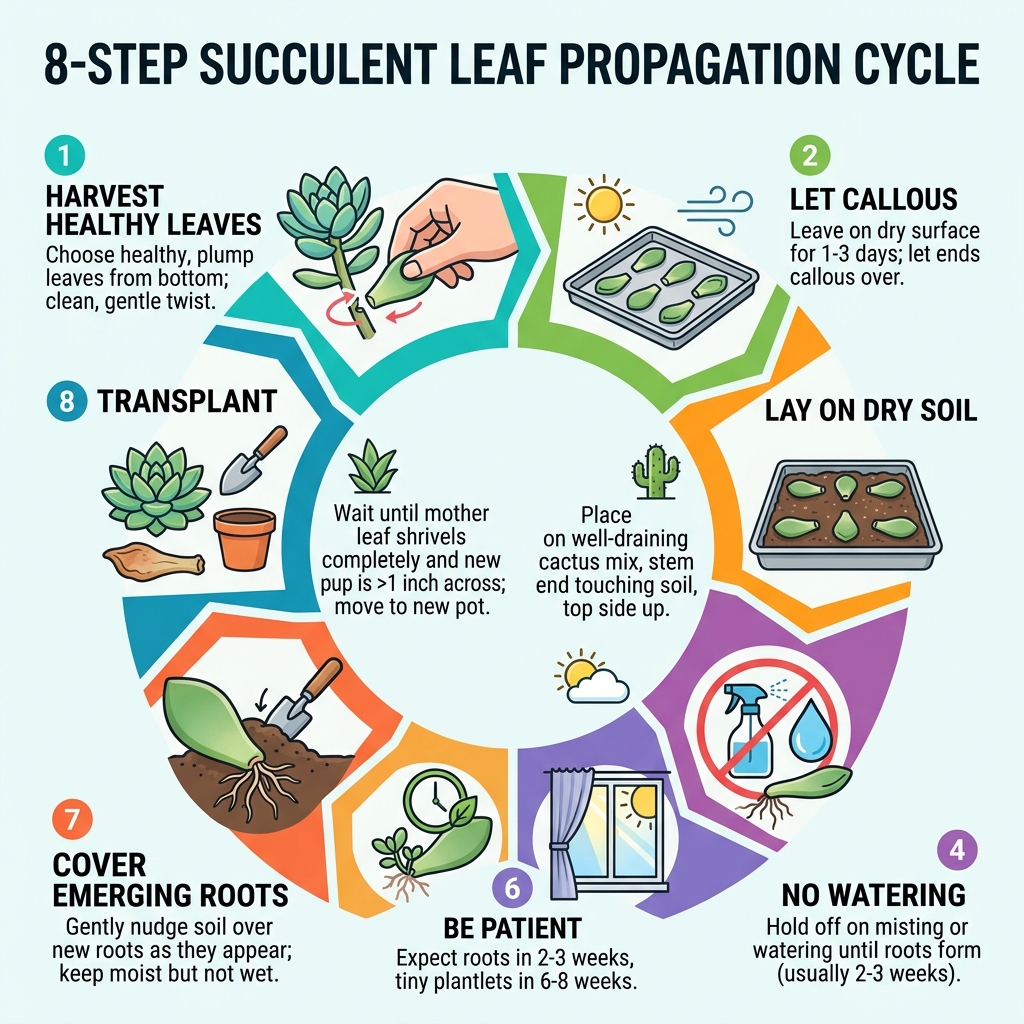
Succulent leaf propagation tips terms to remember:
Essential Succulent Leaf Propagation Tips for Maximum Success
When we first start our journey into “free plants,” it feels like a magic trick. We take a leaf, set it down, and suddenly a tiny clone appears. However, not all succulents are created equal when it comes to this “cloning glitch.” To optimize your rooting success rates, you first need to know which plants are willing participants.
Most “fleshy” succulents are the best candidates. We’ve found that genera like Echeveria, Sedum, and Graptopetalum are incredibly reliable. On the other hand, some popular succulents simply won’t cooperate with leaf propagation because they lack the necessary regenerative cells in their leaves.
| Succulent Type | Propagation Success (Leaf) | Best Alternative Method |
|---|---|---|
| Echeveria | Very High | Stem Cuttings |
| Sedum (Stonecrop) | Very High | Stem Cuttings |
| Graptopetalum | High | Offsets |
| Jade Plant | High | Stem Cuttings |
| Aeonium | Low to Zero | Stem Cuttings / Beheading |
| Sempervivum | Zero | Offsets (Chicks) |
| Aloe / Agave | Zero | Offsets (Pups) |
As you can see, if you’re trying to grow a new Aloe Vera from a single leaf, you’re going to be waiting a very long time for a miracle that isn’t coming! These plants prefer to be propagated via offsets—those tiny “babies” that grow at the base of the mother plant.
One of our favorite succulent leaf propagation tips is to observe how easily a leaf “pops” off. If a leaf falls off just by brushing against it, that plant is likely a propagation superstar. Plants like Echeveria difractens (the “shattering Echeveria”) or Graptosedum ‘Alpenglow’ are famous for this. They use animal disturbances in the wild to spread their leaves and start new colonies. For more deep dives into these strategies, check out these Propagation Tips.
The Science of the Clean Snap and Callousing
If there is one “secret sauce” to ensuring your leaves actually root, it is the meristem tissue. This is a group of undifferentiated cells located at the very base of the leaf where it connects to the stem. Think of it like a plant’s version of stem cells; they have the potential to become either roots or a brand-new rosette.
To keep this tissue intact, you must achieve a “clean pull.” We recommend gently grasping a healthy, plump leaf at the base and wiggling it side-to-side until it snaps. You want a clean, “U” shaped break. If the leaf rips and leaves a chunk behind on the stem, that leaf is essentially a “zombie”—it might stay green for a while, but it will never produce a new plant because the growth cells were left behind.
Once you have your clean leaves, the hardest part begins: doing absolutely nothing.
You must let your succulent leaves callous over. This is a healing process where the open wound at the base of the leaf dries out and forms a protective “scab.” This step is non-negotiable. If you place a fresh, “wet” leaf directly onto moist soil, it will act like a sponge, absorbing too much water too fast. This leads to the dreaded black rot, turning your potential plant into mush within days.
We recommend letting leaves dry on a paper towel or an empty tray for 1 to 3 days. In humid climates, you might even want to wait up to a week. You’ll know they are ready when the ends look dry, white, or brownish and feel firm to the touch. This callousing period is the primary defense against pathogens, as noted in general botanical studies on succulent tissue regeneration.
Setting Up Your Propagation Station
Once your leaves have calloused, it’s time to give them a home. You don’t need fancy equipment, but the environment matters. A shallow tray—like a plastic nursery flat or even a clean take-out container—works perfectly.

The soil choice is critical. We always use a well-draining cactus or succulent mix. If your soil is too “heavy” (like standard garden soil), it will hold onto moisture for too long, which is the enemy of tiny succulent roots. A popular trick we use is mixing the soil with 50% perlite or pumice to ensure maximum aeration. You only need about two inches of soil depth; succulent roots are shallow and don’t need a deep pot initially. For more on this, see our guide on Choosing the Best Container for Succulent Propagation.
Watering Techniques for Succulent Leaf Propagation Tips
This is where most beginners go wrong. We often feel the need to “nurture” our plants with water, but with succulent leaves, less is definitely more.
For the first 2-3 weeks, your leaves don’t have roots. Without roots, they cannot drink. Watering them at this stage only increases the risk of rot. The mother leaf actually contains all the water and nutrients the new baby needs to get started. It’s like a “packed lunch” for the new plant.
When should you start watering? Only when you see tiny pink or white roots emerging from the calloused end. At this point, you can begin light misting. We suggest using a spray bottle to dampen the surface of the soil every 2-3 days, or whenever the soil feels bone dry.
Pro Tip: In very dry climates (like Utah or Arizona), the soil can dry out so fast that the tiny roots shrivel. If you notice this, you can gently nudge a little soil over the roots to protect them. Keeping the roots covered helps them stay hydrated while the leaf itself stays dry.
Ideal Light for Succulent Leaf Propagation Tips
Light is the engine that drives growth, but too much of a good thing can be fatal. While mature succulents often love full sun, baby “pups” are delicate.
The ideal setup is bright, indirect light. A windowsill that gets plenty of light but no direct, scorching rays is perfect. If you put your propagation tray in direct afternoon sun, the leaves will likely “cook” and shrivel before they have a chance to grow.
Temperature also plays a huge role. Succulents are happiest between 70-85°F (21-29°C) for propagation. If it’s too cold, the process slows down significantly. In fact, spring propagations can grow two to three times faster than those started in winter. If your babies are growing tall, thin, and pale, they are suffering from “etiolation”—a fancy word for stretching toward the light. If this happens, gradually move them to a brighter spot.
Troubleshooting Common Rooting Failures
Even if you follow every one of these succulent leaf propagation tips, you will likely face some “failures.” It’s important to remember that in nature, succulents produce hundreds of leaves because only a few are meant to survive. A success rate of 50% is actually quite good for a beginner!
Here are the most common issues we see:
- The Leaf Turns Black and Mushy: This is rot. It’s usually caused by watering before a callous formed or using soil that doesn’t drain. Discard these immediately so the rot doesn’t spread to healthy leaves.
- Only Roots, No Pup: Sometimes a leaf will grow a massive system of roots but never produce a tiny plantlet. This is often due to a lack of light. The leaf “thinks” it just needs to find water, but it doesn’t have the energy to build a new rosette. Try increasing the light slightly.
- Only a Pup, No Roots: This is actually normal! The mother leaf is feeding the pup. Eventually, as the mother leaf dries out, the pup will realize it needs to find its own water and will send out roots. You can encourage this by keeping the soil slightly damp near the base.
- The “Zombie” Leaf: The leaf stays green and plump for months but does absolutely nothing. This happens when the meristem tissue was damaged during the pull. It’s a dud—give it a few more weeks, but don’t hold your breath.
If nothing has happened after 4-6 weeks during the growing season, the leaf was likely defective from the start. You can find more detailed fixes in The Dos and Don’ts of Succulent Propagation.
When to Transplant New Pups
Patience is a virtue, especially here. We often get asked, “When can I give my baby its own pot?” The answer is: wait for the mother leaf to tell you.
As the new succulent (the pup) grows, it slowly drains the mother leaf of all its moisture and nutrients. You will see the mother leaf begin to wrinkle, yellow, and eventually become a dry, crispy husk. Do not pull the mother leaf off early! Even if it looks ugly, it is still providing vital energy to the baby.
Once the mother leaf falls off naturally, the pup is officially independent. We recommend waiting until the pup is at least one inch in diameter and has a visible, established root system before moving it to its own permanent home. This process can take anywhere from 3 months to a full year depending on the variety and conditions. For a deeper look at the long-term growth cycle, check out Succulent Propagation: A Comprehensive Look.
Frequently Asked Questions
What is a realistic success rate for leaf propagation?
For beginners, a success rate of 50% or less is perfectly normal. Don’t be discouraged! Even professional growers lose leaves to rot or genetic defects. The key is to start with more leaves than you think you need. If you want five new plants, start with twenty leaves.
Why is my succulent leaf producing roots but no plantlet?
This is a common frustration often called a “blind” leaf. It usually means the leaf has enough energy to search for water but not enough to trigger the growth of a new rosette. This can be caused by insufficient light or a slightly damaged meristem. Try moving the tray to a brighter (but still indirect) location.
How long does it take to see results from a leaf?
In optimal conditions (Spring, 70-85°F), you will typically see tiny roots in 2-3 weeks. A visible tiny plantlet (the pup) usually appears within 6-8 weeks. If you are propagating in winter, expect this timeline to double or even triple.
Conclusion
Propagating succulents from leaves is one of the most rewarding hobbies for any gardener. It teaches us patience, observation, and the incredible resilience of nature. By following these succulent leaf propagation tips—focusing on a clean snap, a solid callous, and minimal watering—you can turn a single leggy plant into a whole nursery of new growth.
At FinanceBoostX, we believe that gardening shouldn’t be expensive or stressful. With just a little bit of knowledge and a lot of patience, you can expand your garden for free. If you’re ready to take your skills to the next level, learn more about professional succulent care and join our community of successful growers!
Happy propagating!
