
One Leaf, Infinite Plants: What You Need to Know About Succulent Grow From Leaf
Succulent grow from leaf propagation is one of the easiest and most rewarding ways to multiply your plant collection — for free.
Here’s how it works at a glance:
- Remove a healthy, plump leaf from the base of a mother plant with a clean snap
- Dry the leaf for 1-4 days until the cut end seals over (callousing)
- Lay the leaf on top of well-draining cactus soil — do not bury it
- Wait 2-8 weeks for tiny roots and a new baby plant (called a pup) to appear
- Transplant once the mother leaf shrivels and the pup reaches about 1 inch across
That’s it. No special equipment. No green thumb required.
The reason this works is fascinating: succulents contain specialized totipotent cells that can regenerate an entirely new plant from a single detached leaf. Think of it as nature’s cloning system — built right into the plant.
The catch? A few small mistakes — like picking the wrong leaf, watering too early, or using the wrong soil — can tank your results before anything even sprouts. More than half of propagations typically succeed, but knowing what not to do matters just as much as the steps themselves.
This guide walks you through everything, so you skip the trial and error.
Choosing the Right Varieties to Succulent Grow From Leaf
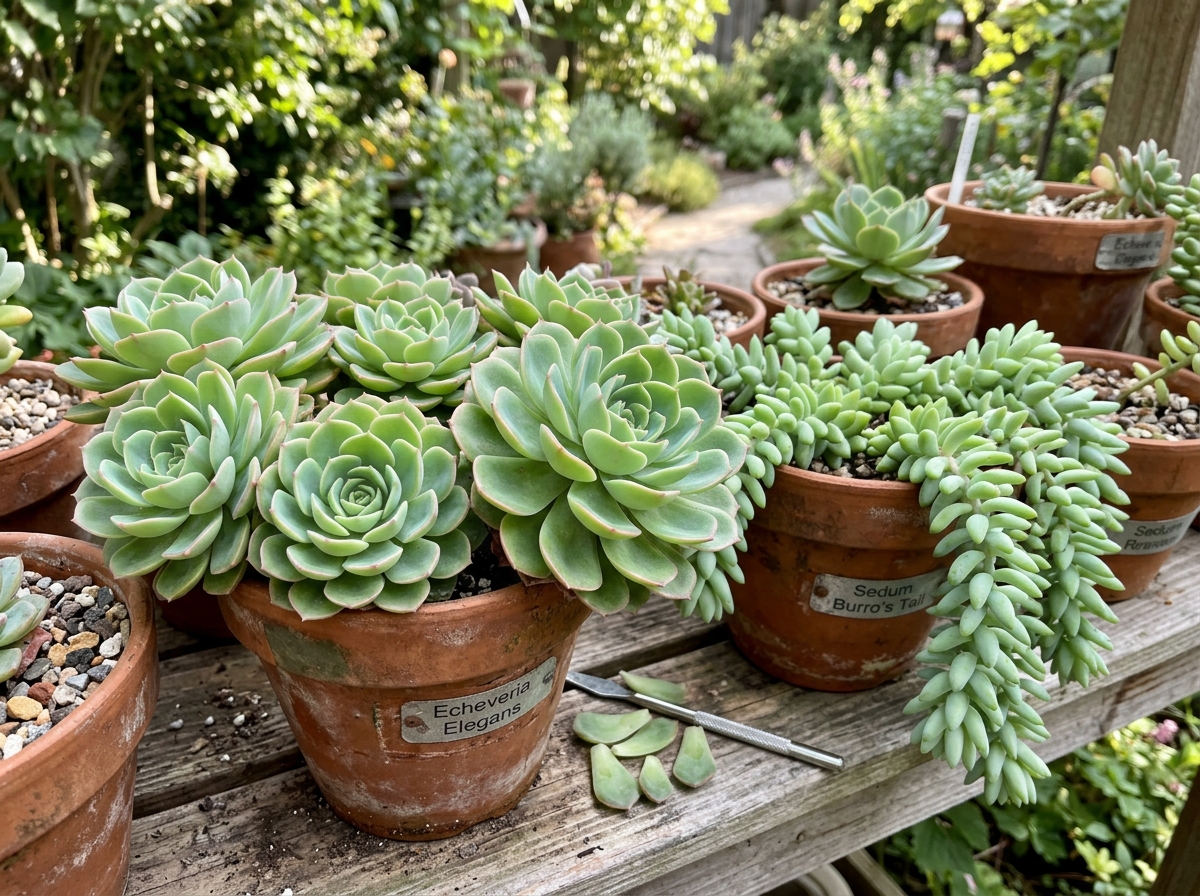
Not all succulents are created equal when it comes to leaf propagation. While it might feel like a “cloning glitch” in nature, some species have patched that glitch. To have the best chance of success, we need to pick plants with “fleshy” leaves. These leaves act as a “packed lunch,” providing all the water and nutrients the new baby plant needs until it can grow its own roots.
The secret lies in the meristem tissue. This is a group of undifferentiated cells located exactly where the leaf meets the stem. If you get a clean break, these totipotent cells can become either roots or new leaves.
The Best Candidates for Success
If you are a beginner, we recommend starting with these “forgiving” varieties:
- Echeveria: These rosette-shaped beauties are the superstars of leaf propagation. Varieties like Perle von Nurnberg are notoriously fast and easy.
- Sedum (Stonecrop): Most Sedums, including the popular “Burro’s Tail,” will grow a new plant from almost any leaf that falls off.
- Graptopetalum: The “Ghost Plant” is incredibly prolific. If you look at a mature Ghost Plant, you’ll often find “babelettes” already growing on the soil beneath it from fallen leaves.
- Jade Plants (Crassula ovata): While some experts find them slower, many gardeners have great success simply by letting fallen Jade leaves sit on the soil.
Success Rates by Genus
To help you plan your indoor garden, here is a quick look at what to expect:
| Succulent Genus | Propagation Ease | Estimated Rooting Time |
|---|---|---|
| Sedum | Very High | 2–3 Weeks |
| Echeveria | High | 3–4 Weeks |
| Graptopetalum | High | 2–4 Weeks |
| Pachyphytum | Medium | 4–6 Weeks |
| Aeonium | Low (Use Cuttings) | N/A |
| Sempervivum | Low (Use Offsets) | N/A |
As we discuss in our beginners guide to propagating succulents, species like Aeoniums and Sempervivums (Hen and Chicks) rarely grow from a single leaf. They prefer to be propagated via stem cuttings or by detaching the “pups” that grow around the base of the mother plant.
Step-by-Step: How to Start the Propagation Process
The most common reason for failure happens in the first ten seconds: the harvest. If the leaf rips or leaves a chunk of its base behind on the stem, it will not grow. It needs that “U-shaped” base where the meristem tissue lives.
The Harvest: The Wiggle and Snap
We don’t use scissors for leaf propagation. Instead, we use the wiggle technique.
- Grasp a healthy, plump leaf near the bottom of the mother plant.
- Gently wiggle it from side to side.
- Apply a light downward pressure until you hear a clean “snap.”
- Check the leaf. The end should be smooth and slightly curved. If it’s jagged or torn, it likely won’t propagate.
The Callousing Phase: Patience is a Virtue
Once you have your leaves, do not put them on soil yet. A fresh leaf has an open wound. If that wound touches moist soil, it will suck up bacteria and rot within days.
We need to let the leaves “callous.” Place them on a dry paper towel in a spot with plenty of airflow but no direct sun. This takes about 1 to 3 days, or up to a week in very humid environments. You’ll know it’s ready when the end feels dry and looks like a tiny scab has formed. This step is the golden rule in the dos and donts of succulent propagation.
For more detailed imagery on this stage, check out our easy guide to propagate succulents from leaves.
Preparing Your Setup to Succulent Grow From Leaf
While your leaves are drying, prepare their “nursery.” You don’t need deep pots yet; a shallow tray or even an aluminum baking pan works perfectly.
- Soil Choice: Never use standard garden soil. It holds too much water. Use a dedicated cactus and succulent mix. To make it even better, mix it 50/50 with perlite or pumice. This ensures the roots can breathe and water drains away instantly.
- The Container: Ensure your tray has drainage holes. If you’re using a decorative saucer without holes, you must be extremely careful with your watering. Read more about choosing the best container for succulent propagation to avoid common drainage pitfalls.
Optimal Conditions for a Succulent Grow From Leaf
Once calloused, lay your leaves on top of the soil. Do not bury the ends. In nature, leaves fall and lay flat; we want to mimic that.
- Light: This is the trickiest part. New propagations need bright, indirect light. Direct afternoon sun will “fry” the leaves before they can grow, while too little light will cause the new babies to stretch and become weak. A windowsill that gets morning sun or a spot filtered by a sheer curtain is ideal.
- Temperature: Aim for 70-85°F. Succulents are more active in the warmth. If you are propagating in winter, a heat mat can help, but expect things to move 2-3 times slower than in the spring.
- Watering (The Secret): Many beginners want to mist their leaves every day. Stop! Until you see roots, the leaf doesn’t need water. It has a “packed lunch” of water inside it. In fact, many successful growers don’t water at all until the mother leaf begins to shrivel. If you do choose to water, wait until roots appear, then lightly mist the soil near the roots every few days. We explore these environmental factors further in our guide to up your gardening game propagating succulents.
Troubleshooting Common Propagation Failures
Even with the best care, not every leaf makes it. It’s a numbers game—if you start with ten leaves, expect five to eight to become plants. Here are the “plagues” you might encounter:
- Rot (The Black Mush): If the leaf turns black, translucent, or mushy, it has rotted. This is usually caused by watering before the leaf calloused or using soil that stayed too wet. Discard these immediately so the fungus doesn’t spread.
- Etiolation (The Long Stretch): If your tiny new pup is growing tall and skinny with lots of space between the leaves, it’s “stretching” for light. This is called etiolation. Move the tray to a brighter location gradually.
- Zombie Leaves: Sometimes a leaf will grow a massive system of roots but never produce a “pup” (the tiny rosette). These are affectionately called zombie leaves. You can try moving them to a brighter spot to trigger leaf growth, but sometimes they just stay as a leaf with roots forever.
- The “Roots-Only” or “Leaves-Only” Problem: If you see roots but no plant, or a plant but no roots, don’t panic. Usually, the other half will show up eventually. If roots are exposed to the air and look like they are drying out, you can gently “tuck” them under a tiny dusting of soil.
For a deeper dive into fixing these issues, see maximize your garden how to propagate succulents.
From Pups to Pots: Transplanting Your New Plants
The “magic moment” happens when the mother leaf—the one you originally snapped off—turns into a dry, crispy raisin. This means it has successfully transferred all its energy, water, and nutrients into the new baby plant.
When to Move Your Baby
We recommend waiting until:
- The mother leaf has fallen off naturally or is completely shriveled.
- The new pup is at least 1 inch in diameter.
- The root system is at least an inch long and looks “fuzzy” (those are the tiny root hairs that absorb water).
The Transplanting Process
- Prepare a Small Pot: Use a 2-inch “starter” pot with fresh succulent soil.
- Dig a Small Hole: Use a pencil or your finger to make a small divot.
- Set the Roots: Gently place the roots into the hole, ensuring the tiny rosette stays above the soil line.
- Firm the Soil: Lightly press the soil around the roots.
- Wait to Water: Give the plant a day or two to settle into its new home before the first deep watering.
Once transplanted, you’ll need to transition the plant from “nursery” care to “adult” care. This means less frequent but deeper watering. We have a full breakdown of this transition in our article on succulent propagation techniques for every home gardener.
Frequently Asked Questions about Leaf Propagation
How long does it take to see roots and pups?
On average, you will see activity in 2 to 8 weeks. However, timing is everything. If you propagate in the spring, you might see roots in just 2 weeks. If you try in the dead of winter, it could take 3 to 4 months. Temperature and light are the gas pedals for this process. We cover these timelines extensively in our mastering succulent propagation an in depth guide.
Which succulent leaves should be avoided?
Not every leaf is a candidate for a succulent grow from leaf project. Avoid:
- Wrinkled Leaves: These are dehydrated and don’t have enough “packed lunch” to support a baby.
- Yellow/Translucent Leaves: This is a sign of overwatering and impending rot.
- Damaged Bases: If the “U-shape” is missing, the meristem tissue is gone.
- Pest-Ridden Foliage: Never propagate a leaf that has signs of aphids or mealybugs, as you’ll just be “cloning” your pest problem. More details on leaf selection can be found in our succulent propagation a comprehensive look.
Is water propagation better than soil?
Water propagation involves suspending the leaf tip just above (not in) a container of water. While it is fun to watch the roots grow through the glass, “water roots” are different from “soil roots.” They are more fragile and often go through a period of shock when you finally move them to dirt. For the strongest, most resilient plants, we believe soil propagation is the way to go. If you want to experiment with both, check out grow more succulents propagation techniques.
Conclusion
At FinanceBoostX, we believe that gardening shouldn’t have to be expensive. Mastering the art of the succulent grow from leaf method allows you to turn a single $5 plant into a garden worth hundreds of dollars. It requires very little “work,” but a great deal of patience.
Remember the three pillars of success: a clean snap, a dry callous, and bright indirect light. If you can master those, you’ll soon have an “army of babelettes” ready to decorate your home or give away as trendy, homegrown gifts.
Ready to take your skills to the next level? Explore more propagation tips and start your journey toward becoming a succulent pro today!
